

By Taylor Williams
DALLAS — Technological innovation has long been a cornerstone of managing and leasing multifamily properties, and that feature of the business has only been augmented in the era of artificial intelligence (AI). But for all the operational conveniences and efficiencies that AI potentially brings to the table, multifamily management has not yet reached the point of phasing out the human element.
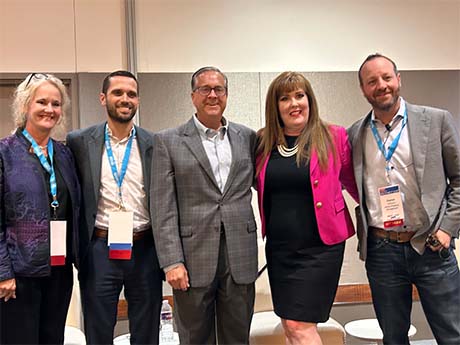
Almost immediately after the members of the leasing and management panel at the annual InterFace Multifamily Texas conference had introduced themselves, this fundamental premise of multifamily management was put forth to a crowd of several hundred real estate professionals — men and women who have built careers based on human relationships. The message to those at the conference, which took place in late September at the Westin Galleria Hotel in Dallas, seemed to be one of reassurance, that even as AI seemingly infiltrates every aspect of human life and threatens to void millions of jobs, the human principles that have long governed real estate transactions remain intact. At least for now.
Editor’s note: InterFace Conference Group, a division of France Media Inc., produces networking and educational conferences for commercial real estate executives. To sign up for email announcements about specific events, visit www.interfaceconferencegroup.com/subscribe.
Ann-Marie Bomba, CEO of Strategic Properties, a regional manager of market-rate multifamily and affordable housing properties, was the first panelist to identify technology and staffing as two sides of the same coin, that coin being industry challenges. Multifamily markets in Texas are, generally speaking, coming out of a major building boom that has seen rent growth stall, while key operating expenses like insurance are rising. Successful navigation of these conditions requires both technological savvy and adequate talent on the ground, she said.
“Staffing, in terms of both filling and keeping key positions, is among the biggest challenges we’ve had in 2025,” she said. “At the same time, we’re looking at different technologies to help keep costs down while trying to implement more streamlined operations. We’ve seen challenges with retention of our teams because we put a lot [of responsibilities] on them.”
“When we’re rolling out new ideas and software and constantly pivoting to adjust to the market demands, it just adds to the stress level,” she continued. “So we’re trying to keep our people engaged and make them feel like their voices matter, because at the end of the day, we’re in the people business. How well we take care of our people translates to how well they take care of residents.”
Panelist Tyler Johnson, division president at national property management firm Asset Living, spoke at length about the need for balance between AI- and human-driven services in multifamily management and leasing.
“We’ve really made efforts over the past few years to embrace technology, but there’s a balance in terms of rolling out the right tech solution and having it be a supplement to the staff rather than a replacement of staff,” Johnson explained. “For example, if we roll out an AI solution for [prospective resident] lead nurturing, it’s meant to be used in off hours as a relief valve. But if a [management and leasing] team is light due to an open position, there may be an overreliance on the AI, and then you lose the human touch.”
Johnson added that apartment renters are just like any other subset of the broader population in that there are some who are open to having leasing inquiries and management tasks handled by AI, whereas others much prefer human assistance and interaction.
“Residents want to be serviced in different ways,” he stated. “There are people who want to sign a lease at 9 o’clock in their living room and not deal with the onsite office, and there are folks that want to have a conversation with the front office and form a relationship.”
“That means retraining and continuing the education of site-level employees so that they’re constantly reminded — especially in the challenging leasing and occupancy market we have right now — that those human touches with residents are so important,” Johnson continued. “Utilizing AI and technology the right way is a tremendous supplement. But there’s a trust factor that comes with forming a relationship with a prospective renter during a tour, speaking to them intelligently, following up with questions that are unique to what we spoke about versus a canned response from a tech solution. That’s a major differentiator.”
Moderator Ed Wolff, CEO of Dallas-based Aerwave, then asked Johnson which leasing and management jobs might be most at risk from AI. Johnson clarified that he believes most strongly in AI’s efficacy to handle repetitive, administrative tasks and field resident requests during non-business hours. He stressed again that AI should be treated as a tool in the kit of onsite leasing and management teams as opposed to being those teams.
“With the additional responsibilities that are being placed on onsite staff members, [having] that relief valve is very valuable,” Johnson said. “But we still have to have the human touch. We want convenience, but we have to have relationships too.”
The panel then discussed other applications of AI outside of lead nurturing. Facets of multifamily leasing and management in which AI-based platforms have been introduced include rent collection, work order management and lease renewal generation, as well as communications with residents who have language barriers. Above all else, AI is best suited for menial tasks like documenting resident conversations and uploading that information into the broader property management software, the panel concluded.