

By Matthew Auchincloss
With prices of construction materials perpetually up across the board and labor shortages persisting, multifamily developers have long been searching for new ways to improve efficiency both in pre-planning and in actual construction.
That’s unlikely to change any time soon. But the quest for elevated efficiency has recently taken a number of different forms, according to Nikolas Fowler, a multifamily project executive at Birmingham, Ala.-based general contractor Hoar Construction.
“What you’re starting to see is more use of off-site construction, whether it’s traditional volumetric modular or panelized or bathroom pods or some of the other things that are out there today,” says Fowler. “As more and more people realize the advantages of those systems and we have more and more challenges with labor, you’re going to continue to see people looking for new innovative ways to make those projects pencil out.”
Editor’s note: InterFace Conference Group, a division of France Media Inc., produces networking and educational conferences for commercial real estate executives. To sign up for email announcements about specific events, visit www.interfaceconferencegroup.com/subscribe.
Construction is historically not a very innovative industry. According to research from McKinsey, construction is the second-least digitally updated industry for the modern era; the first is agriculture and hunting.
“One didn’t change for thousands of years, the other didn’t change for hundreds,” notes Edward Tekin, founder and CEO of Steel Tech USA, a company that specializes in steel construction and conversion. “The conditions are pushing us to think differently and start getting more innovative and making things in a more innovative approach.”
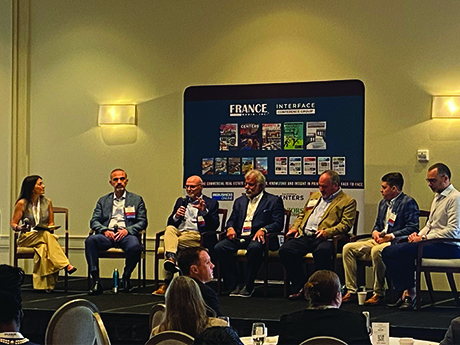
Both Fowler’s and Tekin’s insights came during a panel on design and construction processes at the annual InterFace Houston Multifamily, a half-day event that took place on Tuesday, June 9, at The Briar Club in Houston. About 200 industry professionals attended the event to hear these experts discuss how new building methods are emerging and new technology is improving efficiency.
Shifts Already Underway
Prices for construction materials rarely drop, but rather rise at varying paces. Even so, the post-pandemic era has featured above-average levels of volatility in pricing, including new record highs for some materials. According to Associated Builders and Contractors (ABC), overall construction prices are up 10 percent year-over-year and have risen more than 55 percent since February 2020.
Given this, developers are on the hunt for ways to trim costs while still providing quality builds to the consumers. As previously noted, one potential solution is modular construction. Multiple panelists observed that the industry has become noticeably more open to using prefabricated and modular units when they would traditionally stick to site build.
Indeed, manufactured housing sales are up 8 percent from April of 2025, according to data from the Texas Manufactured Housing Association. In addition, Habitat for Humanity of Houston just installed the first unit of its modular housing pilot program. Once more concentrated in denser markets like those of the Northeast, modular housing is now embedding itself in Houston.
Some developers remain hesitant, however, as the savings are not immediately apparent.
“As far as the cost aspect of [modular construction] goes, it’s built with the exact same materials, the exact same finishes and to the exact same building code,” said panelist Kelly Williams, vice president of development at Ramtech Building Systems. “So it’s not going to magically be 30 percent cheaper to build an apartment building using modular construction. It’s going to be about the same on average for cost, maybe even a little bit more expensive in some markets.”
But the financial benefits are real in other areas, Williams added. The loan cycle on modular construction tends to be shorter as the onsite work time is greatly reduced. Williams pointed to one conversation he had with a developer where the developer told him that while it might cost $500 more per unit to produce something in a factory, it would cost him $2,000 more per unit to produce it onsite. Finishing construction sooner also means residents can occupy the building sooner and expedite cash flow.
One stereotype of modular housing is that it’s too cookie-cutter and low-brow, according to panelist Kenneth Puncerelli, CEO of LAI Design Group. Puncerelli feels that modular is often neither of those things. He recently completed a suburban three-story walkup project that his team set in four-and-a-half days using modular units. Finishing the units and polishing the outside took additional time, but Puncerelli estimated that the project team saved nearly a year of construction time while also delivering a building that looked just as good as if it was built onsite.
“You can hang virtually any kind of architecture that you would like on it — these are not filing cabinets for human beings,” Puncerelli said. “The marketplace in general has that perception, when you say ‘modular’, that we’re going to go into a trailer park. And it’s not at all the case.”
Innovation Drives Efficiency
Developers have focused on increasing efficiency on job sites to cut costs. The entire panel emphasized that the No. 1 method to accomplish this is to plan as much as possible before actual construction begins, as once ground is broken, the construction loan starts accruing interest and costs escalate.
“It’s not [a matter of] designing to build and figuring it out at the job site [anymore],” Tekin said. “It’s more coming into the design to manufacture. So it’s opening a whole new era of industrialized construction.”
One practice that has been shown to increase efficiency involves having parts that were traditionally built onsite manufactured precisely to fit the building. Panelist Hachem Domloj, founder of Houston-based design and engineering firm CIVE, said that his company employed this strategy on a 248-unit student housing development located near Louisiana Tech University’s campus in Ruston.
Domloj, who worked with Tekin on the project, employed two technologies — Building Information Modeling (BIM) and Virtual Design and Construction (VDC) — to anticipate problems and lay out each piece of the building precisely. Using 3D modeling, components like wall panels, trusses and other elements were manufactured offsite and then installed. Ultimately, this approach both prevented costly delays and accelerated the timeline.
However, delays tend to be inevitable in construction no matter how much planning occurs pre-build. That’s where communication between developers and builders becomes critical. It helps, Puncerelli explained, if contractors are working with groups they’re familiar with and that understand the project because they’ve discussed it beforehand.
“We’re not in the development business; we’re not in the architecture business. We’re in the people business,” Puncerelli said. “Real estate is about people; it’s about relationships. The best projects come together when you have relationships with your team because it’s construction. There is always going to be a problem, and you need to be able to work through it. It just is how the industry works.”
Hesitancy on Office Conversions
One form of in-demand construction work in which the panelists did express hesitancy involved office-to-residential conversions, which are often touted as a partial fix to America’s housing affordability crisis.
The panel pointed out that there are numerous aspects of office living that are ill-suited for multifamily housing. First, most modern offices aren’t suited for multifamily conversions because they have many internal areas that do not have windows, which is generally a code requirement for living spaces. Floor-to-ceiling windows also aren’t generally favored by renters, and neither is having windows that don’t open, according to the panel. In addition, there are no trash chutes in buildings; the HVAC system often must be reconfigured, and parking is frequently not connected to the building.
“And then, of course, everybody wants to live in an office park,” Puncerelli concluded sarcastically.
One of the biggest issues is bathrooms. Offices have centralized bathrooms, while apartments need private bathrooms and kitchens. Re-running water lines through buildings is another headache for developers. One possible solution is using modular bathroom pods, which have plumbing fixtures fitted to them, making them easier to hook up to the existing plumbing.
“We’ve seen those bathroom pods inserted into office buildings and it’s actually a very slick system,” Puncerelli noted.
Overall, though, the panel was not optimistic that office-to-residential conversions represented a sustainable solution to the housing crisis. There simply aren’t enough buildings that fit the criteria necessary for a successful residential conversion project. However, conversion to other properties, such as mixed-use, may be more feasible for unused office spaces.
“If it is converted to hospitality, that seems to be a play in an office park,” Puncerelli said.
“That sounds like a favorable reuse of a building like that.”