

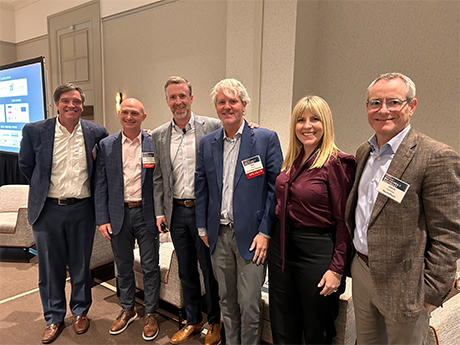
ATLANTA — Jason Nettles, managing director at Northmarq’s Atlanta office, is well-versed on the recent history of U.S. apartment deliveries, knowledge that came in handy for launching discussion among developers at the 16th annual InterFace Multifamily Southeast conference.
Nettles moderated a panel of five regional developers, all of whom also share keen awareness of just how much new multifamily product U.S. markets — particularly those in the highly desirable Sun Belt regions — have added in recent years. In these areas, supply growth is both a dominant narrative on the surface of the multifamily development scene and an invisible hand that guides business decisions behind that scene.
Massive blips in supply, whether positive or negative, impact key facets of underwriting, including rent growth assumptions and concessions, as well as financing terms on both the debt and equity sides of the capital markets. Those figures and assumptions must then be evaluated against hard costs of development, which as a rule do not decline over time, but rather grow at varying paces.
Editor’s note: InterFace Conference Group, a division of France Media Inc., produces networking and educational conferences for commercial real estate executives. To sign up for email announcements about specific events, visit www.interfaceconferencegroup.com/subscribe.
All of those metrics and conditions have to come together in mutually satisfactory ways for new developments to get off the ground. And right now, the vast volumes of new apartment deliveries and the short-term paces at which various costs have risen are making it difficult for those numbers to harmoniously co-exist.
Thus it was only fitting that Nettles invoked these points of discussion first and foremost at the conference, which took place in early December at the InterContinental Buckhead Atlanta hotel. About 300 industry professionals attended the event.
The development panel discourse began with Nettles, who knew that “the falloff in development would be a big part of our conversation,” giving a brief overview of the country’s historic averages of new apartment construction. Understanding the depth of oversupply was instrumental to pinpointing where the financing gaps exist in the capital stacks for new projects.
“In the early 2000s, the United States was delivering between 300,000 and 350,000 new units per year,” Nettles began. “After the Global Financial Crisis, from 2010 to 2012, the average number of units completed in the country was about 150,000, so we literally fell off a cliff to the tune of a 50 percent reduction. We got back to the 300,000-plus clip in 2015, ramped up to about 350,000 to 375,000 [new units per year] in the late 2010s before clipping to about 400,000 [new units per year].”
“In 2024, we delivered 609,000 units, the most since the 1980s, and 200,000 more than what had been the normal run rate,” he continued. “As a result, there have been struggles to absorb those units, and the conversation has revolved around concessions and getting to [certain] occupancy levels. So it’s become very difficult to capitalize deals.”
These unfavorable supply-demand dynamics have ensured that rent growth has been outpaced by costs of new development. But even as interest rates have come down by 150 basis points over the past 12 months and change, construction costs have not decreased such that the basic math routinely justifies new development. Panelist Bennett Sands, executive managing director at local development firm Wood Partners, addressed this ever-present obstacle as it exists in the Atlanta market.
“In 2021, our rents across the industry were about $1.38 [per square foot],” said Sands. “Today, they’re around $1.60 [per square foot]. The difference between those numbers represents about a 3 percent compounded annual growth rate, which makes sense. Our rents today are where they should be, but hard costs, according to [general contractor] Fortune Johnson, are only down about 7 percent from peak levels. We still need another 10 to 12 percent [in price reductions] before the returns really justify new development.”
Sands added that his company’s capital partners, when approached with new project proposals, frequently express approval over the site and the submarket supply story, but have major hesitation when it comes to costs, construction and otherwise.
“They’ll give us a term sheet and say that we have to find $2 million in cost savings to move forward,” Sands said. “Our first move in that situation is to call the land seller, but really it comes down to tightening our belts on hard costs. That’s where savings have to come from in order for us to get back into a development cycle.”
Katherine Mosley, managing director of development in the Atlanta office of Greystar, said that in the immediate short term, construction labor has become more of a wild card than materials. But regardless of where the cost pressures originate from, in order for new projects to be greenlit, the paring down of expenses has to coincide with better performances on the revenue side of the equation, Mosley said.
“We’re all always hoping that hard costs come down, but we also really have to see some improvements in rents, and the concession story has to back off,” she said. “Those are the two variables that we really have to work with right now.”
Alan Dean, regional CEO of Charlotte-based developer Terwilliger Pappas, took the conversation on construction costs a step further by leaning into the “eternal optimist” persona that multifamily developers are known for. Dean said that today, construction costs and trends are among the brighter points of discussions he has with his team.
“Contrast today to the good ole days of 2021 and 2022, when every deal sold at a 3.25 percent cap rate,” Dean said. “But every time you priced a set of schematic design (SD) plans or design development (DD) plans, you had increases of seven figures. People were afraid to price those plans at that time, so at least today we have some stability on the pricing front of the construction side of the business.”
Dean was then asked to weigh in on capital availability and terms for new projects. His analysis zeroed in on the “higher” parts of the capital stack.
“The positivity is at the bottom; we’ve seen proceeds on senior debt increase over the past 18 months, usually to about 60 to 65 percent [of the total project cost], while pricing has come down to spreads that are maybe 225 to 275 [basis points] over SOFR,” Dean said. “But we’re using a ‘rifle shot’ approach with senior debt, and as developers, we have to be careful about approaching too many [lenders] and turning them down. There’s been some consolidation [among banks] lately, but we find senior debt to be the easy part.”
Dean also said that there are plenty of willing participants at the preferred equity and mezzanine lending levels. It’s the limited partnership (LP) equity sources that have been difficult to recruit, Dean said, explaining that the concept of replacement cost had many of those groups looking to buy instead of build. That is slowly starting to change though, he concluded.
“Certain [LP equity] groups are slowly starting to dip their toes back in,” Dean said. “And institutional capital generally tends to exhibit a herd mentality. They don’t get paid to take risks. So we’re seeing some of the private equity or groups with separate account money get back into the market, and we believe that 2026 is the right time to get shovels in the ground. [Assuming a] two-year build-out, you’re delivering product in 2028 and leasing it up into the next year, and those look to be shining-star years, particularly for markets in the Southeast.”