

ATLANTA — In today’s multifamily development world, architects, designers and general contractors do everything in their power to avoid the one thing they dread most — going back to a developer mid-project to ask for more money.
These “uncomfortable moments,” as Lori Ann Dinkins, president and CEO of Mood Interior Design, called them, happen more often these days thanks to rising costs, tariffs and collaboration snafus.
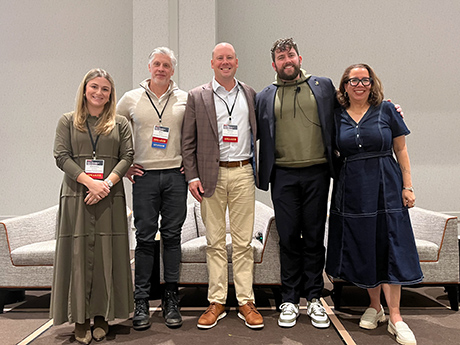
Dinkins led a panel of architects, interior designers and general contractors through a bevy of topics — good, bad and ugly — that define the current state of building and designing apartments at InterFace Conference Group’s Multifamily Southeast event. The event took place over the course of two days at the InterContinental Buckhead in Atlanta.
Editor’s note: InterFace Conference Group, a division of France Media Inc., produces networking and educational conferences for commercial real estate executives. To sign up for email announcements about specific events, visit www.interfaceconferencegroup.com/subscribe.
Residents and developers alike are taking a more practical, less playful approach when it comes to stylizing apartments. Gone are the days of “those huge show-stopper, Instagram-moment amenity spaces,” said Ian Hunter, regional director at Atlanta-based Dwell Design Studio.
“They’re out. And they’re out for a couple of reasons. Not just cost. Renters are savvy. They realize those spaces aren’t usable or functional. It used to be about opulent, grand lobbies. Now, privacy and exclusivity have become such important pieces of the luxury experience, Hunter explained.”
Michael Mitchell, vice president of preconstruction and business development at general contractor Fortune-Johnson, agrees that most amenity spaces are shrinking compared with years past.
“It’s all about pushing efficiency,” he said. “Everyone wants costs to come down, but what we’re seeing is you need predictability, you need fewer unit types. All that helps control costs.”
Costs are no doubt critical today. Although most panelists concurred they’re not seeing major swings on costs of raw materials, tariffs have everyone’s hackles raised.
“We are starting to see those tariff bills come in,” said Dinkins. “It’s like a hot potato. The manufacturer is passing the costs to us that in previous years we would have absorbed, but these tariffs are very large. We’re having to go back to the owners, and it’s an uncomfortable moment, but it is the reality. Some people say tariffs are not a reality. I would add the word ‘yet.’”
Mitchell emphasized that tariffs on cabinets from Canada in particular are at 25 percent. “Come January 1, it’s going to double, so we’re looking at 50 percent. This is something we haven’t seen before. We’re having conversations with developers explaining that all these cabinet manufacturers want at least a 30 percent deposit upfront on the materials.”
Mitchell explained that while a deposit of that size has been typical with items such as countertops, it’s not the norm for cabinets. If a developer does not want to pay that much by way of a deposit, cabinet manufacturers, to protect themselves, must raise the price point of the items by about 15 percent. “They will make up the lost deposit by increasing total costs,” said Mitchell. “We’ll see more and more of that, unfortunately.”
Alexandra Juneau, executive vice president of business strategy with Juneau Construction, added that her firm is doing everything possible on the front end — making selections in advance to lock in pricing and collaborating with architects and developers early on in the development process — to alleviate any potential tariff risk down the road.
Hunter underscored that developers don’t want any surprises when it comes to pricing. So even if the cost is exorbitant, it’s best to accept and plan for that situation in advance.
“Having the 15 percent on the backside if you’re not willing to put the 30 percent down — it does provide certainty,” he said. “Both of those options do seem viable approaches, even though you’re likely looking at six figures for that FF & E (furniture, fixtures and equipment). Those items are purchased at the end of the project. That is the least desirable time to hit developers with six figure bills.”
Millwork isn’t the only burden on construction costs. Elevators also are a fresh pain point to contend with.
“The elevator manufacturers are also coming to us with tariffs,” Mitchell said. “Contractually, we require our subs to bring us proof by way of itemized bills from the port. If we’re going to go back to the owner, we’ve got to show them documentation. Most of the subs are not going to want to do that. Either they don’t have the skillset, they want to avoid showing us all that is happening behind the scenes or they simply don’t have time to chase down the paperwork.
“We’re going to start seeing that a lot of tariff issues may just end up as general material cost escalation,” Mitchell continued. “We’re literally on jobs right now where we’ve installed two elevators and they’ve got a bill out there for $32,000 for the third elevator that is tariff-related. If we don’t pay that, we don’t get the third elevator. We owe the owner a project that contractually we have to deliver at a certain time, so we have to foot the bill for that.”
With all these curveballs in the air, architects and builders are seeking solutions to ensure projects pencil out in this tricky environment. Enter factory-produced materials.
Brian Ward, principal and director of design with Niles Bolton Associates, shared that his firm currently is designing projects with Atlanta Mayor Andre Dickens for his Rapid Housing Initiative (RHI), a program launched in 2024 that aimed to deliver 500 units by 2025 by way of such projects as Waterworks Village.
This $17 million, modularly built development in the West Midtown neighborhood of Atlanta opened earlier this month. The 100-unit property was completed in 10 months using modules manufactured by Vantem. The community provides housing and services to people experiencing homelessness.
“The first mods were delivered at the beginning of August, and we have the grand opening tomorrow (Dec. 3),” Ward emphasized. “Even scaling up to 300 units, that’s one year, twice as fast as a typical timeline. This [trend] has legs. We want our multifamily clients to come and kick the tires and consider modular construction. There’s a future in it for sure as an alternate way of bringing units rapidly to market.”
Hunter agreed. “Five years ago, modular construction was a little bit of a pipe dream. Today, building codes have become much more friendly toward it.”
Juneau says her firm, too, is in the modular market.
“We have executed projects with modular MEP (mechanical, electrical and plumbing) systems and facades that have been very successful,” she said. “We also are very bullish on mass timber. We have a handful of mass timber multifamily projects in our pipeline. ‘Revolutionary’ might be too dramatic of a word, but it really could revolutionize how we build in the Southeast. It just makes too much sense for it to not start happening. We’re hopeful to see it come to fruition in our market.”
— Lynn Peisner