

For industrial developers and owners, Kansas City is an easy sales pitch right now.
“Two years ago, we had to scrounge around [for capital partners] trying to get phone calls returned. Now, they’re calling us saying they’re ready to see what we’ve got,” said Nick Cook, a development manager with Panattoni Development Co. “You’re always trying to sell a story to these folks. And Kansas City is a pretty easy one to sell right now. When it comes to speculative development, we’re feeling bullish.”
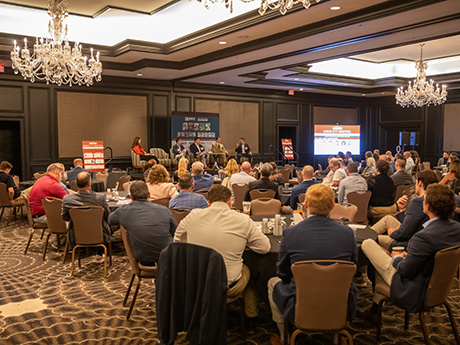
Cook’s remarks came during the developers, owners and investors panel at the InterFace Kansas City Industrial conference, which took place Tuesday, Aug. 18 at the Intercontinental Kansas City at the Plaza. Robert Ciston, a senior principal with BRR Architecture, moderated the discussion.
Editor’s note: InterFace Conference Group, a division of France Media Inc., produces networking and educational conferences for commercial real estate executives. To sign up for email announcements about specific events, visit www.interfaceconferencegroup.com/subscribe.
Fellow panelist Grant Harrison, executive vice president of development with VanTrust Real Estate, also expressed a bullish mindset on Kansas City and said he wants to get in front of the next wave of development. In contrast, there are some markets where Harrison does not expect to build speculatively for a long time.
Harrison cited Kansas City’s central location nationally, its infrastructure, rail access and labor supply as examples of the market’s strengths.
“It makes a ton of sense to be here. We do not have the highs and lows, which is not a bad thing. We’re slow and steady, and we have a great pipeline as a community and metro to keep going,” said Harrison. “The more institutional buyers come to Kansas City, the more it continues to prime the pump for development and [to elevate] how the world or country sees Kansas City.”
Mike Bell, executive vice president with Hunt Midwest, echoed this sentiment.
“Investors are starting to realize that Kansas City is the place to put their dollars and reach the most amount of customers nationwide,” he stated. “Institutions like Morgan Stanley and STAG Industrial are making investments in Kansas City, and that shows Wall Street that Kansas City is a place where they should be because there’s a herd mentality.”
Morgan Stanley Real Estate Investing recently acquired a 1.5 million-square-foot distribution center occupied by Ace Hardware in Kansas City for $158.5 million. Hunt Midwest developed the property in 2025 as the first phase of its KCI 29 Logistics Park.
In addition to expressing optimism for the Kansas City market, panelists also addressed economic uncertainty in today’s environment.
“The only thing you can be certain of nowadays is uncertainty,” said Mike Stromberg, director of real estate development with Opus.
“We’re developers, and we can’t just sit on our hands. We have to look at that uncertainty, put it in a box, quantify it and then focus on the things that we can control.
“Interest rates are seemingly stuck at 4.5 percent. But Kansas City is positioned well with 4.5 percent vacancy and historical absorption just shy of 8 million square feet. It’s a compelling story,” continued Stromberg.
Tyler Wysong, a development manager with Scannell Properties, noted that he has a different sentiment this year compared with last.
“Last year, there were quite a few big box buildings that were sitting vacant, and there was some hesitancy from tenants to be able to take down and expand in a large amount of space due to tariffs and other economic uncertainties,” he said. “But the trend has started to change a little bit. We’ve started to see big box facilities lease up.”
Big box users of 250,000 square feet or larger are very active right now, echoed Stromberg. “They can look through uncertainty and still make business decisions. A lot of them are using the uncertainty to further diversify their supply chains,” he said.
Also advantageous for Kansas City is its pro-development, pro-business mindset and the level of collaboration among industry players, noted panelists. Economic development organizations such as KC SmartPort work to promote the Kansas City area for manufacturing and logistics.
“There is an understanding that a rising tide lifts all ships,” said Cook. “There’s a legacy of an industrial real estate hub in the middle of America that’s taking shape here right now. That’s exciting to be a part of.”
Retail leans on incentives
InterFace Conference Group’s Kansas City Retail and Multifamily events took place the day prior on Monday, Aug. 17. During the developers, owners and investors panel of the retail conference, speakers focused on incentives for development, rising costs of projects and the impact on tenants. Darcey Schumacher, principal with Wallace Design Collective, moderated the panel.
David Block, president of Block & Co., opined that incentives for retail development are mandatory today.
“If you don’t get incentives, I don’t know how you make a project work today,” he said. “It’s a real catch 22.”
As justification for his statement, Block cited construction costs, increased taxes and the rents that a tenant is willing to pay to come to Kansas City.
Block noted that his firm has built several shopping centers without incentives in the past, but that’s when project costs were around $75 to $125 per square foot. Today’s development costs are anywhere from $200 to $400 per square foot, according to Block. In some areas, real estate taxes are more than $20 per square foot for a pad site.
“Costs of all kinds are the biggest impediment to new development right now,” stated Jeff Berg, founding partner of Catalyst Property Group.
Berg noted that municipalities are one of the largest drivers of cost. In addition to “extraordinarily high property taxes,” Berg stated that many city code requirements have become unsustainable and lengthy parts of the development process.
In some cases, incentives are the only way to think about moving forward with a project, said Grant Hromas, a vice president of development with SomeraRoad.
“Every day it’s a challenge to be able to get our projects to move forward, to be able to position them, sign those leases and use tenant improvement dollars on tenants to help attract them to our space,” he said.
SomeraRoad is revitalizing Kansas City’s historic West Bottoms into a 1.5 million-square-foot mixed-use development. The live-work-play destination is being developed through a $500 million public-private partnership with the city.
IAS Partners is redeveloping Kansas City’s Metro North Mall into a 1 million-square-foot, entertainment-focused mixed-use project. Dan Horn, partner with the firm, said incentives are crucial to any type of new development, whether it’s adaptive reuse or ground-up. At Metro North, tax-increment financing and a community improvement district are in place.
Horn also discussed shopping preferences of today’s consumers and their impact on the overall retail market.
“The younger generation is looking for more than just somewhere to eat or somewhere to pick up a product,” he said. “They want to be entertained in the experience as well. They’re looking for that ‘Instagram-able’ moment.”
Bart Lowen, vice president of development with Price Brothers, said the qualitative aspects of a project are what make it “next level” and unique. “I really believe in that, and that’s why we’re so entrenched on challenging yesterday’s anchor with the project type we’re doing.”
Price Brothers is building Bluhawk, a 277-acre mixed-use development in Overland Park, Kansas, that is anchored by a youth sports component. Plans call for 160,000 square feet of ground-up retail.
According to Marcus & Millichap’s third-quarter retail report for metro Kansas City, affluent Johnson County areas such as Overland Park and Olathe should continue to command the highest rents, with tenants frequently signing leases above $30 per square foot triple net in 2026. In contrast, the market’s average asking rent is $15.57.
Michael Berenbom, managing partner with LANE4 Property Group, emphasized that the Kansas City retail market is very tight and asking rents reflect that trend.
“In the parts of town that retailers are targeting, space is incredibly difficult to find,” he said. “Despite all the rising costs and pressures, rents continue to go up because the supply of space is being outstripped by the demand for it.”
Location drives multifamily
The developers, owners and investors panel at the multifamily conference discussed a number of topics from micro markets to Midwest appeal, navigating high costs and how to best use artificial intelligence (AI) for their businesses. Jason Osborne, director of business development with Rosemann & Associates, moderated the panel.
Today, the conversation is about micro markets as opposed to submarkets, said Brandon Brensing, senior vice president of real estate development with Ryan Cos. US. Capital partners want to get more specific; they want to hear why a certain intersection or traffic pattern is the right fit for a multifamily development.
“Markets like Indianapolis, Columbus and Kansas City are the markets where investors feel confident that there are opportunities for rent growth and there’s an easy way to get to a positive 6 to 8 percent cash-on-cash return,” said Brensing.
“Kansas City is firmly on the map, no doubt about it,” echoed Matt Tapp, director of acquisitions and entitlements for Griffin Riley Property Group. “We’ve got strong momentum. So many regional players are working hard to advance Kansas City. I think those demand drivers continue to push forward. We’re super bullish on Kansas City, among other markets.”
For Erin Johnston, a vice president with Copaken Brooks, price is one component of a prospective development. “The demographics, the ‘micro location’ of being in the right intersection and the walkability — all of those are what’s important,” she said.
Johnston added that a “location premium” can command the rents needed based on today’s project costs.
“The underlying market fundamentals, construction costs and the cost of money are continuing to create that gap between what we can build and what rents are sustainable and attainable,” said Johnston.
One of Johnston’s suggestions for developing a multifamily project today amid rising costs is to focus on building efficiency, oftentimes with smaller unit sizes. This way, there’s no compromise on quality.
Banks Floodman, partner and director of real estate development for Sunflower Development Group, emphasized the importance of bringing the general contractor into the development process earlier to help mitigate costs.
“That value engineering used to start a little later in the process, but now having the general contractor from day one can help you and your architect navigate and cut out any items that may be considered unnecessary,” he said. “You really have to dive into those weeds a lot earlier than we used to.”
For Colton Anderson, director of acquisitions with Price Brothers, creating partnerships with cities is how to make the numbers pencil out right now. He cited tax-increment financing, payment in lieu of taxes (PILOT) and historic tax credits.
“Those are the deals actually getting completed — the ones that have some sort of tax incentive to do the project,” said Anderson.
Natalie Gordon, vice president of asset management for EPC Real Estate Group, spoke about combatting costs from an operations standpoint.
“When you think about the rents that you need just to get these deals to pencil out, you’ve got to engage your operations and marketing teams out of the gate to really look at the project in the full scope and not look at it from a lens working backwards,” she said.
Gordon also stressed the importance of spending a lot of time with AI to train it to consistently provide information for prospects or leads. “From an operations standpoint, it’s obviously created a ton of efficiencies,” she said. “But like anything else, it still needs to be managed. You can’t let it go rogue.”
— Kristin Harlow
This article was originally published in the September 2026 issue of Heartland Real Estate Business magazine.