

ATLANTA — Born between 1946 and 1964, the Baby Boomer generation has spent nearly eight decades redefining what each stage of life looks like. From coming of age during a period of sweeping social change in the 1960s to becoming one of the largest and most influential consumer cohorts during the 1980s and 1990s, boomers have rarely been a group that follows a prescribed path.
Now, as the oldest boomers enter their 80s and the younger members approach their 60s, that mindset is following them into senior living. Unlike previous generations, many boomers are arriving with an established sense of identity and a clear idea of how they want to spend their time.
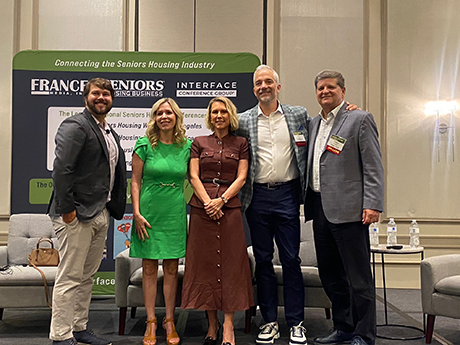
The generational shift was a central theme among senior housing CEOs on “The Power Panel” at the 13th annual InterFace Seniors Housing Conference, which was held on Aug. 25. Jointly hosted by France Media’s InterFace Conference Group and Seniors Housing Business magazine, the event brought together roughly 350 professionals at the Grand Hyatt Buckhead Atlanta.
Editor’s note: InterFace Conference Group, a division of France Media Inc., produces networking and educational conferences for commercial real estate executives. To sign up for email announcements about specific events, visit www.interfaceconferencegroup.com/subscribe.
While executives discussed how operators can appeal to a generation that values choice, independence and experiences just as much as traditional amenities, the message was clear: Baby Boomers do not want to be told what their next chapter should look like. They want to choose it for themselves.
More Choice, More Space
For operators, that means rethinking the physical product itself. The traditional image of seniors housing as a collection of small apartments or studio units is becoming increasingly disconnected from what today’s incoming residents want.
Doug Schiffer, president and CEO of St. Louis-based Allegro Living, emphasized the importance of providing “real space” within apartments that have individual abilities, such as a kitchen and living room, versus a cramped studio floorplan.
“The adult child of yesterday is now going to be our resident,” says Schiffer. “They want something different than what they helped pick out for their parents.”
In comparison, the Silent Generation (born between 1928 and 1945), generally entered senior living with a greater emphasis on stability, care and practicality.
For boomers, the panelists said that moving into a senior living community should not require sacrificing the comforts they have become accustomed to throughout adulthood.
Incorporating more variables within their apartments, such as opportunities for entertaining, cooking, hobbies and visits from family, help preserve a sense of normalcy and independence.
Aging on Their Own Terms
Traci Taylor-Roberts, CEO of Charleston, S.C.-based Harmony Senior Living, shared a specific anecdote that identified just how different the previous generation’s residents were compared to boomers. Whereasthe Silent Generation “did what they were told” and “listened to their kids,” boomers want to be involved in the process of choosing where they’ll live.
“In our resident meetings, I noticed I had a wide audience of CEOs, CFOs and leaders of businesses, so they weren’t talking to me like residents of the past,” explained Taylor-Roberts. “They spoke for themselves and wanted to be treated as fellow business people.”
Rather than waiting for operators to define their experience, newcomers are making their voices heard, offerings ideas, questioning existing practices and asking for changes that better cater to their wants and needs.
That same philosophy extends beyond their living quarters. Operators are recognizing that the ability to choose may be one of the most important amenities they can offer.
“If we’re able to get the programming and engagement correct at our facilities, then that’s going to be the real game changer for them [the residents],” said Sevy Petras, CEO of Fort Wayne, Ind.-based Priority Life Care.
In response to Petras and Taylor-Roberts, Chris Guay, CEO of Vitality Living, noted that the industry “needs to adjust faster,” because current seniors housing communities are not gelling yet with what the residents are demanding, whether it’s dining options, fitness programs, social activities or opportunities for residents to spend time independently.
“We have to evolve quickly, and it starts with how we’re branding ourselves,” continued Guay.
While Guay noted the importance of becoming more active in the digital realm for this generation, he particularly highlighted that the residents are “making decisions digitally before they’re even taking a look at what the developers are doing.”
Compared to the Silent Generation, boomers are entering their senior living accommodations with decades of experience using smartphones, social media, online banking, streaming services and other digital tools.
In agreeance with Guay, Taylor-Roberts acknowledged that this generation “embraces technology” and “wants to learn how to use it.”
“Social media, in particular, is becoming an increasingly important window into seniors housing,” added Guay. “The key to reaching this generation is having a strong social media presence because prospective tenants want to see something ‘real.’”
This creates opportunities for operators to use technology not only to improve the resident experience, but also to rethink how they market their communities.
Independence Without Isolation
The desire for independence is perhaps the defining characteristic of this incoming generation of seniors, according to the panelists. Boomers have spent much of their lives making their own decisions and are unlikely to suddenly embrace an environment that makes them feel as if those decisions have been taken away.
“Boomers don’t want to sacrifice what they have or be told what to do,” Taylor-Roberts noted. “They want to have the freedom to do what they want.”
For senior housing operators, that creates a delicate balance. Communities must provide the support and services residents may eventually need without making those services feel restrictive.
Petras particularly noted that boomers “don’t want to come to a dining room and be told to eat.”
“We have repurposed our bistros to make them more like delis — with coffee, wine or sandwiches — that serve the Baby Boomer who’s okay with paying for it,” says Sevy. “So, they still have the freedom to be able to come in and out and buy what they want.”
The goal is not to make independence easier. The most successful communities may be those that allow residents to determine how much — or how little — they want to engage.
Empowering a New Generation
While independence is important, the CEOs also emphasized that today’s seniors are looking for connection and a sense of belonging. The challenge for operators is creating communities where residents can build meaningful relationships without making socialization feel forced.
This generation’s desire for belonging may be especially important as more seniors make the transition from living independently in a longtime home to living within a community. Although seniors housing communities can provide opportunities to form new relationships, those opportunities need to reflect what residents enjoy and value.
“The boomers are the ‘me’ generation, so we need to focus on their interests,” added Schiffer.
While pickleball courts, fitness classes, art studios and social events may all have a place, the larger objective is to give residents the chance to connect with things they genuinely appreciate.
“We have to listen to what the people want,” emphasized Petras.
In other words, belonging should not mean asking residents to conform to a community, but rather creating a community around the residents.
“I believe senior living in the future is going to be about managing belonging for your residents and helping them feel like they’re a part of something bigger,” concluded Petras.
— Abby Cox