

— By Bill Asher of Hanley Investment Group Real Estate Advisors —
The Inland Empire continues to demonstrate its resilience as one of Southern California’s most dynamic retail investment markets. In the third quarter of 2025, transaction activity accelerated, pricing held firm and cap rates compressed, underscoring investor confidence in the region’s long-term fundamentals. Even with vacancy rising and rent growth moderating, investment trends point to a market adjusting as capital continues to favor necessity-based, internet-resistant formats.

According to CoStar, 73 retail properties traded in third-quarter 2025 compared to 48 in the same quarter of 2024. Average cap rates declined from 7.2 percent to 6 percent year over year, signaling stronger pricing and heightened demand. Single-tenant net lease properties led the surge, with 46 transactions in third-quarter 2025 versus 28 a year earlier. Average cap rates tightened to 5.9 percent, down from 6.8 percent in third-quarter 2024.
Multi-tenant retail also showed healthy demand, with 22 properties sold in third-quarter 2025 versus 20 in third-quarter 2024, and average cap rates compressed from 7.4 percent to 6.2 percent. This momentum reflects a convergence of factors that shaped the second half of 2025. Pent-up demand and impatient capital deployed equity as many sellers met the market on pricing. Slightly more favorable borrowing conditions, combined with lenders narrowing spreads and becoming more aggressive, provided the jolt the retail investment market needed.
Ongoing rate relief is improving financing conditions, yet investors remain disciplined, concentrating on necessity-based assets that deliver durable income. The Inland Empire market continues to favor quality, internet-resistant categories, ensuring transaction velocity remains strong heading into 2026.
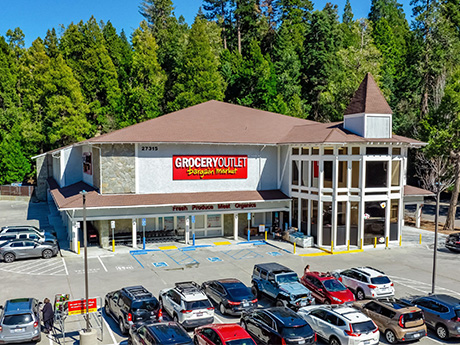
Grocery anchored retail remains a reliable draw for investors. In November, Hanley Investment Group completed the $6.1 million sale of a newly renovated Grocery Outlet in Blue Jay, positioned at the entrance to Lake Arrowhead. Repurposed from a former theater, the property highlights strong demand for essential service retail in resort trade areas.
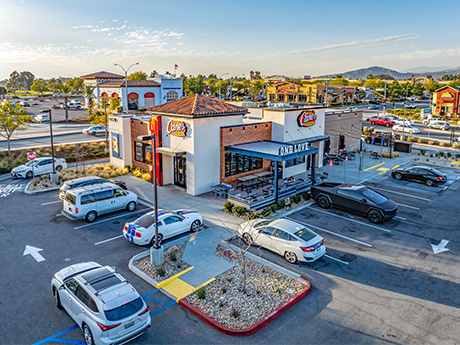
Convenience and fuel formats also defined Inland Empire activity in 2025. Hanley arranged pre-sale transactions for newly constructed Circle K convenience stores in Cathedral City and Coachella, leveraging marketing strategies that secured all-cash 1031 exchange buyers months before store openings. This activity highlights the enduring appeal of single-tenant convenience and fuel assets.
Beyond strong tenant credit and reliable cash flow, the reinstatement of 100 percent bonus depreciation for qualified properties acquired and placed into service after Jan. 19, 2025, is expected to further fuel transaction activity. This tax advantage once again enhances the appeal of single-tenant convenience stores, as well as fuel stations and express car washes, where buyers can maximize value through 100 percent bonus depreciation on a permanent basis, eliminating the phase out schedule that would have concluded by 2027.
Quick-service restaurant and drive-thru formats have also proven resilient. Although the health of this sector is uneven for legacy brands (i.e. Burger Kings, Wendy’s) due to higher labor costs, increased rents and slower or flattening store sales, newer brands (i.e. Dave’s Hot Chicken, Dutch Bros) are aggressively expanding and thriving.
This activity reflects continued demand for assets with strong tenant credit and drive-thru formats, features that have proven durable amid evolving consumer behavior. Essential retail has been the most consistent performer over the past 24 to 36 months. Grocery anchored and shadow anchored centers, quick service restaurants, convenience stores and drive thru formats have all delivered steady results despite broader market volatility. Institutional capital is increasingly pursuing unanchored strip centers as well, attracted by high occupancy, rent growth and repositioning potential. Once dominated by private buyers, these properties are now drawing larger funds seeking scalable portfolios and long term performance.
Adding to this momentum is the Inland Empire’s rapid demographic expansion, with the region’s population growing from 4.2 million in 2010 to nearly 4.7 million in 2025 – a 12 percent increase that outpaces both California and U.S. averages. This expansion contrasts with slower growth in coastal counties such as Orange and San Diego, and positions the Inland Empire alongside national growth markets like Phoenix and Las Vegas. Certain IE communities like Eastvale, which has grown to 70,514 residents with median household income of $162,853, illustrate the region’s strong residential fundamentals.
Looking ahead, pricing is expected to remain firm for quality assets. Higher construction costs and more selective tenant expansion may temper development momentum in 2026. However, recent interest rate reductions are creating a clearer path forward and improving financing conditions for both investors and tenants. Combined with the Inland Empire’s population growth, housing affordability and strategic location, the region remains an appealing retail investment market in Southern California.
Single-tenant net lease properties are expected to serve as a cornerstone of investment strategies, offering predictable returns supported by strong tenant credit and long term leases. With capital gravitating toward necessity based, internet resistant formats, the Inland Empire is well positioned to sustain investor confidence into the year ahead.
— By Bill Asher, executive vice president, Hanley Investment Group Real Estate Advisors. This article was originally published in the December 2025 issue of Western Real Estate Business.