

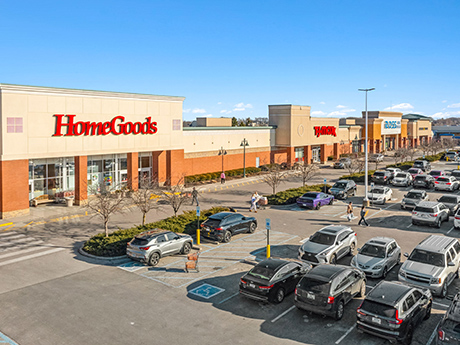
A lack of quality inventory is one of the prominent factors shaping the retail investment sales landscape. Simply put, there is more capital seeking retail opportunities than there are assets available for purchase, says Michael Marks, executive director of retail capital markets with Cushman & Wakefield in Chicago. Strong leasing activity and rising rents are bolstering investor confidence in the retail market, he adds.
Amid historically low vacancy, U.S. retail asking rents grew 2.2 percent year-over-year to $25.65 per square foot triple net, according to Cushman & Wakefield’s second-quarter report. Structural supply constraints continue to support sustained rent growth, as the development pipeline represents less than 0.3 percent of existing inventory.
Retail investors are firmly in acquisition mode, according to JLL’s second-quarter U.S. report. In the first half of the year, retail investment sales volume reached $33 billion, up 14 percent year-over-year and the strongest first half since 2022.
Evan Lyons, executive vice president with West Bloomfield, Michigan-based Encore Real Estate Investment Services, poses the question — where does the next wave of inventory for transactions come from?
“Some will come naturally through ownership transitions, partnership changes, fund lifecycles and other reasons investors need to sell,” predicts Lyons.
“Debt maturities could also be a catalyst,” continues Lyons. “The Mortgage Bankers Association estimates that approximately $875 billion of commercial mortgages mature in 2026, followed by another $652 billion in 2027. Not every maturity creates a sale, but some owners are going to look at today’s refinancing economics and decide that selling makes more sense than putting new debt on the property.”
That scenario should create opportunities for buyers who have capital and are prepared to act, says Lyons.
Who’s hungry for deals?
Private capital remains very active, including individual investors, family offices and regional owners, states Lyons. But perhaps the most compelling storyline is how aggressive some REIT and institutional buyers have become, particularly in the single-
tenant market.
“We are seeing certain REITs stretch below the cap rates at which they have traditionally acquired,” says Lyons. “I think they recognize an opportunity to step into the gap between seller pricing expectations and a private buyer market that has become more sensitive to interest rates and yield.”
Frank Rogers, a senior vice president with SRS Real Estate Partners in Detroit, also sees institutions and
REITs becoming much more active today. He says these buyers have abundant capital to deploy and give sellers the assurance to close deals.
While institutional and private equity capital always play in larger grocery-anchored and core power center deals, the biggest change in the last two to three years has been the institutional buyer returning to the retail strip center category, says Jeff Lefko, executive vice president and partner with Corona Del Mar, California-based Hanley Investment Group Real Estate Advisors.
On the other hand, Lefko notes that private capital, 1031 exchange buyers and high-net-worth individuals remain the most active buyers in the Midwest, especially for single-tenant deals and smaller multi-tenant properties under about $10 million.
Besides private investors, other active buyers include syndicators, institutional advisors, REITs and family offices, says Marks. Recently, he has observed increased participation from international capital and sovereign wealth investors.
For example, Marks recently represented an international buyer in the acquisition of Roosevelt Plaza in the Chicago suburb of Lombard, Illinois. Totaling 125,836 square feet, the grocery-anchored center is home to Aldi, Hobby Lobby, Starbucks and Harbor Freight Tools.
Marks says the deal is a good example of what investors are pursuing today — necessity-based retail with durable cash flow, long-term tenancy and opportunities to create additional value over time.
What do buyers want?
Today, investor demand for multi-tenant strip centers is fierce. Lefko provides an example of an unanchored strip center in Overland Park, Kansas, that his firm brought to market in 2022. The retail center received two to three offers after being on the market for 90 days.
In 2026, Hanley Investment Group brought the same property to market at a 10 percent higher price point. It garnered 10 offers in the first two weeks.
“Investors like the diversified income stream, replaceable rents and the service-oriented, internet-resistant tenant mix. There is no single category in the Midwest with more demand than a well-located retail strip center,” says Lefko.
High-yield, anchored shopping centers make up another category with strong investor demand. In fact, they are one of the only viable options for investors needing a spread between interest rates and cap rates, according to Lefko.
“As construction costs, interest rates and inflation push rents higher, anchored shopping centers offer rents that cannot be duplicated by competing new-construction properties,” he says. “Investors want credit[worthy], junior box tenants like TJ Maxx, Burlington, Ross Dress for Less and Hobby Lobby with strong performance and seasoned rents that are most likely below market.”
Junior box tenants occupy smaller square footages than big box retailers like Walmart.
Hanley Investment Group recently represented a Midwest-based private buyer in the off-market acquisition of Montclair on Center, a 195,149-square-foot shopping center anchored by Marshalls and HomeGoods in Omaha, Nebraska.
According to Lefko, Marshalls and HomeGoods recently executed early lease extensions through 2034 and are operating at sub-4 percent occupancy costs, which was a major draw for the buyer. The occupancy cost percentage, or “health ratio,” measures the total occupancy cost incurred by a tenant relative to the gross sales generated at the property, according to Wall Street Prep. The total occupancy cost consists of charges like base rent, property taxes and utilities.
At the end of the day, retail buyers seek strong demographics, good visibility and access, and a tenant that they believe will be there for the long term, says Rogers. “Convenience, grocery, medical/service-oriented retail and other uses that people visit regardless of the economy are getting a lot of investor attention,” he says.
Value-add deals are another opportunity that buyers continue to keep an eye on.
“In the current market, that means assets with below-market rents, upcoming lease rollover, opportunities to upgrade tenant quality, re-tenant underperforming space or improve the merchandising mix,” says Marks. “Investors are looking for centers where leasing demand and tenant expansion can create additional value and drive higher returns over time.”
Bob Havasi, vice president of Cleveland-based Cooper Commercial Investment Group, echoes this sentiment, saying he’s seeing an influx of value-add buyers. “Investors are capitalizing on the strong leasing market and are confident they can leverage tenant relationships,” he says.
For instance, investors are willing to purchase a property that is 65 to 80 percent occupied, knowing they can lease it up and flip it a few years later for a significant return.
Havasi offers a specific example with the sale of Kruse Commons in Solon, Ohio. Cooper Group brokered the $7.1 million sale of the property in January 2025 when it was 78 percent leased and recently arranged the sale of the same center for $9.3 million when it was fully occupied.
For Lyons, part of a broker’s job is matching realistic sellers with qualified buyers who have a high probability of closing — rather than simply collecting offers. Encore recently brokered the sale of a Walmart shadow-anchored center in Ashland, Ohio. The transaction encountered two separate tenant issues after going under contract, either of which could have derailed the sale, notes Lyons.
“Instead, we worked with a committed buyer and seller to structure solutions that protected the buyer’s income requirements while satisfying the seller’s pricing needs,” explains Lyons.
“The transaction illustrates something important about today’s market: Successful deals are not always the ones without problems. They are the deals where the right buyer, the right seller and the right broker are willing to solve those problems rather than use them as a reason not to transact,” adds Lyons.
Weigh the pros and cons
What concerns and opportunities do brokers foresee for the broader retail market? Interest rates are the main sticking point for Michael Carter, a senior vice president with SRS Real Estate Partners in Detroit.
“If long-term Treasury yields remain elevated, that puts a ceiling on how much cap rates can compress,” says Carter. “On the flip side, opportunistic buyers that are seeking second- and third-generation assets with older lease terms have tremendous upside because of how high rents are becoming in today’s [high-cost] construction environment.”
At its September meeting, the Federal Reserve raised the benchmark federal funds rate — the interest rate banks charge each other for overnight loans — for the first time since 2023 in an effort to curb inflation. The 25-basis-point increase put the rate at a level between 3.75 and 4 percent. The same week, the 10-year Treasury yield hit 5 percent, a level not seen since 2007 except for briefly in October 2023, according to The Wall Street Journal.
The biggest near-term concern for Marks is uncertainty in the broader capital markets. “Volatility in interest rates, inflation expectations and geopolitical events can impact financing conditions and investor sentiment across all property types,” he says.
As for opportunities, Marks cites retailers that continue to embrace omnichannel strategies. For instance, online furniture retailer Wayfair has opened three physical stores in Chicago, Columbus and Atlanta.
“Many digitally native brands are expanding into brick-and-mortar locations, while high-performing retail corridors and experiential shopping environments continue to attract both tenants and investors,” he says. “For owners who can create relevant, engaging retail experiences, the outlook remains very promising.”
Also encouraging is the strength of the consumer. U.S. retail sales rose by 1.2 percent in August to $773.9 billion, rebounding from a 0.5 percent decrease in July, according to the Commerce Department. The August reading was higher than the 0.8 percent growth expected by economists polled by The Wall Street Journal. Sales showed consumer strength outside of high gasoline prices as sales in the “control-group” categories that feed into the gross domestic product formula rose by about 1.4 percent, according to the business publication.
For Lefko, the biggest concern is still the cost of debt. But construction and insurance costs have also risen across parts of the Midwest, making new development and major renovations harder to justify. He says this type of landscape limits the supply of newer, low-CapEx product that traditional 1031 exchange buyers want most.
That said, the same dynamic works in favor of existing, well-located retail.
“Limited new supply protects the value of quality centers already in the ground, and these properties will always have a competitive advantage with lower rents than anything that is newly built,” says Lefko.
“I believe Midwest multi-tenant retail is one of the biggest opportunities in the country right now. Buyers can still achieve cap rates much higher than any other region, while many Midwest markets are flourishing with both population growth and unprecedented average household income growth.”
According to Lefko, cap rates for Midwest retail sales averaged 7.37 percent in the first half of 2026, down slightly from 7.41 percent the year prior. From July 2024 to July 2025, the Midwest was the only region where all states gained population, according to the U.S. Census Bureau. From 2019 to 2024, the average annual increase of median household income in the Midwest was 4.2 percent, compared with 4.4 percent nationally, according to S&P Global.
Lefko continues that the Midwest region’s affordability, population and job growth support retailer expansion and investor demand. “The fundamentals are stable and the demand profile is broadening, creating a favorable setup heading into 2027.”
— Kristin Harlow
This article originally appeared in the September 2026 issue of Heartland Real Estate Business magazine.