

— By John Read of CBRE Retail Investment Properties-West —
Often defined by its 42 miles of Pacific coastline, Orange County’s weather may not be the hottest throughout the Southern California region, but its retail performance arguably is. Orange County remains a target for retailers and investors alike, driving it to be one of the strongest retail markets in the larger region and nation.

Orange County’s coastline and famously consistent weather with globally recognized theme parks — Disneyland and Knott’s Berry Farm — and retail landmarks like South Coast Plaza and Fashion Island, do contribute to the region’s exposure and appeal, but the county’s retail fundamentals are planted in its scale and demographics. Orange County’s nearly 800 square miles are home to more than 3.1 million residents and one of the most diverse populations in the U.S. with significant affluence and education. Average household income exceeds $157,000 and 46 percent of residents hold a bachelor’s degree or higher.
With diversified industry sectors and major employers, including Disney, UC Irvine, Providence, Kaiser Permanente and Hoag, Orange County’s unemployment rate remains low, ending May 2026 at 3.5 percent. Together, those factors support retail fundamentals that remain stronger than many comparable markets.
The Orange County retail market ended the first quarter with a countywide availability rate of 3.9 percent, remaining flat quarter over quarter as strong tenant demand, limited new development and the redevelopment of some obsolete retail continues to constrain inventory. Several Orange County submarkets were even tighter, including Central Coast at 1.8 percent, Central at 3.4 percent and West County at 3 percent. New retail development remains extremely constrained with limited land and redevelopment sites available. Only 5,000 square feet of construction delivered in the first quarter compared to 41,000 last quarter. Net absorption slowed to 21,000 square feet in the first quarter, down from 166,000 square feet in the last quarter.
As retailers continue to face increasingly tight market conditions with limited space availability, Orange County retail rents remain stable and stronger than many of the neighboring counties. The first quarter ended with a countywide average asking rent at $2.56 (triple net) per square foot, up $0.02 quarter over quarter, with some of Orange County’s retail submarkets beating this average, including Central Coast at $4.92 per square foot and South County at $3 per square foot.
With such strong fundamentals, investors have continued to actively and aggressively pursue retail purchases in Orange County, many of which are trading at a pricing premium compared to other markets. MSCI reported an average Orange County cap rate of 5 percent at the end of the first quarter, below the West average of 6.4 percent and the national average of 6.9 percent. The spread underscores continued investor demand for Orange County retail assets, even as broader regional and national cap rates remain higher.
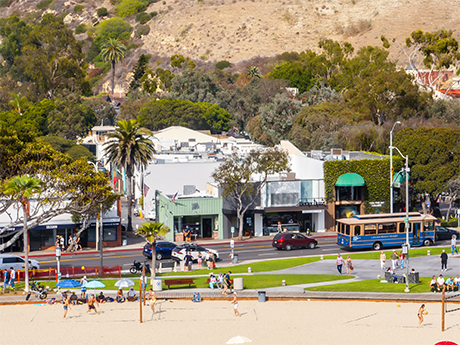
Sizable recent retail center transactions include Asana Partners’ January 2026 acquisition of Gateway Center in Mission Viejo for $51 million, and the February 2026 acquisition of Seacliff Village in Huntington Beach for $151 million. With private investors accounting for about 70 percent of Orange County retail property purchases — consistent with its historical trend and our CBRE Retail Investment Properties-West team’s activity — there are an abundance of premium-priced private capital transactions to point to. These include our team’s 2026 sales in Laguna Beach of Shops at Main Beach for $7.5 million ($1,852 per square foot) and Forest Avenue Mall for $5.75 million ($684 per square foot). We are also currently marketing Trade Marketplace in Irvine, Mission Foothills Marketplace in Mission Viejo, the Village in Lake Forest, and Village Center at Rose in Placentia where we’re seeing strong demand and pricing.
While summertime heat always ends, it’s unlikely that Orange County’s retail market will experience the same cooldown. Its consistently strong fundamentals will continue to provide a stable foundation, driving premium pricing compared to many markets locally and nationally despite challenges including persistent inflation and interest rate volatility as well as economic uncertainty related to consumers and more recently, the Iran conflict.
— By John Read, senior vice president of CBRE Retail Investment Properties-West. This article was originally published in the July 2026 issue of Western Real Estate Business.