

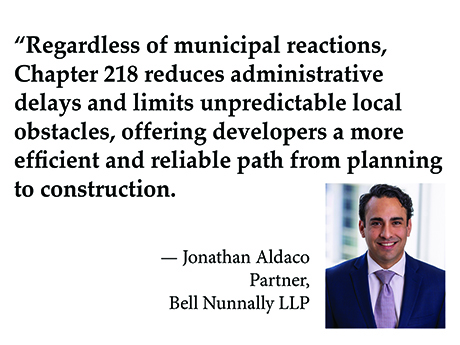
By Jonathan Aldaco, partner at Bell Nunnally LLP
For decades, multifamily developers across Texas have faced a frustrating reality: after investing significant time and capital in projects, multifamily developments can spend months — or even years — sidelined in layers of procedural red tape before construction even begins. And while some projects eventually move forward, some never do.
Senate Bill 840 (now codified as Chapter 218 of the Local Government Code) rewrites the playbook on this trend. Designed to address the shortage of housing in metropolitan areas across Texas, this new law streamlines approvals and lowers regulatory hurdles by allowing mixed-use and multifamily housing by right on commercial property. Only nine months into its implementation, Chapter 218 has made one point clear: The rules governing multifamily development in Texas have changed.

Off the Sidelines, Into the Game
As a threshold matter, Chapter 218 only applies to municipalities with a population of more than 150,000 that are wholly or partly located in a county with a population of more than 300,000. This means that cities like Dallas and Fort Worth and other municipalities in the metroplex like McKinney, Irving, Arlington, Frisco and Plano are impacted by Chapter 218. In total, this new law affects approximately 19 of the state’s largest cities.
Chapter 218 significantly reduces local zoning authority by requiring qualifying municipalities to permit mixed-use and multifamily residential development in any zoning district that already allows office, commercial, retail, warehouse or mixed-use development — without the need for rezoning, land use classification amendments, variances or other discretionary approval processes.
Critically, if a proposed development meets the applicable land development regulations under this new law, the municipal authority must administratively approve the building permit or other required authorization and may not require any further action by the municipality’s governing body for the approval to take effect. This provision eliminates the risk of delays for developers at the city council level; no more waiting months for a city council vote, dependent on public opposition.
Additionally, Chapter 218 provides a “hurry-up offense” and removes some of the peskiest barriers that have long stalled multifamily developments. The law streamlines development by allowing existing commercial buildings to be converted to mixed-use and multifamily residential use without the need for:
- traffic studies
- construction of traffic mitigation improvements or payment of traffic mitigation fees
- additional parking beyond what already exists on the site
- extension, upgrade, replacement or oversizing of utility facilities beyond what is necessary to provide minimum capacity
- design requirements more restrictive than the International Building Code’s minimum standards
- impact fees, unless the land was already subject to an impact fee before the conversion building permit was filed.
These prohibitions apply to buildings currently used for office, retail or warehouse purposes that are proposed to be converted to mixed-use or multifamily residential occupancy comprising at least 65 percent of the building and at least 65 percent of each occupiable floor, and that were constructed at least five years before the proposed conversion date.
While Chapter 218 significantly clears the field for play, the law has exceptions. Specifically, the exceptions include properties located within:
- a zoning classification that allows heavy industrial use
- land within 1,000 feet of heavy industrial use areas
- land within 3,000 feet of an airport or military base
- areas designated as a clear zone or accident potential zone
Additionally, cities also may continue to enforce historic preservation regulations, water quality regulations, sewer and water access requirements, building codes and stormwater mitigation requirements.
New Playbook Delivers Impact, Bite
Since the law became effective on Sept. 1, 2025, some Texas cities have embraced the changes while others have resisted them. Dallas, for example, has taken a seemingly positive position by not adopting any new amendments to local zoning or permitting regulations to contravene the purpose of the new law. Other cities, such as Grand Prairie, Plano and Irving, have adopted amendments to their local zoning laws that are intended to impair the feasibility of using Chapter 218 for mixed-use and multifamily development.
Regardless of municipal reactions, Chapter 218 reduces administrative delays and limits unpredictable local obstacles, offering developers a more efficient and reliable path from planning to construction. At the same time, the law reflects Texas’ effort to address its growing housing shortage by encouraging new development across the state. Although its long-term impact is still unfolding, Chapter 218 has already become a game-changing force in reshaping the development landscape in Texas.
If developers are met with resistance from the “refs” at city hall, they have the right to “challenge the call on the field.” Any housing organization or person adversely affected or aggrieved by a municipality’s violation of the statute may bring a civil action for declaratory or injunctive relief. If the claimant prevails, the court is required to award court costs and reasonable attorney’s fees, creating a strong financial incentive for compliance. The statute also designates the Fifteenth Court of Appeals as having exclusive intermediate appellate jurisdiction over these actions.
Developers considering multifamily or adaptive reuse projects in qualifying Texas municipalities should evaluate how the new law applies to their specific sites and engage experienced land use counsel to navigate the intersection of this new state law with local regulations.