

For much of the past several years, commercial real estate investors have navigated a market defined by uncertainty. Interest rate volatility, inflation concerns, geopolitical tensions and shifting workplace trends have all contributed to an environment where predicting the next move can feel increasingly difficult.
Against that backdrop, the Midwest continues to stand out for a different reason: stability.
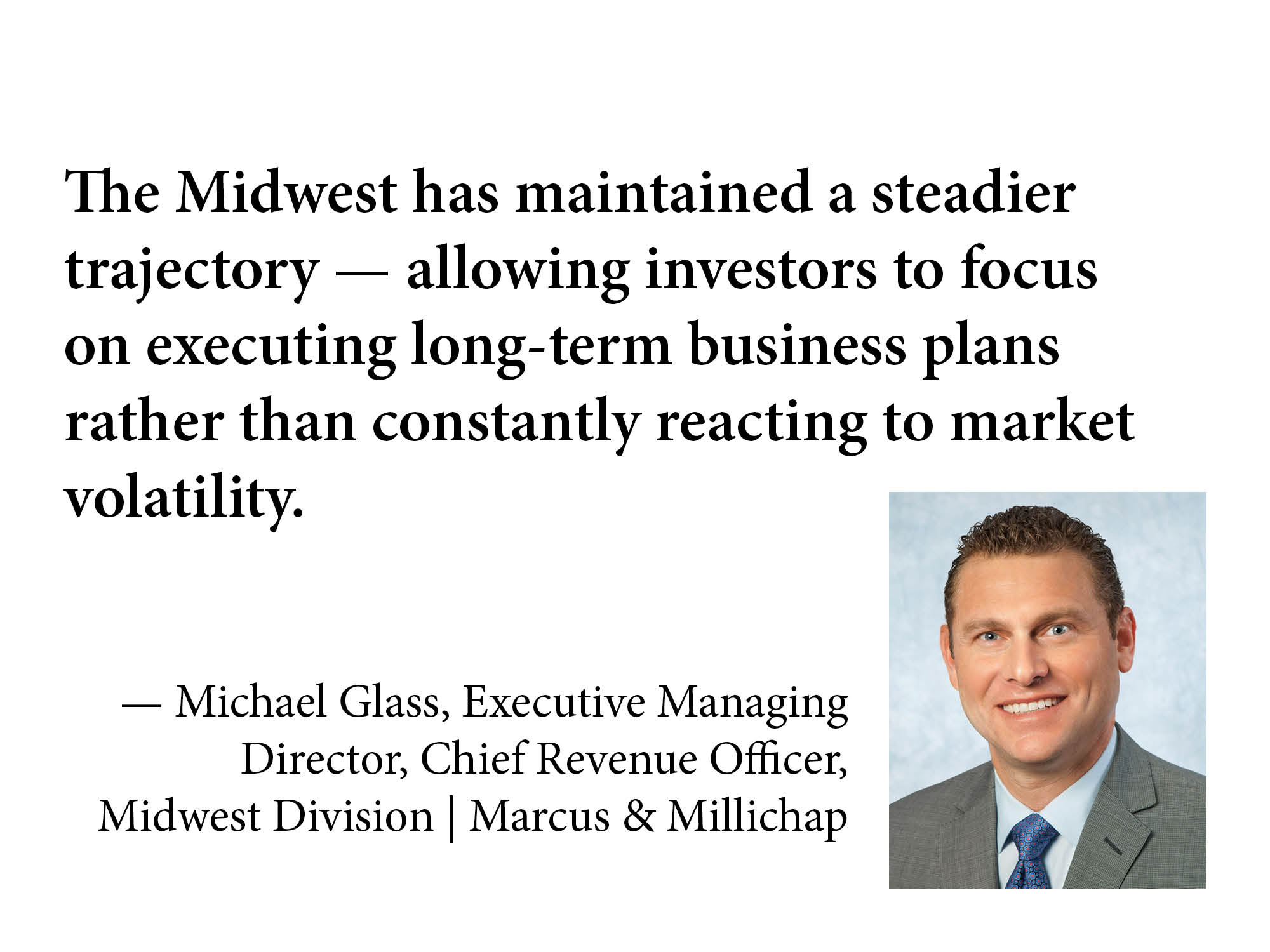
Across many Midwest markets, commercial real estate fundamentals have remained relatively balanced compared with other regions of the country. While some markets have experienced dramatic swings in pricing, development activity and occupancy levels, much of the Midwest has maintained a steadier trajectory. That consistency allows investors and operators to focus on executing long-term business plans rather than constantly reacting to market volatility.
Stability Remains the Midwest’s Competitive Advantage
One of the region’s greatest strengths is the balance between supply and demand. Unlike certain Sun Belt markets that have experienced significant waves of new development, many Midwest metros have avoided substantial oversupply. As a result, property owners have been able to continue implementing value-add strategies, improving operations and generating steady rent growth.
Commercial real estate success is rarely built overnight. In many Midwest markets, returns are generated through disciplined management, operational efficiencies and patient execution over time. For investors seeking long-term wealth preservation and growth, those characteristics remain highly attractive.
The region’s resilience also continues to stand out. Even amid broader economic uncertainty, many Midwest markets remain fundamentally healthy because they are less dependent on rapid growth cycles and speculative development activity.
Property Sectors Tell Different Stories
The office sector continues to face headwinds, particularly in markets such as Cleveland, where tenant absorption has remained limited. In many cases, office tenants are relocating between buildings rather than creating meaningful net-new demand, resulting in vacancy shifts rather than overall occupancy gains.
At the same time, there are signs that portions of the office market may be stabilizing. In Chicagoland, for example, some major employers are increasingly encouraging employees to return to the workplace. While a full recovery may take time, these trends could provide support for the sector moving forward.
Market narratives can also change more quickly than many expect. During the height of the pandemic, retail was widely viewed as one of commercial real estate’s most challenged asset classes. Today, well-located multi-tenant retail centers have demonstrated impressive resilience and, in many markets, strong performance.
Meanwhile, several property types continue to generate optimism throughout the Midwest. Multifamily owners have expressed growing confidence as operational performance improves and long-term fundamentals remain healthy. Multi-tenant retail, manufactured housing and industrial assets continue to perform well across much of the region.
Industrial real estate may receive an additional boost from the continued evolution of artificial intelligence. Discussions surrounding AI, logistics infrastructure, data centers and technological advancement are becoming increasingly common throughout the industry.
Looking Ahead
For now, uncertainty remains the primary factor influencing commercial real estate investment activity. Investors continue to evaluate the future path of interest rates, inflation and economic growth. Questions surrounding tariffs, energy prices and global conflicts further contribute to market hesitation.
As a result, significant amounts of capital remain on the sidelines waiting for greater clarity.
At the same time, there is considerable pent-up demand. Once investors gain more confidence regarding interest rates and broader economic conditions, transaction activity could accelerate meaningfully.
The longer-term outlook may also be shaped by forces beyond interest rates and economic cycles. The internet fundamentally changed how businesses operate by improving efficiency and productivity. Artificial intelligence has the potential to create a similar impact. While there will undoubtedly be a period of adjustment, AI is more likely to become a powerful tool that enhances productivity than a force that completely replaces how people work.
Commercial real estate has always been cyclical. Throughout every market cycle, opportunities have emerged for investors willing to maintain a long-term perspective and remain disciplined in their approach.
While market conditions will continue to evolve, the Midwest’s stability, balanced fundamentals and resilience position the region to remain an attractive destination for commercial real estate investment in the years ahead.
— Michael Glass, Executive Managing Director, Chief Revenue Officer – Midwest Division, Marcus & Millchap. Marcus & Millichap is a content partner of REBusinessOnline.