

By Mandi Backhaus Barr, The Lerner Company
Omaha’s commercial real estate market isn’t standing still, and neither are the businesses, investors and developers shaping what comes next. As we enter the remaining few months of 2026, we reflect on the Omaha market from a few different perspectives. From a high level, Omaha’s growth continues, especially attracting institutional groups who may have overlooked the heart of the country in the past. Even after achieving the magic 1 million metro area population mark, Omaha continues to grow in more ways than just one.

The theme of this year’s Omaha CRE Summit was “Ideas Don’t Move Markets. People Do.” What a fitting theme to describe Omaha’s commercial real estate activity. Generally speaking, each of the asset classes are performing consistently to the previous 24 months. While eminent borrowing costs, geopolitical uncertainty and inflation continued to influence capital markets, improving pricing expectations and more certainty around valuations supported a notable rebound in transactions.
Industrial remains robust with a low vacancy rate of only 3.4 percent. Despite high construction costs, developers can’t seem to build these fast enough to meet the robust demand. Sarpy County, Nebraska’s fastest-growing county, is especially seeing these new construction projects given the available and prime land.
In the office realm, slowly but surely, Class A buildings have begun to stabilize, with the exception of a few outliers. Office vacancy currently hovers around the 7.6 percent mark, with about 5 million square feet of space currently available. From an investment standpoint, we are seeing Class A and B office buildings, particularly in West Omaha, trade in the 7 to 8 percent range.
Additionally, healthcare providers are investing heavily throughout metro Omaha as they seek to meet growing demand from an expanding population. Bryan Health’s entry into the Omaha market at Privada near 204th Street and West Center Road, OrthoNebraska’s continued growth and the ongoing expansion of the University of Nebraska Medical Center and the EDGE District are examples of healthcare providers’ confidence in the market.
Retail continues to perform extremely well, with vacancy rates at 4.3 percent. National retailers are interested and ready to enter the Omaha market, but there is simply not enough space. Fortunately, a handful of new developments have really taken off, allowing retailers to enter the market with their prototypical footprints.
Retail development builds
Avenue One, which is located at the southeast corner of 192nd Street and West Dodge Road, has introduced a new lineup of retailers to the market, many of which will be their first Nebraska locations. These include Arhaus, West Elm, L.L Bean, Pottery Barn, Williams-Sonoma, Ulta Beauty, Trader Joe’s, Perry’s Steakhouse & Grill, Barnes & Noble and many more. This project is expected to be completed in phases throughout 2027 and 2028.
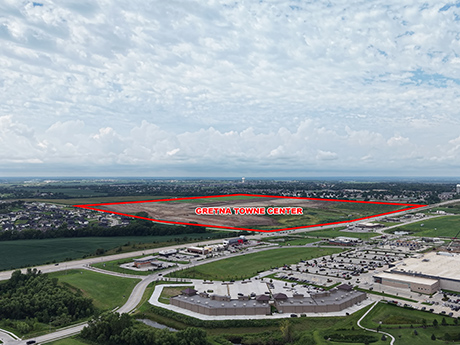
Separately, in Gretna, the metro area’s fastest-growing suburb, Gretna Towne Center is currently underway. This 180-acre project, developed by The Lerner Company, will be one of the largest mixed-use projects in the area. The south half will be residential, with the front along Highway 370 in the works to be retail boxes and pad site users. This development emphasizes the demand for additional retail, dining and service options to support Gretna’s rapidly growing population.
Across Highway 370, HyVee’s largest-footprint location in the county at 150,000 square feet continues to perform extremely well, showcasing the need for additional grocers in high-growth areas. Grocer activity, which has been relatively quiet the last 10 years, has ramped up the last 12 months, with Baker’s (now owned by Kroger) and HyVee both securing multiple sites in void pockets of the metro, primarily in Northwest and West Omaha areas.
Referring back to the notion that “Ideas Don’t Move Markets. People Do,” as we discuss the Omaha commercial real estate market’s successes and challenges, it cannot be done without acknowledging the countless parties involved. Examples include industry professionals collaborating on a deal, or the pro-growth and pro-business local municipalities. Omaha is still described as a “small big city,” and this is evident in the day-to-day progress of projects and developments, from the initial idea sparked by a developer, deals facilitated by brokers, architects cultivating the vision, city officials aligning processes and everything in between.
The revitalization of the urban core and other surrounding submarkets has been invigorating. From the newest skyscraper of Mutual of Omaha headquarters, to the re-activation of The RiverFront with the Heartland of America Park, new restaurants, retail and hotels lining the 10th Street corridor, and the newly planned three-
story, 52,000-square-foot Public Market, Omaha is finding the perfect middle ground of creating spaces that are attractive and efficient for locals and tourists alike.
Overall, Omaha continues to prove that steady growth, strong fundamentals and collaboration can create lasting momentum. The metro’s growth has remained intentional, balancing new development with the character, accessibility and quality of life that have long made the city an attractive place to live and do business. As we look toward 2027 and beyond, Omaha’s commercial real estate market remains well positioned for continued investment and opportunity, driven not simply by ideas, but by the people willing to bring them to life.
Mandi Backhaus Barr is a partner of brokerage services with The Lerner Company. This article originally appeared in the October 2026 issue of Heartland Real Estate Business magazine.