

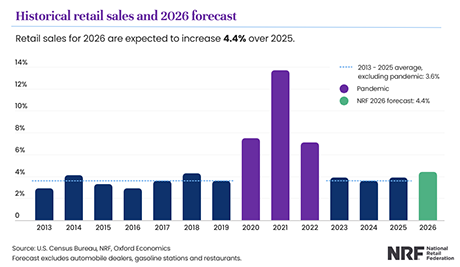
WASHINGTON, D.C. — The National Retail Federation (NRF) has projected that 2026 U.S. retail sales will grow 4.4 percent over 2025 to $5.6 trillion, outpacing pre-pandemic averages and signaling continued momentum despite global volatility. This year’s projection was announced during the organization’s sixth annual “State of Retail and the Consumer” webinar held on March 18, which examined the health of American consumers and the overall retail industry.
NRF’s calculation, created in partnership with Oxford Economics using a new economic model, excludes auto dealers, gas stations and restaurants. The new model integrates a wider range of real-time data to better capture consumer behavior compared to the previous forecasting methods that relied on broader indicators. Although the forecast is in nominal terms (unadjusted for inflation), this model anticipates that a higher proportion of projected sales growth will reflect real gains, rather than inflation-driven increases.
The 2026 sales forecast compares with 3.6 percent average annual sales growth over the past 10 years, excluding the COVID period from 2020 to 2022 when growth was atypical.
“While the geopolitical environment and ongoing trade policy challenges warrant close attention, we remain optimistic that the underlying fundamentals of the U.S. economy will support continued stability in the year ahead,” said Mark Mathews, NRF chief economist and executive director of research.
Mathews added that growth is still bifurcated, as higher-income shoppers contribute a disproportionate share of retail spending, while more price-sensitive consumers remain cautious. The U.S. economy experienced almost zero job growth in 2025 according to the U.S. Bureau of Labor Statistics, yet total retail sales increased by 3.5 percent over 2024. This year, the NRF expects a similar dynamic.
“Consumer spending was a steady and reliable engine of growth in 2025, even as broader economic conditions fluctuated,” said Matthew Shay, president and CEO of NRF. “We expect that consumer resilience to continue into 2026, with household spending once again serving as a pillar of economic support.”
Shay also highlighted that as much as it’s been a challenge to meet the expectations that customers have today, it also “creates opportunities for retailers and businesses that are able to meet and exceed those expectations.”
According to the NRF, the retail industry supports approximately 55 million jobs — which equates to more than one out of four U.S. jobs across 4.6 million establishments, designating retail as the largest private sector employer in the nation. In 2025, holiday sales reached more than $1 trillion for the first time in history, as reported by the Washington, D.C.-based trade association.
Against this backdrop, Bob Eddy, chairman and CEO of BJ’s Wholesale Club, spoke during the webinar about the Massachusetts-based grocer’s growth within the past five years, and how the retailer expects to keep up with changing consumer expectations and supply chain challenges. While primarily concentrated in the Northeast and the East Coast, BJ’s Wholesale Club currently maintains a footprint of just over 260 clubs and is continuing to march westward into new markets, including its entry into Texas this spring.
As BJ’s continues to expand, Eddy emphasized that the formula for retail “always starts with the consumer,” which has been a strong priority in the success of the retailer’s expansion.
“Value is the cross-section of price and product and how we bring it to life,” said Eddy. “We, and all sorts of other retailers, are doing our best every day not just to lower prices, but to deliver the right product at the right time in the format that the customer chooses.”
The “State of Retail and the Consumer” webinar included a segment about Gen Z and their shopping habits, as well as their use of AI in their shopping journeys. REBusinessOnline will provide a recap of this panel discussion next week.
— Abby Cox