

By Taylor Williams
Nobody likes a vacant building, but symbolically, they do have some usefulness.
A handful of empty structures here and there can be illustrative of a market that’s actually balanced and healthy, one in which tenants have some options and flexibility. In addition, vacant buildings can serve as warnings to future developers of what not to do and when not to do it.
Attaching this allegorical significance to the New Jersey industrial market might seem odd, given that this sector has been and should continue to be one of the strongest segments in the country, in terms of both the geography and the asset class. The residential density, highly developed infrastructure and proximity to major ports and transit hubs will likely never lose their appeal to industrial investors and developers. But even the strongest markets can overheat from time to time, and it typically takes a couple years for the high to completely wear off such that indicators of market normalcy can become readily visible.
That’s what appears to be taking shape throughout the Garden State’s industrial market. And without naming names or picking on specific projects, sources say that there are undoubtedly some buildings in New Jersey that are struggling to obtain occupancy, even after multiple years on the market. Many of these projects were capitalized in 2021 and 2022, when interest rates were at historic lows and demand for industrial space was at historic highs. Today, lenders and equity sources might have more pause on pulling the trigger on these deals, all other factors being held equal.
“There’s no question that that’s the case,” says Mark Shearer, senior managing director of the north-central region at Rockefeller Group, in response to whether some New Jersey industrial projects were erroneously or prematurely capitalized in 2021 and 2022. “In those days, we had the combination of [low] interest rates, double-digit rent growth and cap rate compression — that’s a recipe to not fail.”
“We could lease buildings as soon as we started moving dirt then,” Shearer continues, adding that “then” more or less refers to a broader period of 2019 to 2023. “A lot of that was pandemic-based; there was a total shift in consumer behavior, and it was just a unique time. Those days are gone for the foreseeable future. We’re back to more normalized dynamics and decision-making processes. Cap rates are more stable, and rent growth has flattened.”
Jason Bogart, co-founder of Accordia, a New Jersey-based firm that is currently more active in Sun Belt markets, agrees that the market is dotted with projects that represent a sort of overzealousness among capital providers at that time.
“It’s absolutely fair to characterize the market that way,” he says. “We passed on so many deals back then because we thought they were in secondary or tertiary markets, and we believed that when the market turned, they’d be sitting vacant, and that’s what’s happening now.”
Other sources unequivocally agree.
“In 2021 and early 2022, any building that was being built was being leased regardless of other factors. Now people are being a little more cautious,” notes Clark Machemer, senior managing director at Crow Holdings Development, who oversees the firm’s activity in the Northeast.
“During COVID, there was [almost] nowhere better to put investors’ money than Northern New Jersey industrial,” acknowledges Peter Feldman, president of Legacy Real Estate Developers. “There was a lot of uncertainty; the government was printing money, and anyone needing to deploy money saw a safer bet here. Deals were trading at historically low cap rates or built on equal-money margins because of the safety of the asset class. Many of those deals didn’t pan out in the long run. The market is still strong today, but it’s come back to normal.”
As a small company that specializes in rehabbing older Class B buildings, Legacy has been largely removed from these deals. Still, Feldman has come to realize that while it’s not exactly common to drive along the New Jersey Turnpike and see buildings with empty parking lots and longstanding “for lease” (or “for sale”) signs, neither is it incredibly rare.
CBRE’s fourth-quarter 2025 market report for New Jersey industrial cited a vacancy rate of 7.3 percent, an increase of 110 basis points on a year-over-year basis. The elevated vacancy suggests that, like in the post-COVID office world, tenants have demonstrated a flight to quality as larger volumes of new space have come on line. Although that means softening of rent growth, those rents are still workable by any objective measure, and that flexibility speaks to healthier market dynamics as a whole.
“It’s a more stable market today, and people are being more judicious,” says Machemer. “Again, given the demand, anything that was being built at the beginning of the decade was being leased, and you could be confident that even in a lesser location, you could have success. But today, tenants have more options and are definitely looking for higher-quality locations and buildings.”
Don’t Fret
But while nobody knows for certain just what — or when — will mark the tipping point for these struggling projects, sources say there’s really no cause for major alarm.
“The vultures aren’t circling, and that has a lot to do with the maturity of the market and institutionalization of the business,” says Shearer. “It’s not small companies; it’s big groups with sizable balance sheets. Deals are still penciling, and projects that are lagging a bit can be carried. We’ve seen some deals with tenants that have fairly short track records and mediocre financials, and those landlords are plugging holes and living to fight another day.”
“Nobody is panicking,” confirms Bogart. “The market got frothy, but those who have been in the business for multiple cycles know that it’s still fundamentally solid. The business of this asset class has just changed, and it’s not going back to the way it used to be.”
Bogart also says that he sees the same dynamic displayed in certain Sun Belt markets, where costs of development and occupancy tend to be less severe than the likes of New Jersey. His contextualization of the issue underscores the reality that to some extent, for a couple years, some industrial lenders, equity sources, developers and investors in all markets got ahead of themselves in their attempts to capitalize on favorable conditions.
Such is the nature of commercial real estate development, and the industry has a way of self-correcting with time. That’s especially true in a market like New Jersey, says Jessica Fraser, senior vice president in Trammell Crow Co.’s (TCC) New Jersey market.
“The fundamentals are here for this to be an evergreen market,” she says. “We had a period of softening, but even then, vacancy didn’t go much beyond 6.5 percent, which is still very healthy, and we’re seeing that tick down in conjunction with flight to quality. In addition, there’s the question of what percentage of retail sales are still e-commerce? If it’s 25 percent now, we’ll go to 30 or 35 percent, and there’s going to be demand for those facilities.”
Fraser also notes that there’s some validity to the notion that the immediate post-COVID era saw an influx of projects where developers reached on assumptions around pricing and design. As the market has softened, a number of those properties are now trading — sometimes vacant — below replacement cost.
“It’s a resetting of the basis on those buildings; once you have the right basis and can underwrite the appropriate rent, these assets should be better positioned for lease-up,” she concludes.
Bogart says he’s heard of some unusual exit solutions coming to the aid of some distressed projects and their owners, including recent leases by the Department of Homeland Security for immigration detainment and processing. While that’s sort of a one-off occurrence, he admits, he says he’s also seen some shell trades in which new buyers are seeing opportunities in projects that have zoning and approvals but incomplete construction. In either case, the developer is given the all-important reset in basis.
Feldman points out that while super-low interest rates were an impetus for overbuilding a few years ago, they could also offer a window of escape today, especially among those projects that were financed with fixed-rate debt.
“At some point, somebody will hit their number and take the buildings. The sellers will be able to absorb the carry on them, especially if they were built with 2020-level debt,” he says. “Someone will buy these buildings, which tend to be great products, at par or lease them for a decent number — maybe an
owner-occupier, or a large corporation that has time on its side.”
All Sizes Fit One
A subtle indicator of stable, sustainable market dynamics is a wide range of different project types and deal profiles, and sources say they’re seeing demand for big and small developments and transactions alike.
“Tenant demand, especially in Northern New Jersey, is something of a barbell right now,” says Fraser of TCC. “Development over the past few years has been predominantly sub-500,000 square feet or thereabouts, and the sub-200,000-square-foot groups are still taking space at a rapid clip. But over the past few months, we’ve also seen a big resurgence of the 700,000-square-foot and above deals coming back.”
Fraser points to Arsenal Trade Center, TCC’s three-building, 1.1 million-square-foot development in the Central New Jersey community of Sayreville as an example of the variance in demand that exists among local users.
“The buildings range in size from about 285,000 to 450,000 square feet,” Fraser says. “We leased the 342,000-square-foot building to one user pretty quickly and spent much of 2025 looking for additional full-building users. Tour activity was heavily skewed to the sub-150,000-square-foot range, so halfway through the year, we decided to split our 285,000-square-foot building, not just two ways, but three, and now it’s leasing like hotcakes since we met the market.”
Essex Food Ingredients and NekTeck are the latest tenants to commit to Arsenal Trade Center, inking deals for 100,500 and 85,000 square feet, respectively, in Building 1 earlier this year. These deals speak to the efficacy of demising space — an undertaking that can be costly and time-consuming if done post-construction, but also one that can be a game-changer in facilitating occupancy.
“We’re seeing renewed interest in the 450,000-square-foot building after a quieter period and are doing tours left and right since the new year kicked off,” Fraser adds.
Shearer of Rockefeller Group also sees a reversion to bigger deals that were common in 2021 and 2022 taking shape in the market.
“Asian third-party logistics providers have entered the market over the past couple years, and in the past few months, the Amazons and brand-name users have begun taking down big blocks of space,” he says. “That should be reflected in vacancy rates later this year. Smaller spaces are still performing well, but we had a couple years in which the bigger spaces were truly out of vogue, but now they’re back.”
Rockefeller recently unveiled plans for 206 Logistics Center, a 486,850-square-foot industrial project in Pemberton, located about 35 miles east of Philadelphia. In conjunction with NAI Mertz, the New York City-based owner-operator plans to market the project for lease, sale and build-to-suit opportunities — another testament to the breadth and diversity of demand in New Jersey.
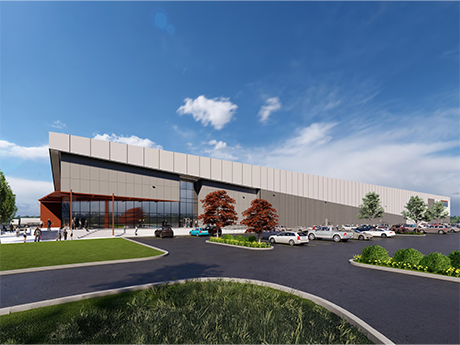
Pictured is a rendering of 206 Logistics Center, a forthcoming industrial project in Pemberton by Rockefeller Group. NAI Mertz brokered the sale of the development site and will market the property for lease, sale or build-to-suit opportunities.
Even with big requirements hitting the market with rising frequency, smaller-scale product should continue to flourish within this region and asset class, sources say. According to Feldman of Legacy Real Estate, part of that trend stems from the fact that land constraints and entitlement processes in New Jersey have always favored the smaller facilities.
“The downsizing of deal and project sizes [that defined market activity a couple years ago] isn’t necessarily a new thing, at least for Northern New Jersey, though it’s a little different in Southern New Jersey,” he says. “We’ve found that larger boxes can be vacant for significant periods of time, whereas smaller spaces tend to turn over right away. The bigger stuff has to wait for the right customer, and the customer base for those spaces is smaller.”
Feldman adds that his company also engages in the perpetual struggle of “to demise or not to demise.” He says that one of Legacy’s newer projects, a 50,000-square-foot, single-tenant building in Hackettstown, came close to being split into two 25,000-square-foot spaces, which would have made for easier marketing. Ultimately, however, a user came in and purchased the building as is.
Machemer of Crow Holdings believes that the market’s ability to support small and big projects and deals alike is a function of not only New Jersey’s strong fundamentals, but also of commercial real estate’s cyclical nature.
“As soon as groups move to smaller-format buildings, there are fewer big buildings getting delivered, so from a supply-demand perspective, from where landlords sit, the larger plays are slightly more favorable,” he says. “That said, there are still some submarkets that are well-suited for smaller buildings. Based on the supply-demand dynamics we see in New Jersey’s more urban, infill markets, you’ll see buildings of 250,000 square feet [or less] under construction because that’s the right size for those locations.”
— This article originally appeared in the March/April issue of Northeast Real Estate Business magazine.