

By Troy Gerspacher, Gerspacher Real Estate Group/CORFAC International
After five straight quarters of tenants giving back more space than they took, Northeast Ohio’s industrial market is finally turning a corner. The reason isn’t a sudden rush of new demand. It’s that almost nobody built anything speculative for two straight years, so the modest leasing activity we’re seeing is enough to move the needle.

A manufacturing market
Northeast Ohio has never been a mega-warehouse market chasing Amazon-style fulfillment. We’re a manufacturing region. Most of the active deals are in buildings under 100,000 square feet run by regional manufacturers and smaller operators who have been here for decades.
Deals aren’t driven by national logistics players making their way in because of population growth. Instead, deals are driven by suppliers to the region’s manufacturing base.
Market data tells the story
Data sources all point to the same fact: Cleveland’s industrial market remains very tight. Vacancy stood at 4.3 percent in the first quarter of 2026, with average asking rents around $6.70 per square foot, according to CoStar. That’s particularly notable compared with the national industrial vacancy rate, which started the year at approximately 7.5 percent.
The market also recorded approximately 420,000 square feet of positive net absorption during the first quarter. New supply remains limited as well, with roughly 399,000 square feet under construction and only 121,000 square feet delivered during the quarter.
Investment activity totaled approximately $127 million, with industrial properties trading at an average of about $54 per square foot, per CoStar. This data points to a market where supply remains constrained, vacancy is low and rents are still growing despite a more measured leasing environment.
What’s driving the activity?
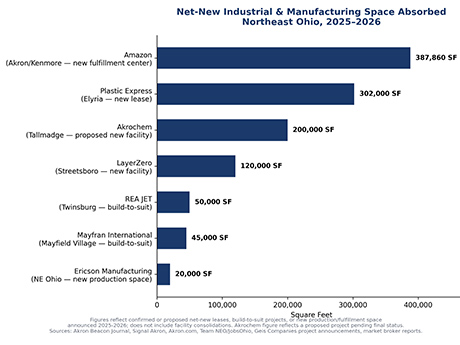
To put it simply: Developers stopped speculating. Construction dropped to under 800,000 square feet across Cleveland and Akron by the end of last year and almost everything still going up is build-to-suit. Geis Cos. is a good example of how the smart developers are playing it right now, building 45,000 square feet in Mayfield Village for Mayfran International and 50,000 square feet in Twinsburg for REA JET. Both sites were spoken for before the first shovel went in the ground. When nobody’s adding speculative space, it doesn’t take much leasing to swing absorption positive.
Smaller buildings are carrying the market. Anything under 50,000 square feet is holding vacancy down, and well-located buildings under 25,000 square feet in Cuyahoga Heights and Garfield Heights are getting snapped up fast. Medina County and Strongsville, sitting right on the I-71 corridor, are outperforming the rest of the metro market.
This activity isn’t driven by population growth. Cuyahoga County has actually lost people the last few years, and Cleveland and Akron have both been flat since 2020.
Medina County is the one exception, as it is growing steadily. Companies are choosing the area because it sits within a day’s drive of most of the Midwest and Northeast along I-71, I-77 and I-80, with the Port of Cleveland adding even more reach for manufacturers moving raw materials.
Deals worth watching
Companies taking on new space are the ones to watch. For instance, Amazon is building an approximately 388,000-square-foot fulfillment center on Manchester Road in Akron, the biggest single net-new deal being tracked right now. Plastic Express leased 302,000 square feet in Elyria.
Akrochem, a rubber chemicals manufacturer that’s been in Akron for nearly a century, has a 200,000-square-foot facility proposed in Tallmadge. LayerZero is building new in Streetsboro, Ericson Manufacturing added production space and REA JET and Mayfran International both landed in new Geis-built space.
A factor worth mentioning
The Environmental Protection Agency is moving to reclassify Greater Cleveland from ozone “nonattainment” to “attainment,” which matters significantly to anyone trying to build or expand in the area. If the reclassification is approved, it will ease the air-permitting process for new construction, which is the kind of regulatory relief that could get speculative development moving again.
Steady recovery
The bottom line is: The market is not in a boom. It is in a steady, disciplined recovery that’s more sustainable than a big surge. Vacancy is tight, the construction pipeline is thin and manufacturers keep showing up and making purchase and lease commitments.
The next 12 months in this market will reward the fundamentals, tight supply, a manufacturing base that keeps growing in place and a logistics position few markets can match, over chasing popularity of other major cities.
Troy Gerspacher is the president and owner of Gerspacher Real Estate Group/CORFAC International. This article originally appeared in the August 2026 issue of Heartland Real Estate Business magazine.