

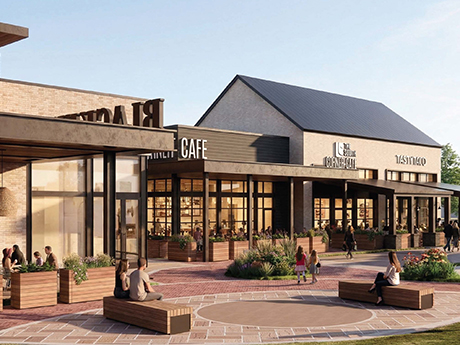
How Avenue One is accelerating the next generation of retail growth in Omaha.
By Abby Cox
Retail has a simple rule: Follow the people. In Omaha, Nebraska, the people have been moving west, and as new neighborhoods, businesses and households reshape the city’s increasingly affluent western edge, the demand for places to shop, eat and gather has followed close behind. Now, at the intersection of 192nd Street and the Dodge Expressway, that growth is converging in Omaha’s most ambitious retail development to date. Avenue One is being designed as more than a collection of stores — it’s a new retail destination built around the idea that Omaha’s next generation of growth deserves a retail environment to match it.
Avenue One is the long-awaited realization of a vision from Omaha-based JSP Development, which assembled the 200-acre site over more than two decades. When the first piece of ground was purchased, 192nd Street was a two-lane gravel road. Now, that same street is six lanes, with the Dodge Expressway seeing more than 72,000 cars per day. Average household income exceeds $200,000, resulting in some of the strongest demographics in the Midwest.
JSP Development and Poag Development Group are leading development, while JLL is handling leasing as part of the companies’ strategic partnership. Vertical construction is underway on the project, with a grand opening scheduled for 2027.
Serving as the centerpiece of Omaha’s most affluent district, Avenue One will comprise 233,000 square feet of specialty retail and restaurants, anchored by a curated mix of nationally recognized retailers, dining concepts and a specialty grocer. Along with high-end shopping and eateries, the project will include a roughly 10,000-square-foot park, patios, green spaces and community programming — amenities that underscore the development’s larger goal of establishing a place people want to spend time in, not simply a place they come to shop.
The project particularly focuses on charming architecture and vibrant placemaking, where shade, landscaping and sightlines create a dynamic environment for shoppers and retailers. The difference in a project of this caliber is in the details: the width of a sidewalk, the direction a door swings and the visual connectivity from end to end of the development.
Individually, these components may seem minor; together, they become “the secret sauce” that the developers strive to implement within their projects.
Built for the Good Life
Avenue One’s significance may be less about its size than about what it represents for Omaha’s retail market. The city has been experiencing a period of retail expansion, supported by population growth, household formation and demand for quality, well-located space. In the second quarter of 2026, Colliers reported positive net absorption of nearly 24,000 square feet in Omaha, while average asking rents climbed 3.3 percent per square foot. Vacancy held at 6.4 percent, despite new inventory entering the market.
For Avenue One, that concentration provides a favorable backdrop. The project is setting up shop in one of the metro’s most active retail corridors at a time when retailers are demonstrating a willingness to commit to new, destination-oriented spaces.
Avenue One is also arriving within a landscape designed to encourage more than commerce. The development, which is one of five Good Life Districts located across Nebraska, is a state-designated geographic zone that helps support retail development by returning a portion of generated state sales tax revenue to local municipalities. The result is the largest retail development in over two decades for Omaha, as noted by commercial real estate experts.
Following Omaha’s Western Growth
Avenue One’s ability to attract brands that are new to Nebraska may ultimately prove to be one of its most meaningful contributions to Omaha’s retail landscape. For retailers, entering a new market is a significant decision. It requires confidence not only in a particular piece of real estate, but in the consumer base surrounding it. Avenue One’s significant leasing activity demonstrates that national retailers see an opportunity in West Omaha.
“Avenue One takes into account what the city values,” says Holly Rome, executive vice president of retail at JLL.
By December 2025, approximately 75 percent of Phase I retail space was either leased or under negotiation.
Rome especially highlighted the specific factors that retailers are looking for when choosing a spot for their business: convenience, accessibility, aesthetics and a strong overall experience.
“When you come to the property, you want to feel good about it, and when we pursue tenants, we layer that aspect into it,” continues Rome.
For Omaha, the arrival of these retailers creates a different kind of ripple effect. A new-to-market brand does not simply occupy a storefront — it expands a city’s retail offering, potentially giving shoppers another reason to stay local while raising the profile of the market.
The project’s first wave of retailers immediately established its positioning. Anchor tenants Arhaus, West Elm, Williams Sonoma and Pottery Barn are among the initial brands, with Arhaus and West Elm opening their first Nebraska locations at the development.
Avenue One’s early emphasis on home furnishings was well timed. The category saw significant growth during the pandemic, when “home” became the center of daily life and consumers invested more in the spaces around them. That surge helped build lasting loyalty to many of the category’s leading brands.
Today, Avenue One sits in the bullseye of Omaha’s westward residential growth, surrounded by the region’s most active areas for new upscale single-family construction. With thousands of new homes taking shape nearby, home furnishings were a natural fit — bringing several of those familiar brands together as a key part of Avenue One’s retail foundation.
Barnes & Noble and Perry’s Steakhouse & Grille have since joined the lineup, with Perry’s also making its Nebraska debut. L.L. Bean and Ulta Beauty are among the more recent additions.
The enthusiasm surrounding home furnishings is only one piece of Avenue One’s leasing story. The development has also generated interest from food and beverage operators, health and wellness concepts and additional soft-goods retailers, broadening its appeal well beyond any single retail category, says JLL.
The outcome is a mix that mirrors the way consumers increasingly experience retail: less as a single-purpose errand and more as part of a larger outing.
However, for Avenue One, the leasing strategy has been about more than just simply filling square footage. Omaha has a unique “coming back home” dynamic: residents may leave for college or career opportunities, but many ultimately return to raise families and put down roots in the community that shaped them. Avenue One is designed to give the next generation of Omaha residents new reasons to stay — and new reasons to come home.
“The Omaha market is very loyal and many of the retailers and tenants that we’re bringing here are community oriented,” says Molly Morgan, executive vice president of retail leasing at JLL.
That loyalty, in turn, underscores the opportunity Avenue One sees in Omaha’s position as an “untapped market.” With fewer established destinations competing for the same consumer, the project has more stretch to curate a blend of retailers and uses that work together, rather than against one another.
The project has also been intentional about creating a symbiotic relationship among its tenants, with the idea that traffic generated by one retailer can benefit the center as a whole. Josh Poag, CEO of Poag Shopping Centers, explains that when a project generates traffic, sales follow — and that is the metric that ultimately matters most to retailers.
The co-tenancy of Arhaus, Williams Sonoma, Pottery Barn and West Elm has created a notable high-end furniture destination in Omaha.
Local Roots, National Reach
For all the attention surrounding Avenue One’s national tenant lineup, the development’s identity won’t be built on recognizable names alone. Avenue One is looking to Omaha’s own retail scene, where local operators can bring a sense of familiarity and authenticity that national brands can’t replicate.
The balance is part of the broader leasing strategy. National retailers can give Avenue One the drawing power and recognition to establish itself as a regional destination, while local brands can give the center a personality that feels rooted in the community it serves.
From day one, Avenue One’s push was to create an experience for the customer through distinct placemaking, with a goal to keep them engaged throughout the day — from morning coffee to afternoon concerts and evening dinners. Not only will customers spend more money at Avenue One, but the center will also become a household name and part of the shopper’s routine.
National brands may put Avenue One on the radar, but local operators can give customers a reason to feel at home once they arrive.
Putting Omaha on the Map
For Avenue One, the opportunity ultimately extends beyond opening another retail destination in West Omaha. It’s about designing a place that’s capable of becoming part of Omaha’s identity as the city continues to grow, while giving retailers an environment where they can stand out.
“We’re creating the canvas for retailers to really shine,” says Poag.
As a result, that canvas is being shaped around more than storefronts. With its fusion of retail, dining, green space, community programming and complementary uses, Avenue One is being crafted to give people a reason to make the trip.
“We strive to become the spot that everyone wants to go to,” adds Morgan.
The combination of tenants at Avenue One shows the demands in the market, the strength of the West Omaha demographics and how the pieces are converging at a moment when Omaha’s retail landscape is expanding its reach. As JLL puts it, “It’s just the right time, right demographics and right place to pull this project together.”
— This article originally appeared in the October 2026 issue of Shopping Center Business magazine.