

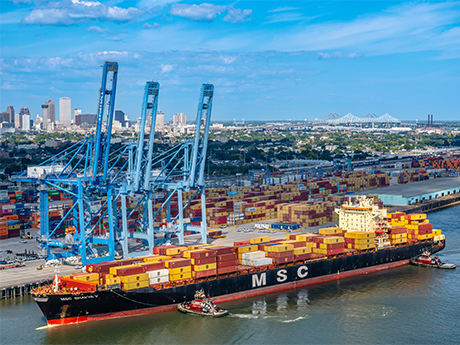
In 2022, the Port of New Orleans (Port NOLA) announced the Louisiana International Terminal (LIT), a new $1.8 billion container terminal coming to Violet, a small city about 10 miles downriver (or south) from New Orleans in St. Bernard Parish. The project is a public-private partnership between Port NOLA and two private maritime industry leaders, Ports America and Terminal Investment Ltd., and is being funded with private capital and public funding from the State of Louisiana and federal sources. The U.S. Army Corps. of Engineers is managing LIT’s environmental review and permitting process, after which the public-private partnership will begin construction.
Set for completion in 2028, the ambitious project is expected to generate 18,000 new jobs by 2050 and handle 2 million TEUs (twenty-foot equivalent units) of cargo traffic annually.
“I consider it the most important project in the entire region,” says Andrew Marcus, founder of local commercial real estate services firm Agile Coast. “From an economic development perspective and from a quality-of-life perspective, it is the single-most important project for our region, period. The LIT is going to be the beachhead for getting modernized containerized cargo ships to come in, and we have the ability to have several terminals as there is lots of land in the south Mississippi River.”
Marcus explains that the key component of the new LIT project is its location, which is downriver from all existing Mississippi River bridges. Thus, LIT is designed to eliminate Port NOLA’s air-draft restrictions in place.
Currently, the vessels that call on Port NOLA’s terminals have a maximum 166-foot clearance height to navigate under bridges such as the Huey P. Long Bridge in Jefferson Parish and the Crescent City Connection, which connects the West Bank to the central business district of New Orleans. Post-Panamax and neo-Panamax ships that are bringing shipments to the Gulf Coast from Asia via the widened Panama Canal unfortunately are too tall to call on Port NOLA.
“We’ve been choked off from modernized cargo shipments, because we’re not going to get rid of the bridges,” says Marcus. “That is the reason LIT is the No. 1 priority for Louisiana Gov. Jeff Landry.”
Marcus likens LIT to a similar container terminal that opened in 2021, the Hugh K. Leatherman Port Terminal at the Port of Charleston, which at the time was the first new container terminal to open in the United States since 2009. Marcus says the $1 billion container terminal, which is the first phase of a multibillion-dollar terminal expansion initiative by the Port of Charleston, was a game changer for the market and ushered in investment by globally recognized companies such as Walmart and expansions from existing employers like Samsung, Volvo and Boeing.
Mike Saucier, president of Gulf States Real Estate Services, concurs with Marcus on the importance of the LIT development, saying the project will position the Southeast Louisiana region to compete more directly with peer seaports in Houston, Mobile and Savannah.
“The LIT is a generational project that will reshape industrial demand in Greater New Orleans and the surrounding parishes,” says Saucier. “Developers are already evaluating land positions and infrastructure capacity across the region, from Chalmette and New Orleans East up through the I-10 and I-12 corridors.”
LIT will be connected to I-10 via a new roadway project and will enjoy Port NOLA’s existing infrastructural advantages, including the Mississippi River and connection to six Class 1 railroads, the only U.S. seaport that can make that claim. The logistical advantages of LIT are expected to drive new industrial development far and wide in the greater New Orleans market.
“Companies are focused on reducing transportation costs, mitigating supply chain risk and staying close to freight nodes, whether that’s direct rail access or simply being within a short drive of port gates,” says Saucier. “Location is increasingly a key value driver. As shipping patterns evolve, more east-west freight traffic will occur. The conversion of I-12, I-10, I-59 and I-55 essentially creates a new loop connecting New Orleans to the North Shore region, an area poised for substantial industrial growth, higher terrain, lower flood risk and corresponding insurance costs.”
Demand rises in Louisiana
Marcus adds that the annual increase in cargo terminal traffic from LIT, combined with Port NOLA’s existing non-containerized business — especially bulk items including grain or natural gas products — should generate millions of square feet of new industrial demand.
“Within 50 to 100 miles, this region of Louisiana is going to need 20 to 40 million square feet of a new industrial capacity,” says Marcus. “Historically, Louisiana has had a big red line around it of ‘do not invest,’ but those days are over. We are poised for people to come in and start making investments here, and there is plenty of opportunity to do so.”
Agile Coast recently completed a speculative industrial facility spanning 125,000 square feet on the West Bank within its new industrial park called Luling Business Park. Located in Luling in St. Charles Parish, Marcus says the project will span 750,000 square feet of modern industrial space upon completion and target manufacturers, distributors and oil-and-gas users.
“Agile Coast is bringing modern industrial capacity and space to a market without nearly any,” says Marcus. “There is essentially zero institutional capital in this market that is building modern industrial facilities.”
Gulf States is the master developer behind Hammond Horizon Properties, which will service Tangipahoa and St. Tammany parishes. Saucier says the project can accommodate a wide variety of industrial requirements.
“We’re designing Hammond Horizon with high flexibility — dock-high, grade-level, small-bay and large-format options to accommodate tenants ranging from 100,000 square feet to over 1 million square feet,” says Saucier.
Saucier says that construction plans are underway to prep pad-ready sites at Hammond Horizon Properties, with vertical construction anticipated to begin shortly thereafter.
He adds that Gulf South Commerce Park, a public-private master development led by Crosby Development Co. LLC and St. Tammany Economic Development Corp., will also service tenants seeking out space on the North Shore.
“In both cases, we expect initial occupancy opportunities to roll out over the next 12 to 24 months,” he says.
Saucier adds that Port NOLA’s expansion of the federal trade zone (FTZ) to St. Tammany Parish “enhances strategic advantages” for international trade and regional importers and exporters that can manufacture and assemble products, which is a key solution for companies that want to minimize their exposure to tariff-related costs.
Another trend to watch in Louisiana is the U.S. Environmental Protection Agency (EPA) is considering the reduction of federal protections for Louisiana wetlands, which would expose 4 million acres in the Mississippi River basin to potential development.
“That doesn’t mean it would all be buildable, but even a fraction entering the pipeline could significantly expand the state’s industrial inventory,” says Saucier. “Other challenges, such as floodplain management, drainage, transportation access, and utility availability, continue to affect the feasibility of development.”
Around the Southeast
In Alabama, the Port of Mobile recently announced that the Mobile Harbor reached a depth of 50 feet, making it the deepest container port in the Gulf Coast. This modernization project was completed in six phases starting in May 2021. Additionally, the port is underway on a new $131 million container berth and the $100 million redevelopment of Pier B South.
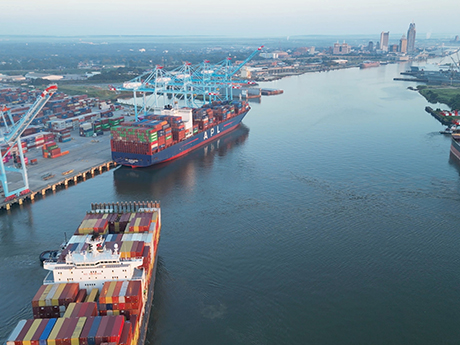
“Since deepening to 50 feet and advancing its modernization plan, we’ve seen a surge of warehouse and manufacturing activity along the I-10 corridor feeding into and out of Mobile,” says Saucier. “New development has followed dredging, not the other way around, demonstrating how private capital responds to scale.”
Saucier says that Mobile’s industrial market is a “true logistics ecosystem” with a balance of importers, exports, distributors and processors. The market also benefits from being in close proximity to the Gulf of Mexico. Two projects that have made headlines in the market include Burton Property Group’s South Alabama Logistics Park, which is the largest master-planned industrial development between Texas and Georgia, and RailPort Logistics Mobile, a 500-acre industrial park by Scannell Properties that CSX has deemed a “Platinum CSX Select Site.”
“Mobile’s trajectory shows what’s possible when port capacity grows,” says Saucier.
“What Mobile has done in the last eight to 10 years with the opening of the new container port facility has been pretty remarkable, and it has led to huge expansions in the region, including a containerized cargo import facility for Walmart,” adds Marcus.
On the Florida side of the Gulf Coast, the Tampa Port Authority and U.S. Army Corps of Engineers are working to deepen Port Tampa Bay’s shipping channels. Other projects include new Post-Panamax cranes, warehouses and container terminals, as well as significant investment in the cruise capacities of the port.
Brad Hutton, director of Franklin Street, says these infrastructural projects meaningfully improve Port Tampa Bay’s chances of wooing larger vessels to call on the port, which would translate directly to industrial demand.
“While Tampa is unlikely to become a primary container gateway overnight, these improvements expand the port’s relevance for project cargo, bulk imports, energy products and niche containerized freight,” says Hutton.
He adds that these port-centric investments will likely drive demand for industrial outdoor storage (IOS), specialized logistics and transloading facilities, build-to-suit projects and general land positions in the region’s East Tampa, Seaport District and I-4 East industrial submarkets.
Last year, Arrow Capital delivered Crossroads Logistics Park, a nearly 60,000-square-foot industrial facility in East Tampa. The developer sold the property in early November to Clarion Partners for an undisclosed price. And recently Franklin Street brokered the sale of 1650 Hemlock Street, a 32-acre IOS facility near Port Tampa Bay that a private equity firm acquired.
Pat Kelly, regional managing director of Franklin Street, says that these smaller one-off projects are the bread and butter for assets near the port.
“Rather than headline-grabbing mega-warehouses, Tampa’s port-related activity is best characterized as steady, durable and infrastructure-anchored, aligning well with long-term industrial fundamentals and Florida’s ongoing population and construction growth,” says Kelly.
On the Atlantic Ocean side of the state, PortMiami is coming off handling 2.3 percent more cargo in fiscal year 2025 than the previous 12 months. The port has had 11 consecutive years of handling more than 1 million TEUs in container volume.
Wayne Ramoski, vice chair of Cushman & Wakefield’s South Florida office, says that the surrounding industrial market also is coming off a stellar year.
“We had a strong 2025, with a slight decrease in year-over-year leasing activity from 2024,” he says. “Our research group shows an overall vacancy rate of 6.2 percent, with the Airport/East Downtown submarket showing one of the lowest rates at 2.8 percent.”
Cushman & Wakefield is marketing Bridge Port Doral, a 2.6 million-square-foot industrial park in Doral that Bridge Industrial is developing. Ramoski says five buildings spanning approximately 1.7 million square feet have been delivered, with companies such as Pepsico signing on.
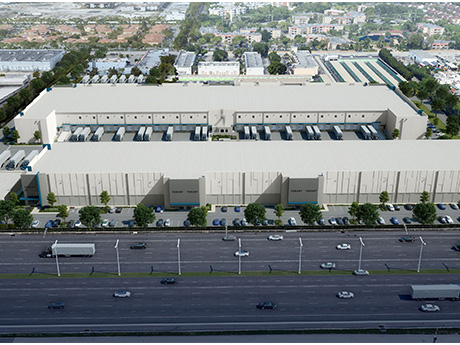
“The balance of the park will be delivered in 2026,” he says. “Bridge Point Doral is the only full-service industrial park in the Airport/Doral submarket delivering up to 2.6 million square feet of space at clear heights from 36 to 40 feet. The development’s main drivers are its proximity to Miami International Airport and PortMiami.”
Further up the East Coast, the Georgia Ports Authority achieved its second busiest year ever in 2025, handling nearly 5.7 million TEUs of cargo at Port of Savannah and Port of Brunswick, an increase of 2.6 percent compared to 2024.
The port authority is in the midst of a self-financed, $4.5 billion port and inland infrastructure plan that will add five new container berths in Savannah, which the Georgia Ports Authority says is the most new berths of any U.S. port, as well as one new roll-on/roll-off (or RoRo) berth in Brunswick.
“The Georgia Ports Authority continues to make a number of investments that will grow the port for years to come,” says Sebastian Findlay, principal of Colliers’ Savannah office. “All the projects they are currently working on will increase TEUs and efficiency from the ocean to the warehouse for Savannah and Brunswick.”
Colliers is marketing a pair of industrial parks in the metro Savannah market, each with features that are indicative of larger trends in the region and beyond. At Central Port Logistics Center at Rockingham in Savannah, Capital Development Partners is developing two 150,000-square-foot flex warehouse buildings (divisible to 15,000 square feet), as well as a rear-load warehouse spanning 168,480 square feet. Colliers recently inked a lease with Lennox Industries at the park.
“Those buildings are the first Class A buildings designed to accommodate smaller industrial users looking for quality space with highway visibility,” says Findlay, who adds that speculative construction is at its lowest point since 2020 for the Savannah market.
Findlay adds available land sites are limited near the port due to billions of dollars in investment by Hyundai and other users in recent years, thus demand will continue to push out geographically. Hence, Clarius Partners is developing Clarius Park Hardeeville in the South Carolina submarket of metro Savannah.
“Hardeeville Building B is now fully leased following the deal with SRS Distribution,” says Findlay. “We now have one building remaining (Building A), which spans 210,000 square feet. Clarius Partners is now looking toward the development of Phase II of the park.”
Also in South Carolina, last year the South Carolina Ports Authority finished the $55 million expansion of Inland Port Greer in the Upstate. Situated near the port and I-85, Augusta Arbor II by Blue Road Investments will comprise multiple smaller facilities totaling 346,680 square feet at full build-out, which is slated for the fall.
“We are still in the grading phases today and will be delivering in the fall,” says Micah Williams, senior associate broker at Lee & Associates | Greenville, which is marketing the development. “We have already had interest from a couple mid-size manufacturing companies, but we also expect to see smaller light-industrial tenants needing between 20,000 to 30,000 square feet come to the park because we are delivering five small, pre-demised suites.”
Williams adds that Blue Road is leaving space for a potential laydown yard with Building C.
Further north, the Port of Virginia announced in early January that it is “nearing completion” of its $1.4 billion Gateway Investment Program, which will culminate in the dredging of 55 feet in addition to the widening initiative that wrapped in February 2024.
“Virginia now has the deepest and widest channels on the East Coast due to the dredging project, which gives the Hampton Roads market a competitive advantage that will directly affect the industrial market,” says Stephanie Sanker, senior vice president and partner at S.L. Nusbaum.
Additionally, the port will soon open its fourth berth for ultra-large container vessels (ULCVs) at Norfolk International Terminal (NIT), with a fifth coming to NIT’s North Berth in 2027 following the terminal’s $650 million overhaul.
Sanker says her clients, which comprise local, regional and national developers and tenants, are closely monitoring the port’s infrastructural improvements as bigger ships and more cargo volume equate to more industrial space needed in the Hampton Roads region.
“The investment in the port facilities will ensure long-term demand for the region from importers and exporters, e-commerce fulfillment centers and regional and national warehouse operators, which will ensure long-term investment from developers,” she says.
Sanker says two deals that S.L. Nusbaum has executed recently include two distributors expanding in Norfolk.
“Land ‘N’ Sea Distributing Inc. leased 115,680 square feet at 3321 E. Princess Anne Road for warehousing and distribution of marine parts, and Locke Supply Co. leased 64,000 square feet at 3670 E. Virginia Beach Blvd. for the distribution of HVAC, electrical and plumbing supplies,” says Sanker. “The most active tenants in the Hampton Roads region are logistics companies, third-party logistics operators and distributors.”
— By John Nelson
This article was originally published in the January 2026 issue of Southeast Real Estate Business.