

— By Austin McElroy of Colliers —
Portland’s retail market is performing better than the headlines suggest. With vacancy sitting at 4.6 percent and triple-net rents averaging $24.45 per square foot — a 10 percent increase over just two years — the market reflects a quiet resilience built on selectivity rather than volume.

The concepts and submarkets gaining traction share a common thread: they actively engage visitors, drawing people in and consistently driving repeat visits. Meanwhile, structural forces are reshaping the playing field. A suspension of the ground-floor retail mandate, a proposed vacancy tax, and a dramatic split in performance between suburban and urban submarkets are defining a leasing environment where quality of space matters more than quantity of options.
Experience Outpaces Transactions
The clearest trend reshaping Portland retail is the primacy of experience over pure transaction. Concepts that draw repeat visits, create community and deliver something beyond a simple purchase are generating foot traffic that traditional transactional retail cannot match.
Nowhere is this more evident than at Bridgeport Village in Tualatin where the opening of a LEGO store drove a 19 percent year-over-year surge in foot traffic — a striking result for a single tenant addition. LaVerne’s Restaurant and Bar in the Woodlawn neighborhood produced a 50 percent foot traffic increase year over year, underscoring the power of food and beverage concepts to anchor neighborhood commercial districts. The Portland Art Museum renovation created a 15 percent uplift in activity across the Park Blocks area from pre-renovation levels, illustrating how cultural anchors can lift a corridor.
Walkable, locally curated streets in close-in neighborhoods are drawing the strongest foot traffic growth. The 13th Avenue Historic District in the Pearl District posted 13.3 percent year-over-year growth; Mississippi Avenue was up 9.4 percent; and Northeast 28th Avenue grew 7.2 percent year over year. These corridors attract younger, trend-conscious consumers who prioritize neighborhood character and independent retail over the predictability of suburban power centers.
The fitness and recreation category is emerging as one of the most active in the market, proving that health and wellness concepts can seamlessly absorb significant square footage where traditional retail has struggled. Planet Fitness franchisee Easy Mile Fitness plans to open four new clubs in the Portland area through the end of 2026, targeting long-vacant spaces in Central Portland and the Hollywood and Milwaukie neighborhoods, while Jumbo’s Pickleball has similarly found success by reactivating legacy spaces in Beaverton and Lloyd Center.
This regional momentum extends across the metro area as well. Dick’s Sporting Goods is bringing its experiential House of Sport concept to the previously vacant Sears at Washington Square Mall in Beaverton, and Crunch Fitness has expanded at Vancouver Plaza in Vancouver, Wash., debuting a modern design with enhanced offerings and overall functionality. Fitness retailers are finding success by filling a gap in Portland’s active entertainment landscape, reactivating a legacy space, and demonstrating that fitness and recreation concepts can absorb significant square footage where traditional retail has struggled.
Local Enterprise Advances as Secondary Formats Retreat
The retail landscape is thinning in the middle. Secondary formats — mid-tier chains without a clear differentiated identity — are consolidating or exiting, while flagship national brands and agile local operators are expanding. The contrast is playing out visibly in central Portland. Nordstrom Rack closed its downtown location after more than 20 years in operation, while the flagship Nordstrom at Pioneer Square remains open, reinforcing the principle that brand-defining locations survive while redundant outposts do not.
On the local side, Shirtzenpantz, a resale brand owned by 24-year-old twin brothers Owen and Ethan Gail, is opening its third Portland location and second in the span of a single year. The brand’s expansion into downtown Portland, after establishing earlier locations in close-in suburbs, reflects sustained consumer appetite for locally operated resale and thrift retail, as well as the willingness of a new generation of operators to invest in Portland’s central corridors.
Significant Developments Reshaping the Market
In the suburbs, the Streets of Tanasbourne in Hillsboro represents one of the most consequential repositioning projects in the market. Controlled by Balboa Retail Partners, the center sold the former Macy’s parcel to Alliance Residential, which plans to redevelop the site into a 308-unit apartment complex with ground-floor retail. The remaining center will undergo renovations and reprogramming, positioning the center as a pedestrian destination and multi-use community hub. The project is a clear acknowledgment that single-anchor suburban retail centers require fundamental reinvention to remain viable and follows a model set at Bridgeport Village in Tualatin, which successfully pivoted to a lifestyle center.
On the regulatory front, Portland’s longstanding requirement for ground-floor retail in new mixed-use developments — widely cited as a driver of retail oversupply — has been suspended through the end of 2028. The pause is expected to improve occupancy in existing spaces and have a positive impact on rents, which have stagnated in some pockets of the market in recent quarters. Separately, the Portland City Council has proposed a vacancy tax that would levy charges on landlords who fail to fill empty retail spaces. The measure is contested: recent studies by ECOnorthwest and Portland State University’s Center for Real Estate found the tax would cause little impact on vacancy but significant harm to landlords, and its passage in current form is considered unlikely.
Where the Activity Is: Suburban Strength, Urban Headwinds
The most active retail submarket in greater Portland is Clark County, Washington. Lower taxes, newer building stock and significant ongoing job growth have made Vancouver and its surrounding communities a magnet for retail investment and leasing activity. Oregon submarkets are led by the Westside suburbs, encompassing Hillsboro and Beaverton, with Southeast Portland showing a recent uptick as well.
The common thread among winning suburban submarkets is accessibility, parking and overall value. Essentially, deliverables that suburban landlords can offer without the public safety concerns that weigh on Downtown Portland.
The Central Business District remains the weakest submarket in the greater metro. Investment interest has followed leasing patterns, with buyers concentrating on suburban and suburban-adjacent product. In central Portland, the trend toward ground-floor retail condo sales over large portfolio transactions reinforces the dominance of smaller, local tenants in urban districts.
Investment Activity and New Market Entrants
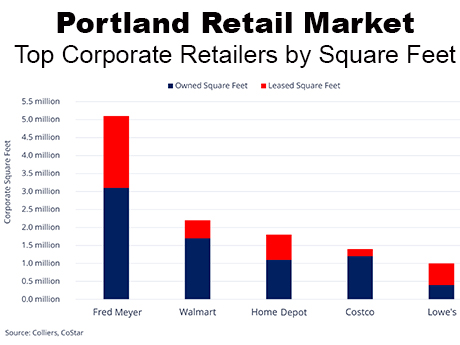
The largest corporate occupiers of retail space in the Portland area continue to anchor the market’s physical footprint. Fred Meyer leads with 5.1 million square feet occupied and 3.1 million square feet owned across the metro. Walmart occupies 2.2 million square feet with 1.7 million owned; Home Depot occupies 1.8 million square feet with 1.1 million owned; Costco occupies 1.4 million square feet with 1.2 million owned; and Lowe’s occupies 1 million square feet with about 400,000 square feet owned.
The most significant recent institutional transaction was the $25 million acquisition of Washington Square II by ScanlanKemperBard (SKB) in partnership with Boston-based Intercontinental Real Estate Corporation. The 87,000-square-foot retail center in Tigard sits adjacent to Washington Square Mall — one of Oregon’s premier retail destinations with more than 10 million annual visitors. The deal marked Intercontinental’s first retail acquisition in the Portland market, reflecting the broader pattern of outside institutional capital entering the metro through suburban gateway assets.
A Landlord’s Market, Despite the Numbers
At first glance, a 4.6 percent vacancy rate and $24.45 per square foot, triple-net asking rent might suggest conditions favor tenants. In practice, the market leans toward landlords, particularly for quality space. The vacancy figure obscures a critical reality: the volume of spaces that actually meet the needs of Portland’s specialized tenant base is limited. While a large volume of ground-floor retail spaces remain vacant, high-quality storefronts in high-traffic east-side neighborhoods garner significant interest and lease extremely quickly, leaving landlords in those locations with genuine negotiating leverage.
Colliers Portland retail transaction data since Jan. 1, 2026 reflects market terms shaped by this dynamic: average lease terms of 76 months, tenant improvement allowances averaging $17.67 per square foot and average rent abatement of two months. The suspension of the ground-floor retail mandate and the low likelihood of a vacancy tax passing are expected to gradually strengthen conditions for landlords over the medium term. In well-located, well-trafficked neighborhoods, the supply of suitable space is already thin enough that landlords hold most of the cards.
— By Austin McElroy, research analyst at Colliers. This article was originally published in the July 2026 issue of Western Real Estate Business.