

Retail investment gained meaningful momentum during the first half of 2026, reflecting growing confidence in market fundamentals and long-term consumer demand. While the national vacancy rate sits at 6 percent, Louisville’s current vacancy rate for retail is at 3.9 percent, according to the “Q2 2026 Cushman & Wakefield National Retail Report.”

The Louisville market continues to demonstrate many of the characteristics that retail investors value: established trade areas, strong grocery-anchored corridors, limited new construction and a growing number of national retailers making long-term commitments to the market.
Retail real estate remains particularly strong in the eastern and northeastern portions of Louisville, with grocery-anchored space continuing to perform well. Cushman & Wakefield research also points to continued investment and new development taking shape across the market.
Louisville has seen roughly $165 million in shopping center transactions close over a recent 12-month stretch, driven heavily by private capital and 1031 exchange buyers. The properties that consistently attract attention are those with strong visibility, established traffic patterns, durable tenancy and demographics that support long-term consumer spending.
Publix reshapes map
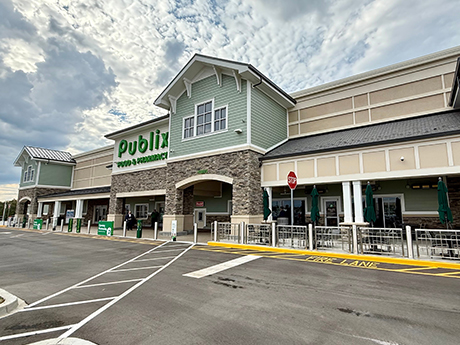
Perhaps the clearest example of where Louisville retail is heading is Publix. From an investment perspective, we believe the significance of Publix goes well beyond the grocery store itself. A high-quality grocery anchor creates traffic, which in turn creates opportunities for restaurants, coffee shops, services and experience-driven retailers.
That dynamic can already be seen around the first Publix to open in the Louisville market. Dutch Bros. Coffee, also a new player in this area, will be opening a location directly across from the Terra Crossings Publix. This is creating a retail component around an established grocery-driven trade area. Dutch Bros. has three other stores in this market, including a recent addition in Springhurst.
The first Louisville Publix property itself also demonstrated the investment demand surrounding the brand. Per Louisville Business First, the Terra Crossing store sold for approximately $20.4 million in early 2025.
Publix is also helping create retail nodes, and as these nodes mature, investors will increasingly look at the surrounding real estate as part of the same consumer ecosystem. There are several more Publix stores underway or already operating including the Brownsboro Road, Middletown, Highlands and Prospect locations.
Mid City Mall
The redevelopment of the former Mid City Mall represents another major theme shaping Louisville retail: the repositioning of existing retail real estate. The former mall is being transformed into Mid City Market, with Publix serving as the anchor and a broader open-air retail environment replacing the traditional shopping center model.
The project is taking an existing property with an established location, traffic pattern and consumer base and attempting to make the real estate substantially more productive. Building opportunities to grow within established retail corridors is a trend that will become more common in many retail markets.
Louisville has a significant amount of older retail inventory. Some of those properties will continue to operate successfully, while others will require significant reinvestment, tenant repositioning or redevelopment. Mid City Market is an important test case for that strategy.
New retailers coming
Another encouraging trend is the continued arrival of new national concepts.
Paris Baguette opened its first Kentucky location on Brownsboro Road in May 2026. The restaurant represents the type of national growth concept that is increasingly seeking established, higher-income neighborhood trade areas rather than relying exclusively on traditional shopping malls or large power centers.
We are also seeing continued expansion from retailers such as Bank of America, Chipotle, Popeye’s, Wawa, Chase Bank and Chick-fil-A. Wawa entered the market in 2024 with plans for seven stores. The most recent one opening at the end of August 2026.
Shake Shack is another national QSR concept reportedly entering the Louisville market with plans to open in Oxmoor Center later this year.
Development milestones
In the first half of 2026, two important pipeline projects received significant news. The Louisville Sports Entertainment District is a 500,000-square-foot mixed-use development in adjacent to Louisville Slugger Field. The downtown Louisville development includes a hotel, apartments, office space, ground-floor retail and a parking garage. Louisville Metro proposed a bond package of up to $275 million for the project, with up to $30 million in tax increment financing. Construction is to begin in 2027, pending financing approval.
The second development is called One Park. Located in the Saint Matthews area, the project is another mixed-use development including office, retail, restaurants, a hotel and apartments. The Kentucky Economic Development Finance Authority granted final approval on a $62 million state tax increment financing incentive. A construction timeline has not been released for this project.
What’s next?
We expect Louisville retail investors to remain active but selective with continued investment around grocery anchors, established neighborhood centers, redevelopment opportunities and high-quality, second-generation retail locations. Retail has always been a location business, and Louisville’s current market is reinforcing that fundamental truth.
— By Austin English, senior director, Cushman & Wakefield | Commercial Kentucky. This article was originally published in the September 2026 issue of Southeast Real Estate Business.