

By Ann Atkinson, Regions Real Estate Capital Markets
Most multifamily real estate owners need to finance or refinance their apartment community at some point. Many utilize the small balance multifamily loan programs available through Fannie Mae and Freddie Mac to do so. Understanding how lenders navigate each phase of the loan cycle can give owners a strategic advantage, especially in a time of elevated rate volatility.
A significant amount of multifamily debt is maturing in 2026. Borrowers should not wait to refinance to avoid the concentrated competition later in the year when lenders are faced with refinancing demand. In addition, modest rent growth today offers refinancing upside; and finally, Fannie Mae and Freddie Mac have higher production caps in 2026, providing more runway for lending.
The following overview, based on Regions Real Estate Capital Markets’ experience, outlines five key phases of the process, with helpful tips throughout:
- Screening and term sheet
- Underwriting and credit
- Legal and closing
- Insurance and inspections
- Servicing
1. Screening and Term Sheet
Loan screening kicks off the relationship between borrower and lender. The lender’s production representative often conducts an introductory call with the borrower, who completes an application and provides due diligence items.
Access a checklist of items to provide to Regions for screening here.
Tip #1: Get all required (and optional, if desired) documentation completed and submitted to the lender as a package to make the process smoother, expedite the approval and/or secure more favorable loan terms.
Underwriting and Loan Sizing
After all materials are received, the lender verifies the information provided, performs a quick underwriting and sizes the loan.
Tip #2: Many variables can impact loan sizing; thus, the integrity of documentation submitted with the loan application is key.
Waivers, Exceptions and Soft Quote
The lender identifies upfront if any exceptions need to be addressed/approved by the government-sponsored enterprises (GSEs) before the loan may proceed. Next, a non-binding soft quote is provided, facilitating conversation between lender and borrower to identify the loan product that best fits the borrower’s needs.
Term Sheet
If the borrower decides to proceed, a term sheet is prepared. The non-binding agreement outlines basic loan terms and conditions, including fees, deposit and third-party reports required. Once executed, and a deposit is received, the underwriting process commences.
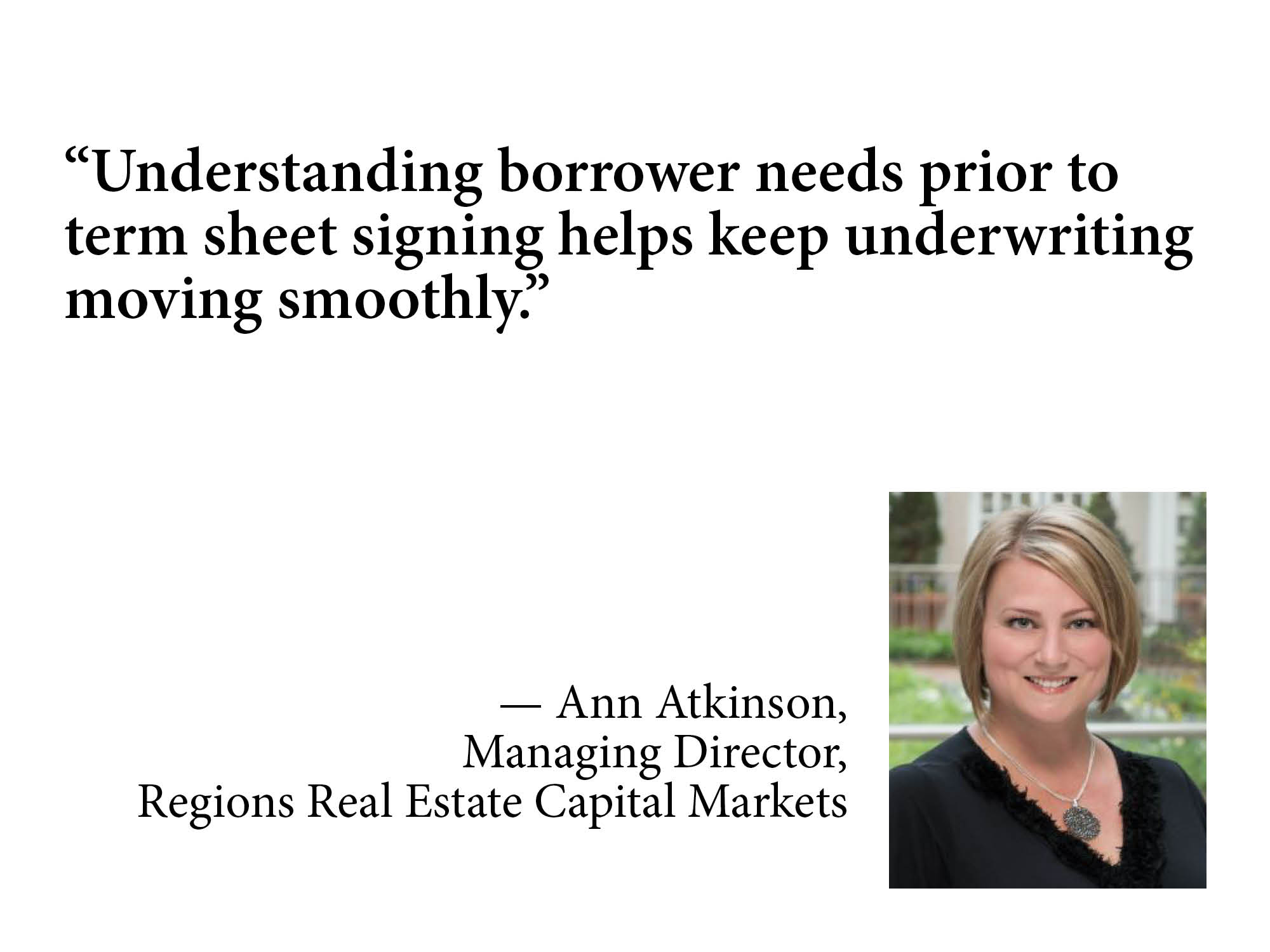
Tip #3: Understanding borrower needs prior to term sheet signing helps keep underwriting moving smoothly.
2. Underwriting and Credit
During the underwriting and credit stage, the lender confirms a borrower is creditworthy, the property has stable operations and is in good condition and the loan meets agency requirements. The lender should complete full property underwriting and a mortgage credit analysis of the owner/sponsor and all parties relevant to the loan. The lender’s team should also engage third-party vendors to prepare an appraisal, property condition assessment, etc.
Three Areas of Due Diligence
Regions focuses on three areas of due diligence during this stage:
Property
- Property cash flow – The history and stability of the property’s net cash flow is evaluated. Real estate tax assessments and insurance premiums are reviewed. Regions identifies any capital expenditures included in the repairs and maintenance line item, as those are handled differently for underwriting.
- Property condition – It is important for the property to be in good condition with little or no deferred maintenance.
Market
Regional dynamics are important. Thus, Regions reviews comparable rent level and vacancy within the submarket, along with employment numbers and drivers, population migrations and more.
Tip #4: Establish and provide your entity organization structure early in the underwriting process to avoid unnecessary delays.
Borrower Experience and Financials
The borrower proving sufficient liquidity and net worth is important, in addition to having experience owning and operating similar properties.
Certain Conditions Impact Underwriting
Forces and conditions outside a borrower’s control may impact underwriting and include:
- Interest rate environment
- Inflation
- Property market trends
- Regional and national economic conditions
Commitment Letter
Once the loan is underwritten and approved, a commitment letter is provided to the borrower for signature. This binding document lists any final conditions for the rate lock and the close.
Rate Lock
A rate lock guarantees the loan’s interest rate for a set period before the loan transaction closes. Freddie Mac and Fannie Mae have a slightly different rate lock process:
- Freddie Mac – The interest rate is held for 35 business days from term sheet execution. The lender has 35 business days for information gathering, due diligence, underwriting and final loan package submission to Freddie Mac. Freddie then has approximately 14 business days to re-underwrite and decide on the loan’s approval, while the rate remains locked.
- Fannie Mae – The full interest rate (spread and treasury) is locked after the loan is approved and all rate lock conditions are satisfied. In certain cases, an early rate lock or a two-part rate lock may be secured. Additionally, a good-faith deposit will be required of the borrower. Once the loan officially closes, the deposit is returned in full to the borrower.
3. Legal and Closing
The lender’s legal team begins to engage in the loan process during the underwriting phase, working in tandem with the underwriting team. Once underwriting and credit are complete, all official final agreements for the loan are reviewed and signed by both the lender and the borrower during closing.
Tip #5: Borrowers are encouraged to engage their own legal counsel to provide sound legal guidance and protect the borrower’s interests. Working with a representative with GSE loan experience is advantageous.
Legal to Review
The lender’s legal team reviews various documents, including:
- Borrowing entity’s organizational structure and supporting entity documentation
- Title
- Property management agreements
- Loan documentation and forms required for closing
- Public record and lien searches
- Commitments and commitment amendments
- Borrower rate lock emails and confirmations
- Settlement statements
Tip #6: Submit all documents requested by legal in a timely manner.
Closing Specific Documentation and Requirements
The borrower will be asked to submit documentation not provided earlier during the origination, sizing, underwriting and credit stages. This may include:
- Executed loan documents and related approvals
- Executed beneficial ownership information (BOI), also known as a BenO Form
- Executed settlement statement, which is drafted by the escrow company
Tip #7: Stay organized, check your email often and respond to lender correspondence in a timely manner.
A Smooth Process and Timing to Reach the Finish Line
A borrower should expect timing to vary for this portion of the process. If the borrower is organized and responds quickly to requests, it may be possible to get a commitment and close the loan within several business days. Timing considerations to include:
- The settlement statement may undergo revisions at any point.
- Signing as many required documents as possible ahead of time is helpful.
4. Insurance and Inspections
Both site inspections and insurance are requirements for the loan closing.
Guidance for Site Inspections
Various parties will attend a mandatory in-person property inspection. Attendees typically include:
- Inspector for Freddie Mac or Fannie Mae (as applicable)
- Inspector for the lender
- Appraiser
- Engineer
- Property owner, management or maintenance staff
- Seller representative (if the transaction is an acquisition)
A single inspection is typically suggested so attendees can discuss pertinent details and minimize tenant disruptions. The borrower, via collaboration with the seller (if the transaction is an acquisition), is responsible for providing tenants with prior notice. The inspection usually includes a sample of occupied and vacant units, as well as common areas and amenities. Access to flat roofs may also be requested.
Tip #8: Tenant notification requirements for property inspections vary by state and should be followed.
Tip #9: Attendees will inquire about the purchase date, renovations/repairs completed and investment in the property.
Guidance on Insurance Requirements
Requirements
Fannie Mae and Freddie Mac have insurance requirements that must be satisfied. These requirements might vary from other lender requirements and may call for additional types of coverage and coverage areas.
Exclusionary Items
Insurance companies may not offer all required coverage; thus, borrowers sometimes need to obtain quotes from additional providers.
Tip #10: Borrowers are encouraged to start working on insurance requirements ASAP as the process can be lengthy.
Forms Required
The borrower submits insurance authorization forms to the lender. Other insurance documentation, or coverage revisions, will be addressed with the borrower’s insurance agent.
5. Servicing
Post-closing, proactive servicing helps preserve loan performance and property value. Borrowers benefit when lenders maintain active communication and digital tools to track compliance, taxes, inspections and reporting.
The loan enters servicing right after funding and the servicing team becomes the borrower’s single point of contact.
The Welcome Call
When the loan enters servicing, the borrower should have a welcome call with the lender. The discussion will cover the property, the borrower’s account(s) with respect to the loan and what to expect over the next several years.
With agency multifamily small balance loans, borrowers make covenants in their loan documents that must be adhered to. Some will be shared with the borrower on the call. Covenants are agreements between agency and borrower for specific actions to be taken, or not taken, by the borrower to maintain financial stability and health. Additionally, if property repairs are required at the time of the loan closing, those will be discussed with the borrower as well. Additional topics to be discussed during the call include:
- Certain expectations of the borrower during the life of the loan
- Certain reporting obligations of the borrower, including financials and rent rolls and additional reporting the borrower is required to provide
- What to expect at the property’s first annual inspection, as well as certain requirements to be satisfied with respect to subsequent inspections
- Borrower contacts for insurance, taxes and repairs
Tip #11: Borrowers are encouraged to ask questions and review and inquire about all loan covenants set forth in the borrower’s loan documents.
About the Servicing Process
During servicing, the lender’s servicing team will monitor performance of the property and the property’s financials, compliance with the loan documents, as well as complete the following:
- Monitoring payment of taxes and insurance
- Responding to borrower requests
- Monitoring financials through quarterly and/or annual financials
- Monitoring property condition via the property’s annual inspection
- Ensuring required repairs to property are completed on time to lender’s satisfaction
- Distributing statements to borrowers
- Posting borrower payments
Tip #12: Borrowers are advised to complete property repairs by the lender-required timeline.
Lender Consent
Agency loan terms stipulate that lender consent is required for some actions the borrower may wish to take. Some of these actions include:
- Property alterations, such as changes to rental unit configurations and number of units
- Property management changes
- Apartment community rebranding and/or name change
- Borrower organizational changes
Tip #13: Always get lender approval before moving forward with any such actions.
Regions Real Estate Capital Markets is a content partner of REBusinessOnline. For more articles from and news about Regions Real Estate Capital Markets, click here.
______________________________
About the Author
Ann Atkinson is managing director, Real Estate Capital Markets for Regions Bank. As a licensed nationwide lender partner to both Freddie Mac and Fannie Mae, Regions Real Estate Capital Markets specializes in a wide range of multifamily loan options, serving borrower needs, including loans for affordable, workforce and market-rate properties. Visit https://www.regions.com/commercial-banking/real-estate-banking/real-estate-capital-markets.
This information is general education or marketing in nature and is not intended to be accounting, legal, tax, investment or financial advice. The information in this content (website, article, event invitation or other form) does not represent an offer or commitment to provide any product or service. These views are as of a certain date and often based on current market conditions and are subject to change without notice. All loans and Lines of Credit are subject to underwriting, documentation, agency and collateral requirements and approval.