

By Ann Atkinson, Regions Real Estate Capital Markets
Midway through 2026, the multifamily industry appears to be holding steady. By many accounts, fundamentals are weathering uncertainties across the economy, job markets and geopolitical arenas. While some key metrics have softened, the overall health of the apartments sector demonstrates how essential this class of real estate is. Simply stated, everyone needs a safe place to call home.
Sustained demand for rental units remains central to the sector’s health, and conditions in the for-sale market continue to shape that demand directly. For many households, homeownership has become increasingly out of reach. Affordability has eroded sharply over the past decade, driven by land use restrictions, constrained housing supply and a widening gap between mortgage costs and income, according to an October Goldman Sachs’ U.S. outlook for housing supply and affordability. Elevated interest rates in recent years have only added to the strain. Together, these factors are keeping many Americans in rentals far longer than they might have planned.
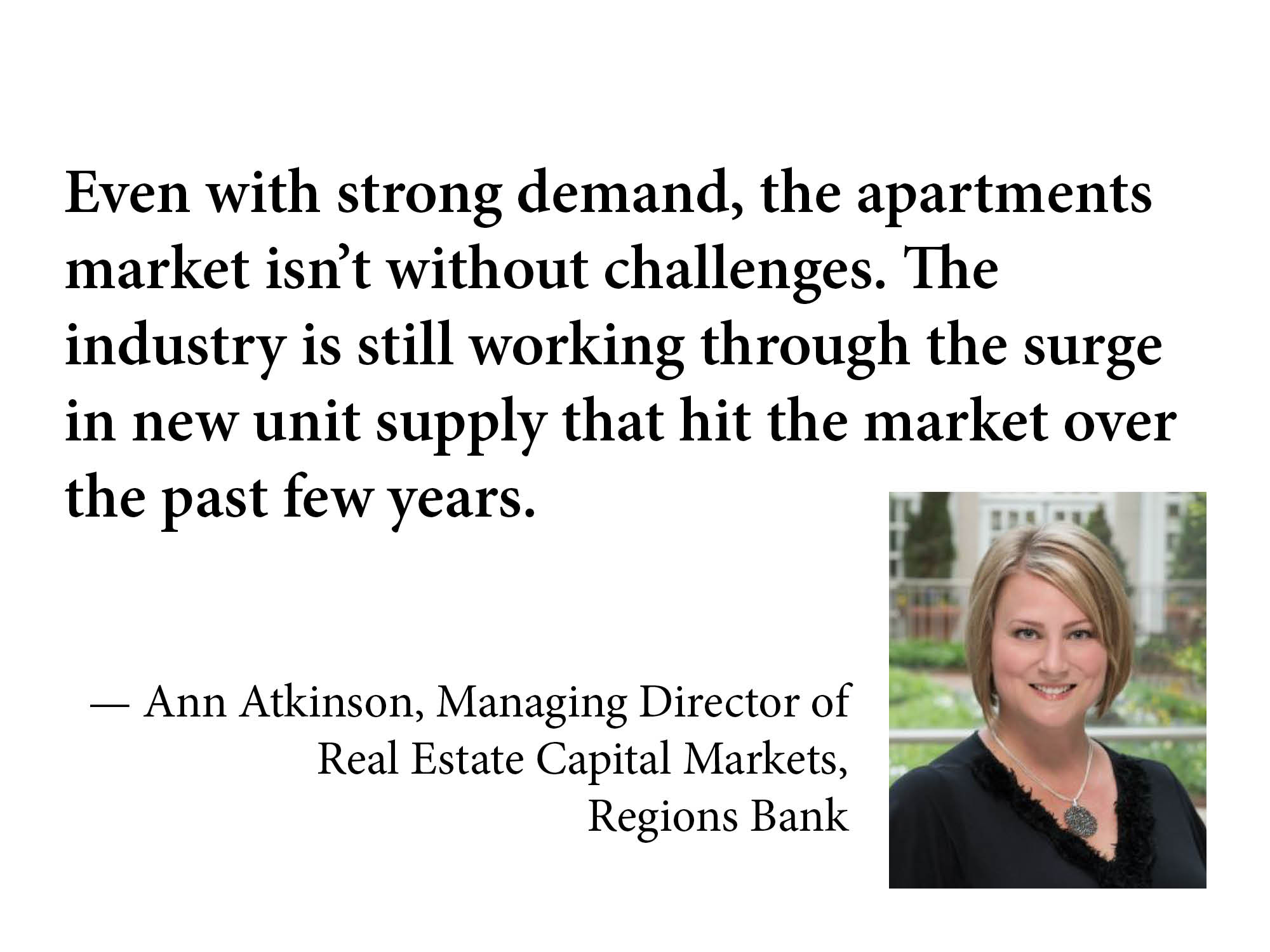
Even with strong demand, the apartments market isn’t without challenges. The industry is still working through the surge in new unit supply that hit the market over the past few years. As a result, rents have decreased in some places. Simultaneously, there’s a dearth in new supply in the affordable arena and too large a share of Americans with lower incomes lack access to rentals they can afford. A recent report by the National Low Income Housing Coalition indicates all 50 states are impacted.
Interest rates are another ongoing challenge. In a move unsurprising to many, the Federal Reserve at its June 17 meeting voted to hold the federal funds rate steady at a target range of 3.50 to 3.75 percent. However, a growing number of the Board members also projected at least one rate hike would be warranted by year’s end.
According to the Mortgage Bankers Association (MBA) 2025 Commercial/Multifamily Loan Maturity Volumes survey, 13 percent of mortgages backed by multifamily properties will mature in 2026 — a wave that has led to a surge in transaction activity, whether successful refinances or forced sales.
In May, the MBA reported a first-quarter 49 percent year-over-year increase in multifamily lending activity. This increase falls in line with the association’s forecast earlier in the year that multifamily origination volume would increase to $399.2 billion this year from the approximately $330.6 billion total in 2025 (as well as ripple effects from the maturities wall). Both Fannie Mae and Freddie Mac, which continue to provide liquidity in the multifamily market in a meaningful way, had their annual loan purchase caps increased 20 percent for 2026 to $88 billion each by the Federal Housing Finance Agency. This may help support the MBA’s forecast for annual sector lending volume growth, as well. However, only actual 2025 volume numbers gathered at year-end will determine if the MBA’s increase prediction comes to fruition.
As is true of all real estate, the multifamily business is localized. Thus, there are market trends and performance metrics that vary region to region. Here’s a look at what’s occurring in some of the most dynamic regions: the Northeast, Southeast and Northern California markets.
Northeast Overview
The multifamily market in the Northeast is stable, but not without its challenges. The region weathered the COVID-19 pandemic relatively well, and occupancies have held steady with little fluctuation in the years since. Transaction volume, however, has been subdued. Elevated interest rates have raised the bar for buyers, who are increasingly required to bring more equity to the table. Compounding this, some sellers are pricing assets based on pro forma projections rather than current performance, which can make financing difficult to secure.
Northeast owners needing to refinance their communities in the near term will need to bring more money to the table than when they first financed; and this will be a challenge for some. Many of the region’s markets in New York, New Jersey, Massachusetts and Pennsylvania feature a significant number of smaller, older apartment buildings historically owned by “mom-and-pop” and mid-sized operators rather than large institutional investors. Those who have not put a lot of credit onto their properties are better positioned to handle the approximate 65 percent loan-to-value and 1.35 debt service coverage ratio offered today by lenders to this lower-risk tier of borrower.
Property taxes on multifamily properties have also increased, as have building material and maintenance costs. In markets such as New York City, rent stabilization laws have further complicated business for owners. While rent-stabilized units certainly benefit renter households by providing more affordable living options, the profit achievable by owners today in these cities is unsurprisingly reduced.
Southeast Overview
The Southeast offers an overall quality of life that has drawn newcomers, particularly from the Northeast and Midwest, over the past several years. Manufacturing and/or other types of employment industries have picked up in key markets — including South Miami, Tampa, West Palm Beach and Charlotte — and provided opportunities for newer residents.
As a result of these dynamics, housing demand has grown and apartment developers have delivered a surge in new unit supply. Much of it is market-rate and luxury options. Unfortunately, new units serving households with lower incomes have been sparse, and demand among this demographic far outweighs available supply today. As a result, many are moving out of major metros into secondary markets in search of more affordable housing.
All said, rent growth and occupancy numbers in the Southeast are generally trending positive. Rents are ticking upward, though at a slower pace than in recent years because of the absorption still occurring with the new unit delivery surge. Occupancy levels remain under modest pressure as the market continues to absorb recently delivered units. Taxes and insurance continue to cause headaches for owners. Specifically, insurance is increasingly expensive, especially in this region, which has experienced its fair share of costly storms and hurricanes. Recently revisited insurance guidelines from agencies Fannie Mae and Freddie Mac have also required more education and legwork to secure insurance on the borrower side.
As is true in other U.S. regions, many southeastern owners are facing maturity on their current property loans and are seeking to refinance. Loan options are available, and government-sponsored enterprises Fannie Mae and Freddie Mac continue to serve the marketplace. Freddie Mac has notably made recent changes to its small balance loans used to finance smaller properties, rolling its offering into its Conventional Loan program.
Northern California Overview
Turbulence brought on by the pandemic created a series of challenges for the region’s multifamily owners and lenders. Falling collections, growing vacancies, demographic shifts, cost of capital increases and widening cap rates created headwinds, dropping transaction volume. Now, several years later, market fundamentals are normalizing and transaction volume appears to be on the rise. Overall, the Northern California multifamily market demonstrates resilience.
Notably, California’s Greater Bay Area markets are unique and varied. San Francisco, for example, is displaying clear signs of recovery. Previously, the pandemic, exodus of tech companies and legislative hurdles created challenges for owners already impacted by rent control. Today, market rents are rebounding, and vacancy sits at about 8 percent. Market participants expect vacancy rates could decline toward 5 percent later this year.
In Oakland, a disproportionate amount of new supply was delivered just before the pandemic hit. With much of it Class A, many renters vacated older units en masse to take advantage of depressed rents on new supply. Now renters are moving back into older, vintage properties, rents are leveling off and vacancies reportedly now sit at 5 to 8 percent overall.
In the Diablo Valley, which includes Concord and Walnut Creek, the apartment market is tight, rents are high and units are in demand. New construction remains sparse, and what does break ground tends to be amenity-rich luxury communities that lease up quickly.
Finally, South San Francisco Bay, home to much of the region’s tech workforce, has proven more stable than neighboring markets. Occupancies and rents held firm through the pandemic and have remained strong since, to the benefit of local owners.
Midway through 2026, multifamily is holding steady. Demand remains strong as homeownership stays out of reach for many Americans, though the sector is navigating lingering supply imbalances, persistent affordability gaps and a complex financing environment. Regionally, the Northeast, Southeast and Northern California markets each tell a slightly different story, but the throughline is consistent: the need for rental housing is not going away.
— Ann Atkinson is managing director of Real Estate Capital Markets for Regions Bank, a nationwide multifamily and seniors housing real estate lender. For more information, visit Regions Real Estate Capital Markets here.
Regions Real Estate Capital Markets is a content partner of REBusinessOnline. For more articles from and news about Regions Real Estate Capital Markets, click here.
This information is general education or marketing in nature and is not intended to be accounting, legal, tax, investment or financial advice. The information in this content (website, article, event invitation or other form) does not represent an offer or commitment to provide any product or service. The views, opinions, analyses, estimates and strategies, as the case may be (“views”), expressed in this content are those of the respective authors and speakers named in those pieces and may differ from those of Regions Bank and/or other Regions Bank employees and affiliates. These views are as of a certain date and often based on current market conditions and are subject to change without notice. Any examples used are generic, hypothetical and for illustration purposes only. Any prices/quotes/statistics included have been obtained from sources deemed to be reliable, but we do not guarantee their accuracy or completeness. Future market conditions, interest rates and economic performance are uncertain and actual results may differ materially from current expectations. This information in no way constitutes research and should not be treated as such.