

By Rebecca Gandour, executive vice president, Buffalo Urban Development Corp.
America’s economic engine was once largely fueled by its industrial might, with manufacturing powerhouses found throughout the Midwest and Northeast and producing billions of dollars worth of goods.
But when factories closed and production moved overseas, many communities were left staring at empty buildings, foreclosed homes and decaying public infrastructure. By losing massive employment anchors, neighborhoods were unable to attract private investments, with developers hesitant to invest in communities that did not provide a clear route to profit. As hesitancy began, the situation grew worse, eroding confidence even further.

Unable to fully rely on traditional real estate developers, Buffalo has found opportunities to embrace a nonprofit-led redevelopment for restoring long-overlooked industrial assets and creating conditions where future private investment becomes possible. The Northland Corridor on Buffalo’s East Side in particular demonstrates what can happen when mission-driven organizations are given the flexibility to think long term, assemble funding and prioritize community outcomes to provide financial stability and opportunity.
Private developers serve an essential role in urban revitalization, but they also operate under a model that prioritizes profitability and providing returns for investors. In distressed markets, where redevelopment may provide limited promise in terms of ROI (return on investment), nonprofit organizations can come in and focus more so on redevelopment with a focus on building up the community.
How Nonprofit Development Works
The key difference between nonprofit and for-profit development is that the nonprofit side prioritizes community building and generating meaningful outcomes, rather than solely seeking ROI. Nonprofit developers don’t have to focus on projects with the highest yields but instead prioritize that which will strengthen communities.
Nonprofit developers also have access to a number of grants and public funding sources. This access helps drive projects forward in a way that may not be possible to their for-profit counterparts. Nonprofit developers can also hold assets over longer periods of time, phase projects strategically and absorb complex problems that may eat up more time than traditional developers are willing to grapple with.
For instance, former industrial sites often bump into environment cleanup issues left from legacy organizations. For-profit developers often want to avoid the uncertainty of what could be found during a cleanup or being on the hook for escalating costs and liability. Meanwhile, the public sector is also worried about the chain of liability, knowing they may be on the hook in perpetuity.
Nonprofit developers, on the other hand, can work around these hurdles and tackle projects head on. Overall, it puts them in a position to convert sites from sometimes unusable parcels into attractive, shovel-ready opportunities for development.
At the same time, nonprofits must operate with strict discipline. They need strong governance, transparent policies and operations and credibility with their capital partners in order to build trust and thrive.
Nonprofit developers need to demonstrate their ability to execute, remain compliant and steward public and philanthropic dollars in order to maintain access to funding. This means the organizations are naturally encouraged to stay on estimated timelines and provide realistic phasing of projects to build institutional trust. However, focusing on reliability for lenders and investors also produces consistent results for the communities they seek to serve.
That reliability and focus on results also translates into community trust as well, which leads to beneficial relationships and partnerships with municipal leaders and organizers, which in turn paves the way for even more progress to be done in future projects. Each success story begets more progress as relationships build between key funding and community partners.
The nonprofit model does not replace private investments by any stretch. But in the instance of Buffalo’s industrial corridor, this approach can serve as a lifeline, injecting investments in a productive way that provides tangible benefits to a community. This creates more certainty and stability, opening the door of opportunity for more private investments to create opportunities for holistic community advancement.
Buffalo In Action
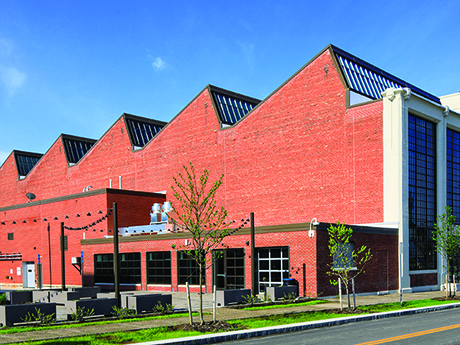
Working alongside the City of Buffalo, regional partners and New York State, the Buffalo Urban Development Corp. (BUDC) is a nonprofit developer that has led efforts to revamp the Northland Corridor, a historic industrial area on Buffalo’s East Side that is positioned along the former Belt Line rail corridor. The strategy has focused not simply on renovating buildings, but on rebuilding an economic driver that had long left the community.
From the beginning, Northland was approached as a phased redevelopment effort rather than a single transformative project. For starters, early planning recognized that assembling site control and preparing industrial properties for reuse would be prerequisites for long-term success. The corridor’s concentration of underutilized industrial buildings and strategic transportation access created an opportunity to think at district scale rather than parcel by parcel.
Phase I started with the establishment of an anchor tenant, redeveloping space to create room for the Northland Workforce Training Center. This facility was designed to create the workforce needed to staff the very manufacturing companies that BUDC was aiming to attract to the area through its redevelopment efforts.
The organization was able to coordinate funding from public programs such as Buffalo Billion, a New York state initiative aimed to channel a billion dollars into the local economy, as well as the Build Back Better Regional Challenge. The latter program is part of the American Rescue Plan Act, which fed federal funds into critical infrastructure projects around the country.
Phase II then focused on channeling those funds into redeveloping infrastructure at the site. For example, upon realizing that sites needed to be accessible and ready for tenants to move in and leverage them immediately, BUDC improved the road running through the campus and also completed critical environmental cleanup work to make the campus ready for new tenants as soon as possible. These are time-consuming and costly processes that would often scare away public initiatives or for-profit developers.
Current Phase III and IV work includes redevelopment at a number of different buildings on the campus, alongside continued improvements to utility and access upgrades. This holistic, phase-centric approach has led to a steady redevelopment of the campus and turned what was once an abandoned area into a genuine economic opportunity for industrial players once again.
What Other Cities Can Learn
The work being done in Buffalo offers a blueprint for other cities facing similar challenges in former industrial areas.
The most important consideration for nonprofit developers undertaking similar projects is to be realistic and take phased approaches. Building institutional trust is crucial for making the partnerships needed to fund and develop projects adequately, and that only comes from setting attainable goals at the outset.
Public and private funding sources want to know that they are working with developers who are able to see their projects through, and that sort of trust is only built through carefully establishing a track record of success and accuracy. That level of trust also comes with facilitating a habit of transparency and clarity.
The work being done in Buffalo is still underway. But the Northland Corridor is a real-world demonstration that, in places where traditional market forces may hesitate, nonprofit development can provide an initial foray into turning a neighborhood around and open it up to future opportunity.