

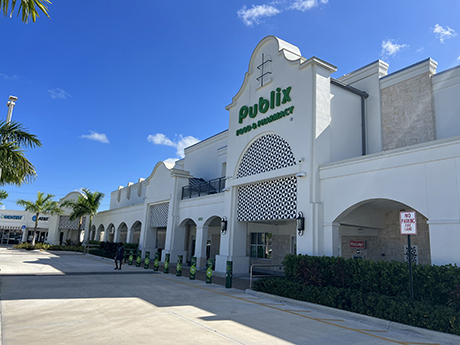
Earlier this year, Publix Super Markets purchased a portfolio of six Publix-anchored shopping centers in the Southeast for $130.4 million. The Lakeland, Fla.-based grocer has been aggressively growing its ownership portfolio of shopping centers as the company sees value in being its own landlord. Other large anchors like Walmart and Dillard’s have also purchased shopping centers and malls in recent months.
Jason Donald, managing director of retail investment sales at Franklin Street, says that it’s not just the big box anchors that are getting in on the trend. Donald represents an undisclosed retail bank that is pursuing this strategy, which he says is becoming more popular as the capital markets make the ownership model more viable, especially for high creditworthy tenants.

“With interest rates coming down and money being readily available, the propensity is shifting that tenants now want to own their own assets,” says Donald. “We’re seeing less leasing and more propensity to own, banks and gas stations especially are getting on that train. That’s the shift in the market we’re seeing more than anything else.”
REBusinessOnline recently caught up with Donald to discuss the buyer pool for retail properties, as well as other investment sales trends including the bid-ask spread between buyers and sellers and the impact of replacement costs on rental rates and investment sales. The following is an edited interview:
REBusiness Online: Today, what would you say is most motivating sellers to sell?
Jason Donald: The desire to free up capital on aging assets where depreciation is already been written off is what is motivating investors. They want to have that powder dry so that as the market continues to improve and they see opportunities, it gives them the chance to attack and start the process over again. If you’ve already had your life cycle of a deal, it’s time to reset and replace the asset that is aging or no longer working for the company/fund.
REBO: Is debt or equity the way most investors are leveraging their acquisitions?
Donald: Debt is much more popular. We’ve seen CMBS come back on-line, which we have not seen in multiple years. Post-COVID, CMBS was relatively flat and we didn’t see many quotes from them. Today, they’re offering competitive quotes for nonrecourse deals with interest-only periods and no origination fees. Between CMBS and the 10-year Treasury yield being in the mid-4s, we’re going to see debt used more for shopping center sales north of $5 million. Anything lower is typically private capital.
REBO: What categories of buyers are the most actively bidding and ultimately purchasing shopping centers?
Donald: There’s not one specific category that is the most active buyer — every retail segment has its nuances. Corporate buyers are looking to buy Winn-Dixie and Aldi-anchored centers in bulk. We’re also seeing some package deals done off-market. Investors are structuring those deals as sale-leasebacks and they’re starting to look at how they can monetize their own portfolios in order to fund their growth.
I represent a very large bank, and right now their MO was no longer to lease. If they had to they would but they wanted to start owning. So we looked at their portfolio and at their renewals and started buying and making offers on our own property, similar to Publix. They wanted to own.
REBO: How would you characterize the bid-ask spread between buyers and sellers currently?
Donald: The gap isn’t as bad as it was during post-COVID. It was like if your neighbor sold his house for $1 million, you would also look for $1 million for your house. No one wanted to accept the fact that their house was now only worth $750,000.
For developers, they would develop a gas station at a 7 cap and they knew they’d sell for a 5.25 cap, which means they had 175 basis points of arbitrage to sell that deal. But when the market changed on them, all of a sudden they could only sell for a 6 cap, which means they only had 100 basis points of arbitrage. They developed at a higher cost, but they weren’t getting the returns from the market.
The reality is that corporate tenants know their value now on the open market and they leverage that to their benefit. We’re always going to have that dynamic, and if that’s 50 basis points that’s just the cost of doing business. But if it’s 150 basis points then there’s a disconnect. We’re seeing more of the 50-basis-point disconnect now, and a lot of that has to do with prices and previous development costs versus the market and what you can sell it for.
REBO: Is there a flight-to-quality trend among investors, or are they chasing yield?
Donald: The big REITs always flock to quality properties because they don’t have to sing for their supper. If you buy a group of independent nail salons, it’s a pretty high risk. But if you own two dozen Starbucks, there’s a lot of benefit because it’s a corporate credit tenant. Corporate clientele always flock to the Class A properties.
Most of your individual investors look for more yield than what those tenants can provide, so they’ll go to QSRs or large franchisees to get those benefits. Private investors are less interested in 5 cap deals, they’ll always go for the 7 cap deals.
There’s really no middle ground between the institutional and private investor pools. There’s a clear line in the sand, and no groups play in both sandboxes. Funds are set up to go one way or the other.
REBO: What is the dynamic currently for replacement cost of retail space relative to pricing?
Donald: Because it costs twice as much to move down the street for most tenants, we’re getting longevity out of the tenants now. For example, Publix won’t wake up tomorrow and rebuild a shopping center two miles down the road because it’s in a bad location. Instead, they’ll restructure their current lease or they’ll redevelop their existing store because the cost of a new store has grown so much that it’s almost become not cost-effective to build a new store.
Replacement costs have gotten so high, and that’s impacted growing retail concepts that are looking at speed to market. We represented Saucy by KFC in its expansion plans, which did all second-generation space because they need speed to market.
REBO: How is market tightness impacting investment sales?
Donald: Most sales are underwritten at a certain “rent to sales”’” percentage ratio. Well, the problem is we don’t have enough increase either in rents or in lease values to be able to offset the cost of construction. If something was built 15 years ago and it was $18 per square foot to rent, if you build something new, you don’t go from $18 to $22 you have to go from $18 to $40 in order to make the numbers work on a pro-forma basis. Unless that market really is now $40 per square foot, it’s really hard to move an $18 tenant to $40.
That’s why we had such a lag in development in retail — rents just have not kept up with what development costs. Development costs skyrocketed through COVID and they never came back down. The pressure is rising between rents and development costs, especially in emerging markets like Raleigh. Tenants may think because it’s in North Carolina it’s great for new development and for growth, then they see that there’s no product available or nothing they want to move into, so it’s causing this lag time.
— This article was originally published in the May 2026 issue of Southeast Real Estate Business.