

Richmond’s retail market continues to be one of the bright spots in commercial real estate, and it’s not difficult to understand why. While many markets across the country are still working through elevated vacancies and changing consumer habits, Richmond continues to benefit from steady population growth, a diverse economy and a retail inventory that remains remarkably full.

Retailers continue to expand here. Investors continue to buy here. And perhaps most importantly, consumers continue to support both national brands and local businesses in a meaningful way. The result is a market that feels healthy, active and well-positioned for future growth.
Quality space is hard to find
If there’s one thing everyone in can agree on today, it’s that quality retail space is increasingly difficult to find in Richmond.
Vacancy throughout the region remains exceptionally low, particularly in established corridors, hovering at around 3.6 percent in the second quarter. Areas like Short Pump, Midlothian and many neighborhood shopping center locations continue to operate with very little available inventory, creating a competitive environment for retailers looking to enter the market or expand existing operations. This has caused rents to continue to trend upward, leaving the landlord with the upper hand.
The interesting part is that this isn’t being driven by a lack of demand. In fact, tenant activity remains strong across virtually every category. Restaurants continue to grow, fitness operators remain active, service-oriented retailers are expanding and experiential concepts like Sandbox Virtual Reality, Teebox and Back Nine Golf — and many others — continue to look for opportunities throughout the region.
The Giavos family, operators of Stella’s Market, Continental and many other concepts in Richmond, expanded the Stella’s Market store into Midlothian and opened Lafayette Tavern downtown this year. EAT Partners also continues to open new locations across the Richmond market in Hanover and Short Pump.
We have seen several boutique fitness concepts such as Club Pilates, Re+Forme, Burn Bootcamp and Orangetheory Fitness expand their footprints. Additionally, some of the larger-format gym chains such as Planet Fitness, Gold’s Gym and Onelife Fitness have been actively seeking new locations.
There has also been an increase in leasing for “medtail,” or medical retail, as we see medical tenants like the urgent care users, veterinarians and ABA (applied behavior analysis) therapy groups seeking space in the retail sector instead of traditional office space.
For many retailers, the challenge isn’t whether Richmond works, but finding the right space when it becomes available.
Strong fundamentals
One of the reasons Richmond continues to outperform many peer markets is that its economic growth isn’t dependent on any single industry.
The region benefits from a healthy mix of healthcare, finance, higher education, logistics, advanced manufacturing, government and technology employment. New corporate investment continues to flow into the market, bringing jobs, residents and consumer spending along with it, which in turn helps prop up the retailers.
We saw Eli Lilly announce new development plans for Goochland County, The LEGO Group is expanding in Chesterfield and CoStar Group has doubled down in downtown Richmond’s central business district within the Foundry Park mixed-use project.
Richmond also continues to attract people looking for a strong quality of life without the costs associated with larger East Coast metros. As more residents move into the region and existing communities continue to grow, retailers are benefiting from a larger and increasingly affluent customer base.
Simply put, the fundamentals that support retail growth remain firmly in place.
‘Measured’ development
Another factor working in Richmond’s favor is the relatively measured pace of new development. Unlike some high-growth markets that experienced an influx of speculative retail construction, Richmond’s development pipeline has remained steady and stable. New projects continue to be delivered in strategic locations and, in many cases, are attracting tenant interest well before construction is complete.
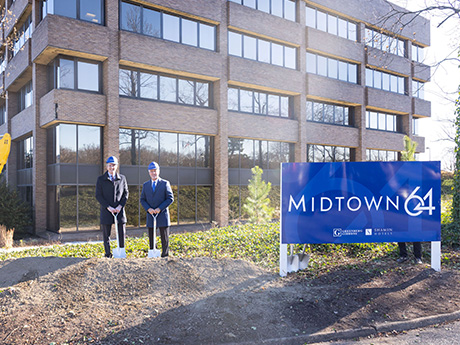
A couple of big projects that come to mind include Midtown 64 and the Diamond District. Midtown 64’s developer, Greenberg Gibbons, has already preleased to Trader Joe’s and other national retailers in its mixed-use project just outside of the Willow Lawn submarket at Glenside and I-64 (former Genworth Financial site).
The Diamond District not only includes the full redevelopment of the baseball diamond but also the surrounding parcels along Arthur Ashe Boulevard, adjacent to the Scott’s Addition neighborhood. Signed deals with Hirschler Law office, as well as a local restaurant group, have already been announced. This project has attracted both national and local interest for preleasing Class A office, retail,and even the hotel site development, and has already had a positive impact on local hospitality users benefiting from increased traffic to the new baseball stadium on gamedays.
The balance between supply and demand has helped occupancy levels stay strong while supporting rental rate growth across many of Richmond’s submarkets.
Investors circle Richmond
Investor confidence in Richmond’s retail market remains extremely strong. Over the past two years, we’ve seen a steady stream of shopping center transactions as investors continue to pursue grocery-anchored centers, neighborhood retail assets and other well-positioned centers throughout the region.
Several notable sales took place during the first half of 2026, including West Broad Commons, Tuckernuck Commons and The Fresh Market-anchored Ridge Shopping Center. These transactions sold to out-of-town capital, giving Richmond a vote of confidence and expanding their holdings in the market. Those deals are part of a larger trend that has generated tremendous retail investment volume since the beginning of 2024.
What’s particularly encouraging, however, is the wide variety of buyers pursuing acquisitions. Local investors, private capital groups and institutional investors all continue to view Richmond as a market capable of delivering long-term stability and growth.
Looking ahead
From where I sit, there are plenty of reasons to be optimistic about where Richmond’s retail market is headed. One of the clearest signs of market confidence is the continued growth of the grocery sector. New grocery-anchored developments continue to emerge throughout the region, including two Publix-anchored shopping centers, one near Brandermill and adjacent to Caldwell Park on Route 301, both of which are expected to deliver around 2028.
Trader Joe’s is also planning a new location at Midtown 64, the transformational redevelopment of the former Genworth campus along West Broad Street. Beyond these projects, there continue to be market rumblings about additional grocery growth opportunities throughout Hanover and Chesterfield counties.
Perhaps the most intriguing aspect of these announcements is where they are happening. Retailers are not just chasing the established trade areas; they are positioning themselves in growth corridors and expanding residential communities where they see long-term opportunity. That’s ultimately what makes Richmond’s retail story so compelling. The market isn’t growing because of one project, one retailer or one trend. It’s growing because the region continues to attract people, jobs and capital.
In a commercial real estate environment where certainty can be hard to find, Richmond continues to provide something investors, retailers and developers all value: confidence. And based on the activity we’re seeing today, that confidence appears well-placed.
— By Annie O’Connor Brosius, senior vice president of Cushman & Wakefield | Thalhimer. This article was originally published in the August 2026 issue of Southeast Real Estate Business.