

Supply and demand dynamics within the seniors housing sector are at a crossroads, according to the Emerging Trends in Real Estate 2026 report produced by PwC and the Urban Land Institute. Like most commercial real estate property types, new supply is constrained due to increasing financing and construction costs. However, demand for senior living units continues to grow.
According to the report, factors driving demand for seniors housing include a rapidly growing older adult population and an increase in older adults renting. The 75-plus age category is expected to grow by more than 4 million people by 2030, according to U.S. Census Bureau projections. The oldest baby boomers turn 80 in 2026.
The National Investment Center for Seniors Housing & Care (NIC) expects that the limited new supply and steady demand will drive the average seniors housing occupancy rate above 90 percent in 2026, potentially reaching the highest occupancy rate reported in the 20 years that NIC MAP has tracked this data.
Investors are poised to achieve strong returns. The National Council of Real Estate Investment Fiduciaries (NCREIF), which tracks the performance of institutional-grade U.S. commercial real estate, reports that seniors housing strongly outperformed all other property sectors in 2025, posting a 10.6 percent total return. That figure was more than double the Expanded NCREIF Property Index total return of 4.9 percent, according to NIC.
“If new supply remains constrained while the senior population continues to expand, we could see pockets of undersupply emerge over the next several years,” says Mark Lockwood, president and CEO of Southfield, Michigan-based Lockwood Cos., which provides development and management services.
“The capital markets environment is influencing timing, but it is not changing the long-term demographic trajectory. We belive the next decade in seniors housing will likely be defined more by supply discipline than demand uncertainty.”
Aging population
In the Midwest, long-term demand fundamentals for well-located independent living and affordable senior communities are very strong, says Lockwood. In many cases, existing housing stock predates modern accessibility standards.
“In states like Michigan and Ohio, many seniors are living in homes that weren’t designed for aging in place with multi-level layouts, maintenance burdens and limited accessibility,” he notes.
Lockwood Cos. focuses exclusively on independent living and affordable seniors housing because “the strongest long-term need in many Midwest markets is for housing that supports autonomy rather than clinical care.”
Seniors often want to remain rooted near family and familiar services, but they need a housing option that reduces maintenance and improves accessibility. Development decisions are rooted in local demographic data — age concentration, income distribution, homeownership rates and existing inventory.
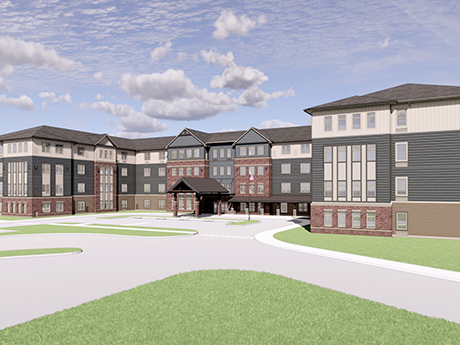
Lockwood Cos. opened Lockwood of Ann Arbor in the summer of 2024. The $47 million independent living community in Ann Arbor, Michigan, offers 154 units, 65 of which are designated as affordable for residents earning up to 60 percent of the area median income (AMI).
Amenities at Lockwood of Ann Arbor include chef-prepared meals, a game room, craft room, raised bed gardens, a barber shop and beauty salon, movie room and fitness area with exercise classes.
Chicago-based Evergreen Real Estate Group is taking a similar development approach, focusing on building seniors housing in Ohio, specifically for residents who wouldn’t otherwise be able to afford traditional assisted living.
“In Ohio, the senior population grew more than 10 percent between 2020 and 2024, and the 85-plus cohort — those who need hands-on care the most — is projected to grow by more than 50 percent by 2040,” says Jared Isenthal, vice president of development at Evergreen.
Evergreen recently broke ground on two new projects in the state. Green Oaks of Canal Winchester, on the southeast side of Columbus, is a 120-unit affordable assisted living community. Green Oaks of Holland, located about 12 miles west of downtown Toledo, will also provide 120 units of affordable assisted living.
Both are slated to open in spring 2027 and will be designated for seniors earning up to 80 percent of the AMI.
The Green Oaks platform is focused on bringing high-quality, Medicaid-supported assisted living to communities where middle-income and lower-income seniors currently have few options. Units feature individual climate control, a kitchenette, private bathroom and emergency alert system.
Amenities at Green Oaks communities include a full commercial kitchen serving three meals and snacks daily, a fitness room, beauty salon, game room, library, lounges, activity rooms, walking paths and transportation services.
Kansas City-based Tutera Senior Living & Health Care often utilizes the continuum of care retirement community model. These properties combine independent living, assisted living and memory care in a single campus, enabling residents to age in place as their needs evolve.
Dominic Tutera, director of development, says the decision on what type of property to build always begins with detailed market research and an understanding of the future resident population.
“Just like any other commercial real estate development, the market ultimately tells you what you need,” he says. “We analyze demographic trends, income levels, competitive supply, healthcare infrastructure and projected population aging patterns. From there, we identify gaps in the market and determine which level of care or housing option will be most sustainable.”
In Tutera’s view, the Midwest presents demographic and supply characteristics that position the region for sustained need across independent living, assisted living, memory care and skilled nursing.
“The demand for seniors housing in the Midwest is entering one of the most significant growth cycles the industry has seen in decades,” says Tutera.
Development decisions
Today, the two biggest factors hindering new development include the higher cost of capital and increased construction expenses. These pressures make it more difficult for new developments to pencil out without some form of incentive or creative financing structure, says Tutera.
“That reality applies across nearly all sectors, but some asset classes, such as market-rate multifamily, can more easily offset these pressures because they often benefit from stronger asset appreciation and lower operating expenses than seniors housing,” he adds. “Senior living communities typically require higher staffing levels and specialized services, which add complexity to the financial model.”
Development costs also play a role in determining what type of seniors housing property to build, according to Matthew Rezkalla, chief investment officer at Agemark Senior Living in Omaha, Nebraska. “Different care types have varying construction requirements and operating models.”
Agemark’s typical preference for new development projects is the continuum of care approach, offering independent living, assisted living and memory care within a single campus. But determining the appropriate mix of care types requires a detailed market analysis.
“We evaluate demographic trends such as population growth, income levels and age cohorts as well as the current supply and performance of competing communities,” says Rezkalla. “Occupancy levels and rental rates by care type are particularly important indicators.”
In Omaha, Agemark opened Symphony Pointe in phases starting in late 2023. The community comprises 70 independent living units, 52 assisted living residences and 36 memory care units.
Two of New Perspective Senior Living’s most recent developments are in Arden Hills, Minnesota (just north of Minneapolis), and Weldon Spring, Missouri, a western suburb of St. Louis. Both communities offer the continuum of care.
“While the mix of units can shift depending on the demographics and needs of a particular market, the independent living, assisted living and memory care continuum has served us well,” says Adam Cozine, senior vice president of real estate at Minnesota-based New Perspective.
“Strong care delivery with hospitality-driven services, dining and programming is what ultimately creates a great experience for residents and families.”
What do seniors want?
Modern senior living communities look very different from what people may have imagined a generation ago, says Cozine. Residents expect “vibrant environments” with amenities such as restaurant-style dining, fitness and wellness spaces, social gathering areas, outdoor patios, libraries and activity rooms.
Services are just as important. “Residents benefit from hospitality-driven dining programs, life engagement programs, transportation, housekeeping and wellness support,” says Cozine.
Rezkalla echoes this sentiment, saying that today’s seniors are looking for communities that feel more like hospitality environments than traditional care settings.
“They expect high-quality dining, vibrant common spaces, strong programming and exceptional customer service,” he says. “Communities that successfully blend care services with lifestyle offerings will be best positioned to meet the expectations of this new generation of residents.”
For larger campuses that include independent living and assisted living, amenities often resemble those found in high-end multifamily or hospitality settings. Examples include restaurant-style dining venues, bistros and coffee bars, movie theaters, fitness and wellness centers, pickleball courts, pools and spas and dedicated spaces for social programming.
Rezkalla says may communities also feature bars and regular happy hours to foster social interaction among residents.
It’s important to align the amenity package and service offerings with the price point of the community, emphasizes Rezkalla. While higher-end properties with premium rental rates must deliver a robust experience, middle-market developments may offer a more streamlined amenity package to maintain affordability.
For Tutera, seniors housing design must balance two critical priorities: operational efficiency and resident choice.
“More than most commercial real estate assets, the physical design of a senior living community directly affects how efficiently care teams and staff can serve residents. Layout, circulation patterns and proximity between resident units and service areas all help reduce friction in daily operations,” explains Tutera. “At the same time, design must support autonomy and lifestyle preferences.”
Today’s independent senior resident is highly lifestyle-oriented, says Lockwood. “They’re looking for convenience, predictability and connection — not an institutional environment.”
This year, Lockwood Cos. launched its new “Thrive Resident Engagement Program.” The goal of the programming is to help residents thrive across five pillars: physical, social, spiritual, intellectual and vocational.
“Research consistently shows that social isolation is one of the greatest risks facing older adults,” says Lockwood. “Community design and programming like Thrive are not amenities — they’re essential components of resident well-being.”
— Kristin Harlow
This article originally appeared in the March 2026 issue of Heartland Real Estate Business magazine.