

By Taylor Williams
“People are still spending money.”
That’s what Nick Skeparnias, principal at Agora Commercial Realty Partners, a full-service advisory and development firm, identifies as the single-biggest point of optimism about the state of the greater Philadelphia retail market.
According to data from the U.S. Commerce Department, U.S. retail sales totaled roughly $774 billion in August, a 1.2 percent increase over the previous month. The Wall Street Journal also reports that spending in discretionary categories of retail, namely electronics and appliances, rose by 1.6 percent in August versus July. And according to both The Journal and Breitbart, the actual volume of retail sales in August exceeded economists’ expectations by anywhere from 40 to 70 basis points.
Within Skeparnias’ simple, five-word declarative statement, there’s no question that “still” is the operative term.
“Retail is only as good as the money that people have to spend on it,” he elaborates. “So when you consider the biggest concerns for this asset class, there’s nothing specific to retail itself, but issues that are more global. There’s always going to be something at the retail level; first it was e-commerce, then COVID-19. Now we have AI [artificial intelligence], and if that starts taking people’s jobs, they’ll be much less likely to go to the nail salon or have gym memberships or engage in other forms of luxury, nonessential spending.”
CBRE’s second-quarter report on the Philadelphia retail market paints a similar picture via its headline: “Sustained Positive Absorption Signals Continued Resilience.” The report’s synopsis immediately follows and begins with a none-too-subtle introductory phrase that speaks to this perspective — “despite macroeconomic headwinds” — and concludes that “the quarter’s activity showcased the market’s ongoing ability to evolve through redevelopment, tenant expansion and necessity-based investment.”
The Big Picture
Within the 2026 U.S. political lexicon, there are few words that are quite as delicate — and yet also inflammatory — as “affordability.”
The term is a cornerstone of the campaign that the current U.S. president ran on, as well as a concept that members of the opposing party feel can be weaponized against his allies in the upcoming midterm elections. Just up the road in New York City, socialist initiatives are being unfurled to combat high costs of living, and commercial real estate — through rent freezes in apartment buildings and the prospect of city-owned grocery stores — is an unwitting public face of that experiment. And just south in the nation’s capital, Washington remains embroiled in an overseas conflict that has disrupted global energy markets. And since the price of virtually every consumable product or service has an energy component baked into it, the lines between geopolitics and everyday spending and budgeting have blurred in recent months.
Even so, sources within the Philadelphia retail market say that generally speaking, tenants’ sales are strong enough such that they can manage rent increases, which in turn means that developers can underwrite revenue streams that make new projects feasible. Such is the natural ebb and flow that underlies organic growth in brick-and-mortar retail, and healthy consumer spending is the mechanism that makes it all possible.
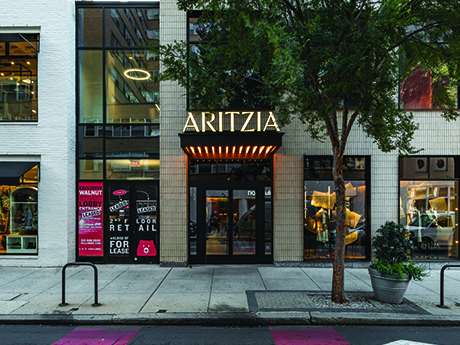
For the moment, concerns about those consumer spending habits dropping off substantially remain un-actualized. And while Agora primarily plays in Philadelphia’s suburban submarkets, other sources say that within urban Philadelphia’s prime retail districts, robust tenant sales bear considerable responsibility for the overall health of the market.
“We see tenants doing well in what we call the ‘little treat economy,’” says Maddie Whitehead, managing principal at local brokerage firm Blueprint Commercial. “The reality is that people want to have those ‘third spaces’ that aren’t their homes or workplaces. Even with the broader challenges and craziness of today’s world, people still want to be able to go out and get their food and drink or service or workout or whatever it may be.”
“In Rittenhouse Square and along Walnut and Chestnut streets, tenants are doing as well [with sales] as they ever have on a per-square-foot basis,” adds Douglas Green, principal at local brokerage and consultancy firm MSC. “So you don’t see much market movement. And because there’s minimal vacancy, landlords have the leverage and in some cases are pushing ‘as is’ deals — no TI [tenant improvement] allowances, no landlord work — simply because they can.”
As Green notes, strength of sales contributes to a relatively static market in which tenants infrequently switch and/or upgrade their spaces. In addition, he points out that within core Philadelphia retail nodes, tenants’ options are further constricted by the fact that so many buildings are older and therefore more costly to retrofit for new users. Even if a location checks all the right boxes, that factor alone can kill a deal.
“Tenants have to take these older buildings mostly as-is, where-is, and without TI,” Green explains. “Getting tenants comfortable and fitting out older buildings and taking construction risk when they have other options nationally with newer buildings and allowances from landlords — that’s challenging.”
But at the same time, employing such a cut-and-dry deal structure can be helpful to smaller, startup tenants that are competing for spaces with less resources at their disposal.
Mom-and-Pops Make It Work
As for the overall mom-and-pop segment of the market, sources are encouraged by the opportunities that exist for these users in Class B centers and secondary and tertiary submarkets.
“Class A properties in Philadelphia are pretty picked over, and it’s hard to get tenants into spaces in these core suburban markets, but we have a lot of grocery-anchored centers in submarkets that are great for mom-and-pops,” says Scott Benson, executive vice president of brokerage services at Metro Commercial Real Estate. “So we expect the B and B+ product in good trade areas to remain strong for the mom-and-pops, because they don’t typically go into new construction, nor do they need to.”
Benson’s coworker, Brian Goodwin, who holds the title of executive vice president and principal at Metro Commercial, agrees that the greater Philadelphia region is fertile ground for mom-and-pop operators, especially those that are willing to be flexible about what spaces they occupy.
“We’ve recently gotten more inquiries and calls that have translated to
mom-and-pop deals than at any point post-COVID, even if it’s mom-and-pops with franchise models,” Goodwin says. “The mom-and-pop category remains as robust, if not more so, across all categories, so we remain bullish on them because they fill needs of centers and balance out the credit that the developers can go to the bank for.”
Flexibility Is Paramount
Flexibility is also important on the landlord’s side of the negotiating table.
“The ability to remain flexible on deal terms and starting rents and keeping cash on hand typically breeds more success,” says Benson. “Some regional landlords are willing to do that and be flexible, but it’s very case by case depending on positions with lenders.”
On the supply side of the market, Benson and Goodwin both say that the potential volume of new inventory, both ground-up construction and redevelopment, is also as strong as it’s been at any point in the recent past. Grocery and fitness users remain especially popular anchors for these projects, and the fact that these groups are expanding into newer construction with higher rents is inevitably a factor of strong sales.
“The fact that we haven’t seen this much proposed supply coming on line in the last decade-plus speaks to the strength of tenant performance, especially anchors, and how they’re willing to relocate and rightsize to get into these new developments,” says Benson.
“The larger shopping center owners in the area like Brixmor [Property Group], Federal Realty [Investment Trust] and Kimco [Realty] are commanding higher rents, but retailers are typically willing to pay because sales are strong,” says Goodwin. “The amount of new projects in planning that should come to fruition is high, and there’s people moving dirt now, which has a trickle-down effect that helps mom-and-pops and regional tenants via more opportunities to backfill. So it’s challenging, but the overall sentiment is optimistic.”
While grocery sales may not be the best indicator of consumer confidence and resilience in times in which the cost of living is high, fitness spending would seem to be a good barometer of that metric. Fusion Gyms, Barre and Club Studio, which is part of LA Fitness, are among those users that have more recently expanded in the market.
Local Authenticity Rules
Multiple sources point to the Philadelphia market’s love of retail, restaurant and entertainment concepts that are both unique and rooted in local culture.
“Philadelphians want authenticity,” says Green. “They don’t want to be told what they should like or that they should appreciate a certain concept because it was popular in another city. Local branding, local marketing and local social media efforts are important and resonate in Philadelphia, which has a reputation as a city that keeps its people and is not as transient as other major cities. So people want to support concepts that have approached them the right way.”
“We’re particularly excited about the local-operator segment of the market, because those groups are the real innovators and have some of the coolest concepts and freshest experiences in Philadelphia and the surrounding area,” concurs Whitehead.
Both Green and Whitehead say that this segment of users reflects the healthy consumer spending that keeps the broader market anchored, as many of these groups could be considered nonessential retail.
Late last year, for the first time in its history, The Michelin Guide awarded stars to three Philadelphia restaurants: Provenance, Her Place and Friday, Saturday Sunday. And according to CBS Philadelphia, the restaurant publication also added more than a dozen Philadelphia-area restaurants to its “recommended” list.
“Episodes like that are really cool for this market and make this such an interesting time,” says Whitehead.
Blueprint also represents The Buttery, a bakery concept that has infiltrated the suburbs, first with a bakery and coffeeshop in Malvern, followed by another such location in Bryn-Mawr and more recently, a pop-up stand at the Farmers Market at Suburban Square in Ardmore.

Local brokerage firm Blueprint Commercial is marketing this space at 1811 Frankford Ave. in Philadelphia’s Fishtown neighborhood that is currently home to an art gallery. The space can support traditional retail and food-and-beverage users, both of which would benefit from proximity to a new, small-format Whole Foods Market that is planned near the site.
Brokers who mostly focus on infill submarkets agree that small-shop spaces tend to move most quickly in this market, and that brokers have to be ready to move at a moment’s notice.
“In the current market, because construction costs and tenant build-out costs are so high, there are fewer opportunities, so you have to know what’s coming up or you’ll miss it,” says Whitehead.
“There’s tremendous demand for small-shop space — 5,000 square feet and below — in the city,” adds Green. “That’s where you have the nexus of demand for all categories — service, fast casual restaurants, apparel — they all come together for that size of space.”
The suburbs aren’t much different in that regard.
“Turnaround time is almost instantaneous for those smaller spaces,” says Skeparnias. “Whether they’re absorbed by credit or mom-and-pop tenants, spaces of that size generate tons of calls, whereas 15,000-square-foot spaces may only generate a few calls. So a lot of the smaller spaces right now, as was the case in years past, are getting rapidly absorbed up by both credit and mom-and-pop tenants.”
— This article first appeared in the August/September 2026 issue of Northeast Real Estate Business magazine.