

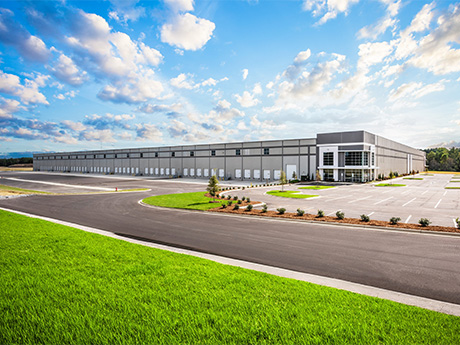
More than seven months have passed since Liberation Day, where the Trump administration declared a sweeping package of tariffs for foreign trade partners and specific commodities, including steel and aluminum. Since the announcement in early April, there has been a boon in the amount of multibillion-dollar advanced manufacturing, life sciences, semiconductor and data center investment announcements around the country, with the markets along the I-85 Industrial Corridor being no exception.
To name a few: Toyota has recently begun production at its $13.9 billion battery plant in Liberty, N.C.; Rivian broke ground on its $5 billion electric vehicle plant near Social Circle, Ga.; JetZero is planning to create 14,500 jobs for an aerospace manufacturing facility in Greensboro, N.C.; Eli Lilly is developing a $5 billion pharmaceutical manufacturing facility in the Richmond suburb of Goochland County, Va.; and Google is developing a trio of data centers in metro Richmond’s Chesterfield County.
“We have incredible momentum bringing business back into the United States, which is going to drive industrial growth, particularly in the Southeast,” says Jim Anthony, CEO and founder of APG Companies. “We’re not unionized, we have lower taxes, fewer regulations and lower cost of energy, which is huge factor in site selection for manufacturers.”
Brokers from around the region have noted more manufacturers touring sites, with some citing tariffs as a direct catalyst. Todd Barton, senior vice president of CBRE’s Atlanta office, says that his home market is shifting somewhat in the makeup of its industrial base.
“The Atlanta industrial market has been much more of a distribution market rather than manufacturing, and it still is, but we are seeing a pretty good uptick in manufacturing requirements, and therefore a lot of different types of products,” says Barton.
Dillon Swayngim, vice president of Colliers’ Spartanburg, S.C., office, says that even though the Greenville-Spartanburg market is a legacy manufacturing base due to being the U.S. headquarters for BMW, the Upstate region is also experiencing tariff-related investment.
“We’re always seeing foreign direct investment in this community,” he says. “Now, is that just natural, organic growth, or is that tariff-driven? I think it’s probably a mix of both.”
Swayngim and other brokers have noted that the tariffs have also made projects tougher to pencil for smaller developers and users due to volatility in construction materials pricing and unavailability of imported items such as machinery and appliances, as well as general uncertainty surrounding pricing.
“It’s a tale of two cities; I’ve seen the smaller companies actually be impacted by the tariffs more,” says Swayngim, who mentioned a company that had to scrap its expansion plans for a 200,000-square-foot project because the imposed tariffs on Chinese imports heavily impacted the company’s business plan.
“There are some products that companies just have to import, so the tariffs really hit their bottom line,” says Swayngim.
“The uncertainty created by the tariff talks caused users to pause on their expansion plans,” concurs Barton. “It’s not as if those deals went away — they’re just not moving forward at the speed they would normally, or they’re not finalizing the deal because of the uncertainty.”
Solutions in the works
Developers and tenants have had to get creative in navigating the hurdles created by tariffs, as well as general inflation. The producer price index (PPI) for construction materials increased by more than 5 percent year-over-year as of August, according to the U.S. Bureau of Labor Statistics (BLS).
Sources interviewed for this article say that there is some pricing relief occurring due to interest rate cuts. At its September, October and December meetings, the Federal Open Markets Committee (FOMC) decreased the federal funds rate by a combined 75 basis points, bringing the target range down to 3.5 to 3.75 percent as of this writing.
“Developers are waiting to see what is going to happen with the FOMC meetings going into next year,” says Matthew Capizzi, research associate with Savills.
Chase Kerley, managing director of Crescent Communities’ AXIAL industrial brand, says that capital costs remain the No. 1 constraint for industrial developers.
“There are higher debt costs, which are starting to come down, so we’re seeing opportunities to increase leverage,” says Kerley, who also oversees Crescent’s YIELD life sciences platform. “But tighter equity makes site selection and our overall quality even more critical. We underwrite the headwinds, but we invest [in markets] where fundamentals ultimately can carry us through these cycles. We’re expanding in new markets and existing markets that align with population migration, heavy infrastructure investment and the reshoring of manufacturing we’re seeing nationally”
Developers are also looking for solutions at the property level. Kerley mentions the importance of optionality and flexibility in design as a means to future-proof the company’s various AXIAL-branded projects underway.
“Our approach is not just market-driven, it’s product-calibrated; we’re growing both bulk and shallow-bay simultaneously,” says Kerley. “Users want speed to market and flexibility. We’re not just betting on a macro rebound, we are building around localized growth in our pipeline.”
Ian Andres, director of business development at ARCO Design/Build, says that developers are opting to enlist the services of design-build firms like ARCO to streamline efficiencies for the planning and construction phases.
“The design/build method has become more and more popular over the years as owners look to minimize risk and surprises, while maximizing speed and efficiency,” says Andres, who adds that the company has more than 20 active projects along the I-85 corridor from Alabama to Virginia. “With the design/build approach to construction, owners have one budget, one contract, one source of accountability and one cohesive project delivery.”
Developers are also forming solid relationships with vendors and general contractors as a way to take cost overrun risks off the table.
“We try to mitigate cost pressures by locking in roof and steel packages early and leverage more national vendor agreements to control our costs, and ultimately control our schedule,” says Kerley.
The relationships that developers form with general contractors are vital because the repeat business can help developers achieve economies of scale. Connor Tomlinson, director of strategic relationships at Poettker Construction, says that the value-engineered solutions that general contractors can bring to the table are critical in maximizing efficiencies, even overcoming the uncertainty stemming from tariffs.
“General contractors are continuously evaluating material and labor cost trends and are looking for opportunities to help their clients lock in the best prices early for their projects,” says Tomlinson. “We work closely with clients and subcontractors to get creative, offer value-engineered solutions, mitigate risks, expedite procurement and work with local partners that best suit our clients’ needs.”
End users are also getting in on cost control methodology. Ben Bruni, senior vice president and partner at Commonwealth Commercial, says that there are more build-to-suit developments in the pipeline than in years past. Bruni’s firm is marketing a build-to-suit opportunity at Airport South Commerce Center, a three-building industrial park underway on a 55.5-acre site in the Richmond submarket of Henrico County.
“Local, regional and even national businesses want to stop leasing,” says Bruni. “They want to own their real estate because they’ve seen rental rates increase so much, and they want to be able to control their own destiny.”
Tomlinson adds that tenants opting for build-to-suits have notable design trends at the property level.
“As the industry is shifting to more build-to-suit developments, we are seeing trends toward more automation in warehouses, an increased emphasis on sustainable operations, more flexible layouts for tenant customization, increased office space, more elaborate front entrance designs and earlier engagement with contracting community for budget and schedule control,” says Tomlinson.
Richmond
Graham Stoneburner, senior vice president of Cushman & Wakefield | Thalhimer’s Richmond office, says that the “party has calmed but continues” in the Richmond industrial market.
“We are a high barrier to entry market for new development, and our demand has kept up with supply, keeping vacancy low and allowing rents to continue to grow at a very healthy pace,” says Stoneburner. “Richmond is the headwaters of I-85 and is poised to be a leader for the corridor for the foreseeable future.”
Stoneburner adds that the Richmond vacancy rate is under 5 percent and could dip below 3 percent if leasing momentum continues on its current trajectory relative to the market’s available inventory, both existing and in the pipeline. Peter Ferramosca, director of research at Range Commercial Partners, says that rent growth for metro Richmond is up more than 16 percent year-over-year due to high demand and conservative construction starts.
“While this level of rent growth might not be sustainable long-term, it highlights the scarcity of space and how much pricing power Richmond landlords hold in today’s market,” says Ferramosca. “Richmond’s industrial market has emerged over the past few years as one of the preeminent logistics hubs on the East Coast.”
He cites The LEGO Group’s decision to locate LEGO Manufacturing Virginia, a $1.5 billion manufacturing facility that was recently topped out, in Chesterfield County as indicative of metro Richmond’s superior location. In addition to the factory, LEGO broke ground in mid-November on a new $360 million regional distribution center in nearby Prince George County. The Danish toymaking giant plans to deliver the factory and 2 million-square-foot distribution center in 2027.

“Deals like LEGO in Chesterfield County, Amazon’s Project Rocky in Henrico County and Target and Autozone’s distribution centers in New Kent County all create significant jobs in the region, both during construction and ongoing operations, which generates trickle-down demand in smaller centers throughout the metro,” says Ferramosca. “On a local level, these major deals contribute to the institutionalization of the Richmond industrial market. These large tenants are essentially a stamp of approval on the local/regional economy and provide confidence in future growth for similar tenants.”
“The amount of attention from out-of-town investors that want to be here is pretty amazing,” adds Bruni. “High-quality businesses want to locate here from a developer standpoint because good end users are coming to fill the developments. The momentum that the region has is impressive.”
Sources interviewed for this article point to Richmond’s location near “Data Center Alley” in Northern Virginia as another feather in the cap for the state capital. Suppliers to those data center users, which handle more internet traffic than any region on the globe, as well as being a value alternative in site selection have bolstered Richmond’s industrial base.
“Richmond is really the last city before you get to Northern Virginia, which should be a whole different state because it’s so different than the rest of Virginia,” says Bruni. “We’re able to be a lower cost real estate and lower labor cost market, but can still service the Mid-Atlantic region.”
Bruni says that for Commonwealth’s Airport South Commerce Center project, site selection was several years in the making because finding quality entitled sites with access to utilities has been a challenge as Richmond’s industrial market has matured.
“The site had been under contract to another speculative developer that was trying to assemble and chase a 1 million-square-foot deal,” says Bruni. “They tied it up, put it under contract with a local family here and we stayed very close to that family. Once we heard the deal was on shaky ground and fell apart, we made a competitive offer that was accepted.”
Bruni says that Commonwealth went with a smaller footprint to capitalize on demand trends for the market, which fell more into the 60,000- to 200,000-square-foot range. The project’s main building is about 335,000 square feet and can be multi-tenanted.
“Our ability to flex up or down with tenant demand is going to be a really big competitive advantage for this property,” says Bruni.
Airport South’s second facility is a 70,000-square-foot, shallow-bay facility that can also accommodate multiple users.
“We learned from a previous project, 9003 Old Staples Mill Road that we completed a year ago, that there are tenants that want to be in that 11,000- to 30,000-square-foot range that are tired of occupying older-vintage product with lower ceiling heights.”
Commonwealth is opting to market the third building for build-to-suit opportunities and also retain portions of the site for eventual industrial outdoor storage (IOS) and trailer parking. Bruni says that both manufacturers and distributors, as well as data center suppliers, have expressed interest in the project. The developer plans to clear the site soon and deliver in late 2026 or early 2027.
Stoneburner echoes Bruni’s sentiment about shallow-bay projects, pointing out the “solid activity” for the product type.
“Merritt Properties is wrapping up the first phase of its expansion of Crescent Business Center in Ashland,” says Stoneburner. “Merritt has completed a 32,000-square-foot building that was preleased to three separate tenants, and its 72,000-square-foot building will be complete in the next few weeks and be ready for occupancy.”
Crescent Communities is in the process of finishing AXIAL Rockville 64 in Rockville, a northwest Richmond suburb in Hanover County. The project is situated near I-64 and will feature two rear-load buildings that measure 154,100 square feet and 181,220 square feet. Atapco Properties is co-developing the 29-acre project and providing equity.
“Tenant interest has been really strong and broad out of the gate,” says Kerley. “We’ve got third-party logistics, data center adjacent suppliers, some manufacturing and e-commerce groups all looking to cover the I-64/95/295 triangle. The project is timed to catch users rolling off older leases in the market that want efficiency gains without investing in more expensive build-to-suit options.”
Triangle, Triad
North Carolina’s Triangle region (comprising primarily Raleigh and Durham) and Triad (Greensboro, High Point and Winston-Salem) have recently attracted several high-profile companies. Toyota, JetZero, Amazon, Johnson & Johnson, Apple and Genentech have all expanded in this cluster on I-85.
Pharmaceutical developer and manufacturer Novartis recently announced a $771 million expansion of its footprint in the region. According to the company, the expansion will create 700 new jobs in Durham and Wake counties and more than 3,000 indirect jobs by the end of 2030. The North Carolina expansion is part of the Swiss company’s pledge to invest $23 billion in U.S. infrastructure over the next five years.
Vulcan Elements, a rare earth magnet manufacturer, recently signed a full-building lease at CrossPoint Logistics Center, a speculative industrial facility in the south Raleigh suburb of Benson. The developer, Edgewater Ventures, broke ground on the facility in 2022.
Vulcan Elements plans to expand the current 501,215-square-foot facility to more than 1 million square feet. The company plans to invest $918.1 million into the project and create 1,000 new jobs. CrossPoint Logistics Center is the largest speculative industrial facility ever constructed within the Raleigh-Durham MSA, according to Edgewater Ventures.
In the Triangle market of Holly Springs, N.C., Fujifilm Biotechnologies recently opened its $3.2 billion bio-pharmaceutical manufacturing facility. The project is expected to create 1,400 jobs by 2031 and to support the manufacturing of medicines for Johnson & Johnson and Regeneron.
APG’s Anthony says that the region is enjoying “very robust growth” on the leasing and development side.
“The market is extremely healthy in terms of expansion and the amount of absorption of space,” says Anthony. “But there’s so much being built that vacancy rates are climbing.”
Anthony notes that the metro Raleigh area has had 10 million square feet of space delivered year-to-date and the Durham area has welcomed 4 million square feet of space.
“The Greensboro market is also growing very quickly,” says Anthony. “Greensboro is really coming on as a manufacturing center because of these large new facilities that are being built.”
APG executed a sale-leaseback for a 400,000-square-foot facility in Guilford County and is working on another 250,000-square-foot sale-leaseback deal in High Point that will soon come to market. The firm is also marketing a 200,000-square-foot facility in Wilson County, with Mann + Hummel, an air filtration manufacturer, taking down space.
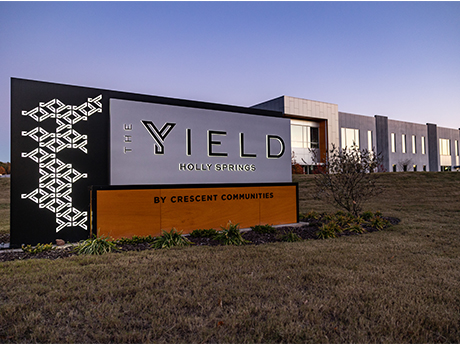
On the development front, Crescent has delivered The Yield Holly Springs, a 120-acre life sciences campus in Holly Springs, as well as AXIAL Liberty Commerce in Greensboro.
The Keith Corp. is developing a 244,400-square-foot, rear-load building in Mebane that will deliver in third-quarter 2026. The developer is also partnering with IDM Ventures on South Point Commerce Center, a 1.6 million-square-foot development in High Point.
“In addition to four rear-load buildings ranging from 126,000 to 200,000 square feet, we also have a 1 million-square-foot, cross-dock building that is fully permitted,” says Giannuzzi of The Keith Corp. The firm also co-developed a 48,000-square-foot expansion of Woodbridge Furniture’s facilities in Thomasville Business Park, about 25 miles outside of Greensboro.
“This expansion was driven by the growth of Woodbridge’s business, which speaks to the region’s strong demand in the high-end home furnishings market,” says Giannuzzi.
In other development news, Stotan Industrial will deliver approximately 487,200 square feet of small-bay space across three new buildings in Fuquay-Varina, a southwest Raleigh suburb along N.C. Highway 55.
Charlotte
One of the more notable deals in the I-85 Industrial Corridor in 2025 is the recent $300 million investment announcement by Walmart in Kings Mountain, N.C. approximately 30 miles west of Charlotte. The Arkansas-based retail giant will create more than 300 jobs at the 1.2 million-square-foot fulfillment facility when it opens in 2027. The Keith Corp. delivered the industrial building, dubbed Kings Mountain Corporate Center, in late 2023.
“We are very pleased to complete the transaction in Kings Mountain, which was the culmination of a 15-year partnership with the Matthews family on the site,” says Alan Lewis, managing partner of The Keith Corp.’s industrial department. “We saw an uptick in tenant activity at the start of 2025, which led to us initiating discussions with Walmart in the first quarter of this year. Walmart was a great partner to work with, and we’re excited for the jobs and economic growth coming to Gaston County.”
The Keith Corp. also recently sold a 735,560-square-foot industrial building at Newton Corporate Center in Catawba County for $55 million. The developer delivered the property, a distribution center for home décor retailer Crate & Barrel, in 2021.
Another major announcement in recent months was energy drink giant Red Bull breaking ground on a new 2.3 million-square-foot production, manufacturing and distribution bottling plant in Concord, a northeast suburb of Charlotte in Cabarrus County. Partners on the fully automated development include Ball Corp. and Rauch North America.
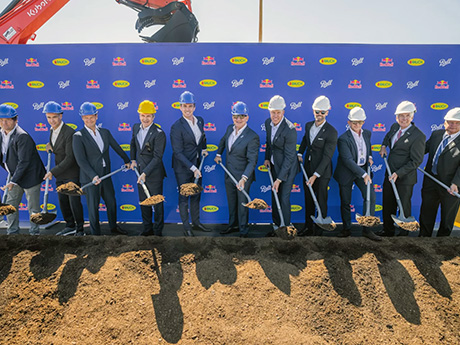
The $1.5 billion investment is expected to begin operations in 2028, with maximized filling capacity anticipated by 2031. The Red Bull project is a redevelopment of a 500-acre site that formerly housed a Philips Morris cigarette plant.
“Not every market is seeing interest from these bulk users,” says Capizzi of Savills. “Charlotte is having demand for these big-box deals on a national scale. This speaks to the strength and sentiment toward the Charlotte market.”
“Charlotte has been a healthy market but is bifurcated between larger deals driving the market while the infill, multi-tenant market, which has historically been our ‘bread and butter,’ is sluggish,” adds Matt Treble, vice chair of Cushman & Wakefield’s Charlotte office.
Another major storyline for the market is its double-digit vacancy rate. The Charlotte industrial market had a vacancy rate of 11.9 percent in the third quarter, according to Capizzi. He did note that absorption has increased to 4.3 million square feet of positive absorption year-to-date compared to 1 million square feet in the same time period in 2024.
“Charlotte’s vacancy rate is elevated, but we believe that it is stabilizing as demand catches up with the construction pipeline,” says Capizzi. “There were a lot of deliveries over the past three years, but the market feels balanced now as leasing momentum begins to pick up.”
Treble says that new construction has slowed down in metro Charlotte as entitlements are becoming more challenging and utilities are harder to procure.
“The Charlotte market has seen a slowdown in new construction to date this year,” says Treble. “This is largely due to the unprecedented amount of industrial development our market has experienced over the past four to five years.”
Crescent has been very prolific in its home market of metro Charlotte in recent years. The properties in the firm’s development pipeline include AXIAL Midway 321, AXIAL Commerce Station and AXIAL Rapid Commerce.
Additionally, Crescent sold AXIAL Southgate 77, a 220,281-square-foot industrial property situated within Antrim Business Park in Rock Hill, S.C., roughly 15 miles south of Charlotte. Washington, D.C.-based Penzance purchased the property, which was developed in 2024 on 30 acres and was fully leased to three tenants at the time of sale.
ARCO Design/Build is constructing a pair of developments in the metro Charlotte market. One is Constellation 485 South, a 374,000-square-foot speculative warehouse in Charlotte that Avison Young is marketing.
“This state-of-the-art speculative industrial facility stands out as the largest infill project to be delivered in Charlotte this year,” says ARCO’s Andres. “With move-in ready office space, 36-foot clear heights, 315-foot building depths and 84 trailer parking spaces, this building is the perfect opportunity for a distribution user with immediate need for space near Charlotte Douglas International Airport and the I-85/I-77 corridors.”
The design-build company is also building a 175,000-square-foot manufacturing facility in Charlotte for HSP Trench Group. Set to come on line next year, the property will be used in the manufacturing of bushings, a key component in high-voltage power transformers.
“This $50 million project is a testament to the increasing demand for manufacturing and distribution space in Charlotte, specifically in the Westinghouse submarket,” says Andres. “HSP, a German subsidiary of Trench Group, chose Charlotte to establish its U.S. headquarters due to proximity to major interstates and the airport.”
The Keith Corp. is also actively developing in the Charlotte market.
“We recently closed on a 178-acre site in Rock Hill as part of the broader Legacy Park East that can support about 1.5 million square feet across multiple buildings,” says Giannuzzi of Keith Corp. “We are working on design now and are excited to get started in the upcoming year. We’re bullish on the York County submarket as Charlotte continues to grow, particularly to the south.”
Greenville-Spartanburg
John Montgomery, managing director of Colliers’ Spartanburg office, says that the Upstate region of South Carolina is unique because of a variety of factors, including the region’s strong labor pool, Inland Port Greer, I-85 and BMW.
“The Upstate is a very attractive place for manufacturers because of our labor, but also distribution companies because of the interstate network and where we are located in proximity to Atlanta, Charlotte, Raleigh and up the entire East Coast, including the Port of Savannah and Port of Charleston,” says Montgomery.
The industrial market experienced a tidal wave of new development in the post-COVID era. Montgomery says that 30 million square feet of product was delivered in a three-year span. Unfortunately, due to the uptick of interest rates to stave off high inflation, leasing activity had a two-year cooling off period. The result was a very elevated vacancy rate — north of 11 percent — in third-quarter 2024.
Montgomery says that leasing momentum began to pick up in earnest in fourth-quarter 2024 and has continued throughout 2025. Year-over-year, the vacancy rate has fallen by 426 basis points to 7.1 percent, according to third-quarter research from Colliers.
“The Upstate market leased 5.4 million square feet in the third quarter alone,” says Montgomery. “We’re at about 13 million square feet absorbed year-to-date.”
The big story in the Upstate region is DHL, which took down three 1 million-square-foot facilities, according to Montgomery.
“DHL was on the sidelines but had to start moving because there’s not only time constraints, but actually finding the sites to land these bigger box deals is getting more difficult as the weeks go by,” says Swayngim of Colliers. “The big-box market is really healthy here.”
Swayngim and fellow Colliers colleagues recently negotiated a 1.3 million-square-foot lease at Cherokee Commerce Center 85 (CCC-85), a 290-acre industrial park in Cherokee County by Chicago-based Glenstar and capital partner Creek Lane Capital. The tenant, First Solar, will invest $330 million to transform the facility into a 3.7-gigawatt manufacturing plant for the company’s series of solar modules. The project is expected to create more than 600 jobs and begin operations in the second half of 2026.
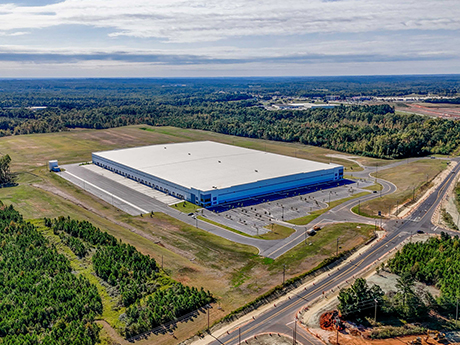
Montgomery says BMW suppliers have also been taking down space in the region. DraxlMaier Group recently signed a lease at Tyger Ridge Logistics Center in Duncan, S.C.; ZF Group is investing $500 million to expand its automotive transmission plant in Gray Court, a city in Laurens County ; and STAG Industrial and Trehel Corp. recently delivered the expansion and renovation of the Autokiniton manufacturing plant in Fountain Inn, S.C.
Additionally, Isuzu North America Corp. chose a 200-acre property in Greenville County for a new project earlier this year. The car manufacturer will invest $280 million to convert the 1 million-square-foot facility into a new assembly plant and will create more than 700 new jobs. Isuzu plans to begin operations in 2027.
Garrett Scott, managing director of Colliers’ Spartanburg office, says that the Greenville-Spartanburg region is a maturing industrial market that is starting to see more sophistication than in the past.
“We’re reaching some of those maturing milestones,” says Scott. “We’re at nearly 270 million square feet and starting to see different pricing in different submarkets throughout the region. These are things you see in larger, institutional markets, so we’ve cleared that hurdle and should be viewed that way.”
Scott adds that the development discipline for Greenville-Spartanburg is different than the overbuilding of the previous real estate cycle. Montgomery adds that the strong absorption in the market might as well be a flashing neon sign to developers that more supply is needed in the region.
“We are begging our clients to get the band back together and start building again, because we are going to be out of product soon,” says Montgomery.
The only question is, where should they build?
“We have available land with utilities here in Spartanburg County; Greenville County is about tapped out,” says Montgomery. “Anderson County has utility shortfalls, which really make it very difficult to develop. Pickens and Oconee counties also have topography issues with wetlands and streams — it’s really hard to assemble a big tract of land and it’s cost-prohibitive to get sewer lines out there.”
Even with those obstacles, there are some projects in those counties worth noting. Locally based RealtyLink is developing Speedway Business & Technology Park in Easley, a city in Pickens County. The site, which will accommodate up to 4 million square feet of development, sits on the 600-acre site of the former Greenville Pickens Speedway.
Phase I of the project, which is estimated to cost roughly $100 million to develop, will span six warehouses, and Phase II will add four additional buildings to the site. RealtyLink recently obtained a $28.5 million construction loan to help fund Phase I.
Additionally, Farpoint Development recently executed a new 10-year lease with BMarko Structures, a manufacturer of modular buildings, at 134 Long Road in Williamston, S.C. Farpoint recently delivered the 560,240-square-foot facility in Anderson County.
“BMarko took space along with Veritiv,” says Justin Patwin, principal at Farpoint. “We bought that 50 acres in 2023 and delivered it in 2024, which was a tough leasing year for the Greenville-Spartanburg market.”
BMarko’s new corporate headquarters is expected to create 225 full-time jobs and tap into the skilled workforce and advanced manufacturing presence in the I-85 corridor, according to Farpoint. Patwin echoed Montgomery about the difficulty of developing in Anderson County, though the market has obvious potential from a location perspective.
“Anderson County is an ideal location being equidistant between downtown Atlanta and downtown Charlotte and not far away from Greenville,” says Patwin.
The Keith Corp. owns Battleground Commerce Center, an industrial park in Cowpens, S.C., that can accommodate a 507,600-square-foot cross-dock facility and a 233,280-square-foot rear-load building. The development is situated in Spartanburg County.
“We’ve seen an uptick in leasing activity in the Cowpens area and across Greenville-Spartanburg market as a whole,” says Matt Giannuzzi, vice president of industrial development at The Keith Corp. “We are excited to build out the park in the near future.”
In Greenville, Crescent Communities is currently developing AXIAL Crosspoint, a three-building industrial park spanning nearly 560,000 square feet.
“We are now 82 percent leased to five tenants,” says Kerley. “The facility had 32- to 36-foot clear heights, ample trailer and auto parking and deep truck courts. We are now looking for our next investment in Greenville.”
Atlanta
Atlanta is one of the pillars of the I-85 corridor, exceeding 900 million square feet in size as of third-quarter 2025 with a vacancy rate that currently sits at 9 percent. According to research from CBRE, this is the highest vacancy rate for the market since 2014.
Atlanta has about 4.1 million square feet under construction, which represents less than a half-percent of the market’s inventory and roughly 10 percent of what was being developed three years ago. Barton of CBRE says that the overall Atlanta market is in a healthy place, though it’s not without its warts.
“2025 is a little flatter than we thought for development,” says Barton, citing tariff concerns as a fly in the ointment. “Activity in the fourth quarter is back to the level we saw in the first quarter. We are going to see good momentum going into 2026.”
Similar to construction, leasing activity has been pretty muted this year. The market absorbed less than 2 million square feet in the third quarter alone and a little over 3 million square feet year-to-date, according to CBRE.
“Absorption was a little over 10 million square feet in 2023 and 14 million square feet in 2024,” says Barton. “One of the things that has been notably absent from the Atlanta market are bigger bulk warehouse tenants — they’ve been on the sidelines.”
One recent deal is Power Grid Components (PGC), a Blackstone portfolio company that manufactures and distributes advanced components for utility transmission and power distribution, taking a little more than 250,000 square feet in Locust Grove, Ga. Granite REIT owns the park, which sits about 36 miles south of Atlanta.
Barton is confident that the Atlanta market could “snap back” if leasing activity picks back up due to the minimal amount of new construction underway. He adds that although Atlanta’s user base is diverse, automotive groups are finding outsized success in the metro region, including the new Rivian plant in Social Circle, Ga.
“There are a lot of automotive-related companies, and they can be either gas or electric vehicles,” says Barton. “We are in a great spot for automotive-related manufacturing companies, because we’ve got Kia down in West Point and Hyundai in Savannah and Montgomery.”
Barton says that Atlanta’s growth is very broad-based as every submarket has a few projects underway. Trammell Crow Co. and a consortium led by CBRE Japan are developing Buford Creek Business Center, a three-building, 686,400-square-foot industrial park in the northeast suburb of Buford in Gwinnett County. The development team plans to deliver the project by third-quarter 2026.
Holder Properties, along with equity partner Hartford Investment Management Co., is underway on Dogwood Logistics Center, a 388,960-square-foot industrial project in Conyers, an eastern suburb of Atlanta in Rockdale County. Another infill project in the pipeline is LogistiCenter at South Forsyth, a 93,960-square-foot facility by Dermody Properties in Johns Creek, Ga.
In Atlanta’s Northeast 85 industrial submarket, Logistics Property Co. has broken ground on Phase II of Gainesville 85 Business Center, a 1 million-square-foot, four-building industrial park in Gainesville. Phase II will comprise two buildings, 1800 and 1850 Fulenwider, that span 326,040 square feet.
Barton says that the upcoming Northeast Georgia Inland Port, which will connect directly via rail to the Port of Savannah and will open next year, sits about six miles from the site of Gainesville 85 Business Center.
“An inland port is a key transportation component that has been missing from the Northeast Atlanta industrial market,” says Barton. “The inland port is starting to generate a good bit of interest and activity; it’s going to be a big benefit to users in the area.”
On the southwest side of town, Seefried Industrial Properties is developing a 1.6 million-square-foot sortation center in Hogansville. Set to open in 2027, the property in Troup County will serve as Amazon’s third sortation center in Georgia.
Farpoint, along with Grandview Partners, is underway on Lafeyette Logistics Park, a 134-acre industrial project located with I-85 frontage in LaGrange. Plans for the site include the development of up to 2 million square feet of industrial facilities across two phases.
“We delivered the first two buildings in Phase I of Lafayette Logistics Center in March, and even before delivery we had a ton of activity on the leasing front,” says Patwin. “We have already leased up Building B, which is 265,000 square feet. Then we have a group that’s interested in about 30 percent of Building A. So in a short amount of time, we’ll be 75 percent leased, which is strong by comparison because Atlanta is having a down year in terms of absorption.”
Patwin points to the thoroughness of the LaGrange Development Authority’s Scott Malone and Kelley Bush as being vital to the success of LaGrange from a business activity standpoint, along with the unique legacy infrastructure set up by the Callaway family. The city will also be home to the upcoming West Georgia Inland Port.
Long story short, Patwin says that LaGrange is the best kept secret in the I-85 Industrial Corridor, referring to the market as a “needle in the haystack.”
“Transportation and utilities are the two most important factors for industrial users, so since LaGrange has both, it was inevitable the market would attract industrial users,” says Patwin. “And if you want to look at it holistically, over the past four years 3,000 new multifamily units have been delivered. The economic development team looks at the market as a 360-degree ecosystem to support business.”
— By John Nelson; This article was originally published in the November 2025 issue of Southeast Real Estate Business. Visit interfaceconferencegroup.com for more details about the upcoming I-85 Industrial Corridor conference this spring.