

By Taylor Williams
The Texas industrial market could use a little ABS.
The acronym, which stands for automated ball-strike system, has been a — wait for it — game-changer in 2026 for Major League Baseball, the innings of which are often invoked as metaphors for points in real estate cycles. The ABS system establishes a clear, objective picture of the strike zone that eliminates doubt among players, managers and umpires about whether a pitch is a ball or a strike.
Like any good sports technology, the system provides clarity on the rules of engagement, which leads to better operational execution. It’s been a — wait for it again — big hit for the game.
Efficiency in real estate development and investment similarly hinges on data that is governed by universally accepted frameworks. While there is always the hopeful possibility of stumbling upon a hidden indicator, most real estate investors and operators are inter-reliant on themselves — in the form of industry comps — and their established metrics to understand where they are in a given cycle. There is room for disagreement, but only to a certain extent.
With regard to industrial real estate in Texas, what is essentially indisputable is that a period of oversupply ensued following the immediate post-COVID building boom. In some markets, like Dallas, bulk product specifically got overbuilt; in others, like Austin, pretty much all product got overbuilt in what some industry professionals now view as a “coming out party” for the state capital’s industrial market. What’s less clear today is whether an inflection point has either very recently (by industry standards) passed, is happening right now or is right around the corner.
Like everything else in commercial real estate, the answer is submarket- and product-specific. But sources interviewed for this article agree that at the very least, absorption of industrial space is showing signs of improvement, meaning it’s only a matter of time until a groundswell of new projects get going and more deals start trading.
“The idea that all the new supply has led to depressed deal volume is more of a 2025 narrative; across all markets in 2026, we’ve moved on from that phase, and there’s been a massive wave of absorption,” says John Colglazier Jr., partner and managing director at Partners Real Estate. “Supply is getting absorbed, and the [development] pipeline is down to a trickle. It’s not a green shoots conversation by any means, but the market is beyond the correction phase and is now at the front end of the next cycle.”
Colglazier points to elevated absorption of bulk product in Dallas-Fort Worth (DFW) as perhaps the most telltale sign of improved market performance.
“In DFW, there were about a dozen million-square-foot buildings [that were vacant] at the beginning of the year, and they’re pretty much all gone now,” he says. “That’s where the wave started, and it’s since rolled through the state. We’re working at a pace now that’s more aligned with traditional cycles — a market that’s not on fire, not tanking, just a healthy balanced market. And it feels weird because the last six to seven years have been marked by extremes.”
At least one owner shares this perspective.
“It does feel like the market has turned the corner,” says Taylor Starnes, regional vice president of acquisitions at CapRock Partners, a California-based development firm that is active across Texas and maintains a second headquarters in Fort Worth. “During the peak COVID years, the U.S. market delivered close to 2 billion square feet, so supply did get out of balance. But over the past couple of years, deliveries have slowed down, primarily driven by the capital markets, which has resulted in a more controlled balance between supply and demand. As a result, we’re now starting to see developers take up land positions and kick off new projects.”
Starnes also alludes to stronger demand for larger buildings in the powerhouse DFW market as a surefire sign of rebound.
“Much of the tenant activity in DFW this year has been driven by bulk-user demand, specifically ‘super bulk’ — 700,000 square feet and above,” he says. “There are a lot of tenants with those size requirements. We aren’t seeing as much activity from the 50,000- to 200,000-square-foot users, but overall DFW had more than 20 million square feet of net absorption in 2025. That’s been a barometer over the past seven to 10 years, and we’ve consistently exceeded it.”
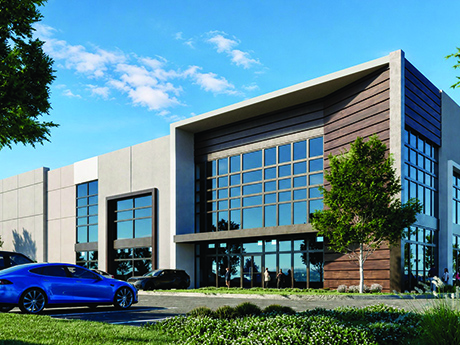
Jackson-Shaw recently broke ground on Horizon 35, a 908,730-square-foot project in Denton. Sources say that 2026 has thus far proven to be a year of healthier absorption of large-scale industrial product throughout the metroplex and North Texas as a whole.
Adam Abushagur, senior managing director of investments in Marcus & Millichap’s Dallas office, notes that small- and medium-sized industrial product was never drastically overbuilt in DFW compared to bulk. Yet those segments of the market did inevitably cool off as larger macroeconomic and geopolitical factors took root and impeded sales volume.
“Smaller and middle-market product have experienced a sort of market gap in the past couple years. There hasn’t been enough pain to where sellers are willing to meet the market in a lot of cases, and buyers can’t pay what they were paying five years ago because the math doesn’t math,” Abushagur explains.
“There’s been a pickup in leasing in the past month or so, but overall the past 18 months have been a very slow leasing environment, and it started to create some pain,” he continues. “The market made it through the big shock in which buyers and sellers got acclimated to the new [interest rate] environment, but now we have a war and inflation issues on the horizon, so buyers are chasing yield and stability.”
Sales Patterns
Sources say that from an investment sales perspective, markets are demonstrating trends that are more consistent with traditional philosophies.
Whereas a couple years ago, when rents were still growing at healthy clips, investors were hot for mark-to-market deals with low weighted average remaining lease terms (WALTs) and little concern for tenant credit. Today, investment opportunities featuring properties with creditworthy tenants and longer WALTs are firmly back in the spotlight.
“That was a short-lived trend that went against most traditional real estate fundamentals,” Colglazier says of the low-WALT investment craze. “There’s always a place for credit and term, regardless of the flavor of the day. Some investors may want rocky road or mint chocolate chip one day, but chocolate ice cream is always going to be chocolate ice cream, meaning there’s never going to be a full departure from credit and term.”
“Credit and term are definitely back, which is a return to real estate fundamentals in the sense of having functional, cash-flowing assets,” agrees Starnes. “That’s what real estate professors and textbooks have taught since the beginning of time; it was an anomaly to see the broad range of groups chasing those low-WALT and mark-to-market deals with such vigor. Today, investors are showing a flight to quality — functional buildings, strong credit and long-term cash flow.”
Abushagur notes that mark-to-market deals can still be found in industrial submarkets that are still maturing but agrees that by and large, the outsized emphasis on low-WALT deals that prevailed a couple years has been “flipped on its head.”
“Savvy investors are always looking for deals that are leased below market rates and finding ways to get to market,” he says. “The piece that’s changed is the risk that buyers are willing to take in today’s environment.”
“Back in 2020, for a fully vacant, shallow-bay deal, buyers could and would underwrite $12 per square in rent, and we’d have an offer within a few hours,” he continues. “Today, that’s a whole different world; groups are underwriting lower rent — maybe $8 per square foot — and maybe a 15 percent vacancy factor. They’ll still buy, but the risk level is different; they’re a lot more hawkish on rent growth and vacancy.”
Another pattern taking shape in the investment sales market centers on occupiers making bids to own their buildings. This push has been especially common among manufacturers, which has led to increased valuations of those facilities, says Jim Autenreith, market leader in the Houston office of KBC Advisors.
“It’s very expensive to relocate as a manufacturer. A lot of institutional capital groups, especially those that left the office market post-COVID, have gone all-in on bulk distribution and manufacturing, buying buildings they wouldn’t touch five or six years ago,” he says. “But now there’s actually credit [behind those manufacturing deals] along with a high likelihood of renewals, so those capital groups are making it harder on users [because they also want to own those facilities], which is driving up prices.”
In certain parts of Houston, Autenreith sees room for value appreciation in properties that are leased to vendors and other groups that support data center development. He says that leasing activity among these groups has been strong throughout the past year or so and could easily continue in that direction.
“The data center boom really represents a second wave [of demand following the pandemic], and we’re probably still in the first couple innings of it,” he says. “The money is starting to trickle down from the developers buying the land; they’re now doing sitework and ordering components, which creates demand from smaller companies.”
“On the other hand, shallow-bay industrial occupancies in Houston that have seen high levels — in the mid-90-percent range — are now seeing occupancy in the 80 percent range and are struggling to get to market rents, so we may see more pain in that segment of the market,” Autenreith concedes. “The second rush from data centers could be masking some of that pain, and while there seems to be plenty of runway left, like all real estate cycles, the music will stop at some point. Let’s just hope it’s not any time soon.”
Sources in the metroplex, including Abushagur and Sean Dalfen, president and CEO of Dallas-based owner-operator Dalfen Industrial, say that data centers have yet to really generate meaningful leasing activity in DFW. However, Dalfen says that doesn’t mean that those plays have been completely meaningless to that market, which is objectively more mature than the markets of greater Houston or Central Texas.
“We haven’t necessarily seen the users servicing [data centers] here like we have in other markets, where parks can fill up overnight with vendors,” Dalfen says. “But data centers have reduced the availability of infill industrial land, which has made existing product even more finite and valuable. There’s simply less land to build, and it’s harder to get [sites] approved.”
Cycle In, Cycle Out
Multiple sources also say that a slowdown in one of the final stages of a deal — the returning of capital to investors — is a manifestation of how the Texas industrial markets are showing significantly different conditions today than five to seven years ago.
“Broadly speaking, deal volume is down because capital from past deals and projects hasn’t been returned to investors,” says Dalfen. “Today, especially in the fund world, there’s a need for DPI (distributions to paid in capital), which refers to the extent to which investors have received [back] the money they invested, which wasn’t important five years ago. A few years ago, pricing was clustered; the market was very liquid, and there were always buyers.”
“In the past, you could show book returns to satisfy investors; today, to raise more money, you have to actually be putting money back in investors’ pockets,” he further explains. “If as an owner, you haven’t distributed that money to investors, being able to do so is more important than getting an extra million or two [on the price] of a given deal. If you missed that window and are unable to sell, that’s just more time away from getting capital back to investors.”
Dalfen also says that from the perspective of a seller, especially institutional groups, that change can take the form of awarding deals to buyers that aren’t necessarily offering the best price. The certainty that the buyer will close and the seller’s investors will get their money back in a timely manner can be just as, if not more important, because that’s a prerequisite to kicking off the next deal.
“Recycled capital has definitely had a role in delayed deal volume,” agrees Abushagur. “Those same buyers of value-add and speculative industrial bought those deals throughout 2019 through 2022. The window for lease-up and markup to market and exiting those deals is usually, at worst, five years.”
“So we’re past that already, and on a lot of those deals, owners have had to refinance or kick the can with their lenders,” he continues. “The money is stuck waiting for lease-up to happen and the exit to occur, whereas historically those owners would have sold and bought another deal — if not multiple deals — already.”
Indeed, hindsight is truly 20/20 with the Texas industrial market. But both industrial real estate as a whole and the overall Texas economy have major tailwinds at their backs, and with the benefit of a little more time, more data and insight may well emerge to solidify the broader narrative of the past seven-plus years. But today, the picture is less clear, and the acceptance of a single narrative is less absolute.
“Looking back at 2019 through 2022, when interest rates were at all-time lows and deals were trading at or below the [10-Year] U.S. Treasury yield — you can see what free money does to an economic engine,” says Starnes. “We can also see that from 2023 through today, real estate has been in a recession; there’s been lower trading volumes and less recycling of investor capital. But tenant activity is picking up, and supply is becoming more balanced, and yet it’s still hard for a lot of deals to pencil based on where costs of capital and exit cap rates are being underwritten today. So while we’re not out of it yet, we certainly seem to be moving in the right direction.”