

By Taylor Williams
On some level, they knew this was coming, right? They just thought it would be over by now.
Indeed, the expression, “survive till ’25” has proven insufficient as a barometer for when the multi-year slowdown in multifamily rent growth and valuations — inevitable consequences of the record-high sales prices and record-low cap rates that were achieved in 2021 and 2022 — would eventually fizzle out. Unprecedented supply growth in recent years, catalyzed by historically low interest rates and insatiable demand and taken to perhaps the highest of highs in Texas, has, unsurprisingly, generated cyclical pain in subsequent years. True, that pain is submarket-specific and is likely on its way out, but that doesn’t change the fact that it’s tough sledding for many multifamily owners right now.
“Multifamily has had almost everything possible thrown at it in the past few years: interest rates rising, rental rates flatlining due to supply growth and operating expenses going up across multiple categories, from payroll to insurance to repairs/maintenance,” says John Griggs, co-CEO and co-founder of Texas-based developer Presidium. “Everything started flipping the wrong way at the same time. Some of those variables may correct in our favor, but it’s now been several years of challenging conditions.”
Concessions are up, values are down and equity investments for new projects are less common than a deep Cowboys postseason run. Yet developers are still actively scouring sites, forging new capital partnerships and meeting with local municipal leaders, as well as embracing tech-driven solutions to boost leasing velocity and efficiently manage concessions at existing properties.
In other words, they’re doing what they always do. Unless they’re not, in which case they’re actively looking for properties to buy, trusting that the established wisdom of the theory of replacement costs will lead them to success.
Some developers that this writer has reported on in recent months openly declared 2026 to be a “pencils-down year.” Yet all sources interviewed for this story say that despite the challenging market conditions, they’re maintaining an aggressive approach to business, whether through building or buying.
“We’re searching for premier sites and trying to get ahead of the next cycle and have new product on the ground when rents start taking off again,” says Tim Harris, senior vice president at Dallas-based Rosewood Property Co. “We’re bullish on starting new projects and getting them capitalized in certain submarkets with high barriers to entry. Those deals can take a long time to get in the pipeline, but we’re underwriting more conservatively than we have in the past while staying just as active.”
Rosewood’s recent activity reflects that mindset. In April, the company received zoning approval from the Plano City Council for Heritage Creekside, a 156-acre mixed-use development that will feature a heavy residential component: 340 single-family homes and 2,000 apartments to be developed in phases.
At the time, Rosewood said that these pieces of the project represented a shift in the previous plans for Heritage Creekside, which was originally planned to feature heavier office and hospitality uses. The statement could be interpreted as an implicit endorsement of the belief that better multifamily fundamentals are on the horizon.
Other developers describe similar situations.
“We’ve started five deals since the beginning of last year, have another project that will start in August and have two more that we’re actively designing that we project will go vertical either by the end of this year or by the first quarter of 2027. So we’re are not sitting on the sidelines,” says Kevin Hickman, principal at Trammell Crow Co. (TCC). “We’re trying to pick markets carefully and identify those submarkets that have limited near-term supply growth.”
In April, High Street Residential, TCC’s residential subsidiary, broke ground on a 281-unit project in the northeastern Dallas suburb of Richardson. A few months prior, the company began construction on a 394-unit project that is situated adjacent to DART’s SMU/Mockingbird Station in Dallas. The projects, which have yet to be formally named, are both expected to be complete in late 2027.
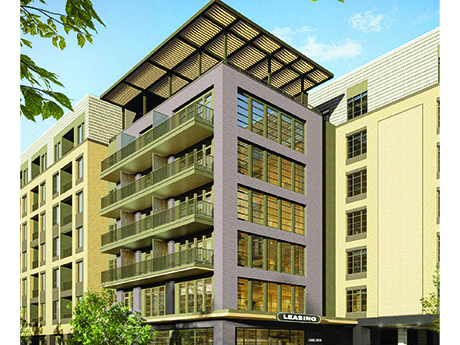
Pictured is High Street Residential’s new project by DART’s SMU/Mockingbird Station in Dallas, which is expected to be complete late next year. Although fundamentals remain unfavorable, the firm is still actively pursuing new developments, banking on the established patterns of outstanding long-term job and population growth throughout Texas.
Presidium is one group that has chosen the alternative method — buying — as a means of staying busy during the multifamily downturn. Griggs says that acquisitions have been a bigger part of the company’s activity this year. The firm completed multiple projects — the 374-unit Presidium 183 in North Austin and the 338-unit Presidium Valley View in the northern Dallas metro of Farmers Branch — in late 2025.
Presidium’s latest acquisition is Whitney at The Heights, a 186-unit apartment complex located just outside of downtown Houston that was built in 2001 and has value-add potential.
“We expect acquisitions to continue to be a big part of our business [in the near term], especially for deals that are distressed or can be acquired below replacement cost,” says Griggs. “If you can buy below replacement cost, it begs the question of ‘why build?’ There’s still a perception that this isn’t the best time to build because more supply is still coming on line and exceeding demand, at least in certain submarkets.”
Although his firm is actively developing, Harris also acknowledges the logic of this approach based on current market conditions.
“New apartments almost always have higher rents and higher returns for investors,” he says. “But it’s hard to justify taking the development risk and going through that process today as opposed to buying a property without that risk, especially in submarkets in which you’re competing with projects that just came on line and are listed for sale.”
Only The Best
Regardless of how loaded their company’s development pipelines are, all sources interviewed for this story agree that any project that gets capitalized today has to have some sort of X factor behind it.
“We are selectively pursuing some new developments,” says Griggs. “But these new projects really require ‘plus factors’ to work, like a partnership with a housing authority that allows for tax abatement, or HUD financing that’s relatively high-leverage and low on the interest rate, or a low land basis. The bottom line is that for deals to pencil right now, there has to be some sort of interesting circumstance.”
In addition, all sources say that securing equity is among the most challenging parts of said capitalization process.
“Today, equity is looking longer-term and getting most excited for differentiated projects with best-in-class developers,” says Matt Bronstein, managing director at Houston-based BHW Capital. “Equity investors are looking to see solid, yet conservative, in-place assumptions backed by real-world actual data. Across the board, each assumption and deal point are getting picked apart in fine detail as investors dive deeper into developers’ track records, sponsors’ actual equity investment, underwriting assumptions, complete development team and overall portfolio performance.”
“At this point in the cycle, many institutional equity providers remain cautious about committing capital to new ground-up development,” notes Will Marsh, principal at Austin-based Endeavor Real Estate Group. “Like Endeavor, equity groups that are investing in multifamily high-rise projects today are concentrating on a very limited number of submarkets across the country.”
Endeavor, in partnership with Canyon Partners Real Estate, recently announced plans for Lucille, a 22-story apartment building in Uptown Dallas that will have 265 units. Marsh says that the neighborhood’s built-in combination of “exceptional office leasing activity, a walkable urban environment, substantial barriers to entry, high replacement costs and limited near-term supply” make the submarket a very compelling landing spot for new projects. Lucille is expected to be complete in late 2028.
“Select groups that do have equity know they’re in a select set since many groups are not deploying, so they get to be picky, and they won’t capitalize just any project,” says Hickman. “The development has to be special and have a unique story, and the developer has to be able to show why the project won’t be ridden with oversupply in the next year or two.”
“Investors are looking at rents today without making [strong] assumptions about where they’ll be in two years,” adds Harris. “Some equity groups can see the forest through the trees. But despite what you can show investors in terms of fundamentals after the project is built and leased, some still want to see occupancy and rents going up and paces of absorption improving today.”
That’s essentially a complete 180 from the capital markets mindset of a few years ago. At that time, the adage of “every deal works at 3 percent interest” was not just a popular saying, but a legitimate framework through which some projects were capitalized — projects that sources say would likely not come together in today’s market.
“What happened [in 2021-2022] is that people still made a lot of money on deals or projects that weren’t that great because they got bailed out by a crazy good market,” recalls Harris. “That fueled more of that type of activity, and when the tide went out, it became clear who wasn’t wearing a swimsuit. So you can’t overstate the importance of having solid underwriting that is defensible and doesn’t reflect a sense of just doing a project for the sake of doing a project.”
The silver lining within that sentiment, if there is one, perhaps lies in the fact that Texas perpetually has such strong job and population growth, which should function as a mitigating factor of oversupply, in theory. In addition, recent data released by the U.S. Census Bureau shows that nationally, new construction starts are down in 2026 on a year-over-year basis.
“Deliveries will come way down over the next couple years, so if you start a project today or next year, you’ll likely be delivering into a market with less supply,” notes Griggs. “But you really have to have conviction that you’ll be delivering into a market with minimal competition and that the dearth of supply growth we should see in the next year or two will help with operations and cash flow.”
Renters Take Advantage
According to industry publication Multifamily Dive, which cited data from the Dallas Federal Reserve, concessions are “more widespread in Texas’ major metro areas relative to the nation.”
Austin appears to be the market leader in that category. The Austin American-Statesman, citing data from Apartments.com, reported in June that some 700 apartment complexes in the state capital are currently in concessions mode, with 60 percent offering one to two months of free rent. And according to CoStar Group, over 60 percent of recent leasing activity in the Dallas-Fort Worth area has been subject to concessions.
“Concessions for new leases have become prolific across most Texas markets for Class A [multifamily product],” confirms Bronstein. “They are proving to be sticky as renters today continue to face inflationary pressures throughout everyday life. Both the oversupply and slowing demand-side factors — both job and population growth — in specific markets will continue to be a driving factor in the prevalence of concessions as a rental tool to attract new residents.”
That dynamic is not lost on renters.
“We have projects delivering in certain suburbs that are high-supply submarkets, and what we’ve noticed is that these prospective tenants are sharp and educated and want to shop for the best deals,” says Hickman. “So from our perspective, structuring concessions appropriately for each submarket is very important.”
“Renters have become savvy and knowledgeable, especially with the online resources available today,” agrees Bronstein. “They are often seeking ‘a deal,’ which most often comes in the form of a concession. And so across our portfolio, we analyze and structure concession offerings at each community frequently, using multiple specific asset factors to try to optimize each individual asset’s performance.”
In competitive times of oversupply, developers and operators try to zero in on key in-unit features and amenities that resonate with renters. While providing built-in work nooks or poker tables or sponsoring happy hours on the property may yield an additional lease or two, sources say that the key to creating an advantage in the current leasing environment is more abstract.
“We’re trying to create communities where renters feel at home as soon as they walk onto the property,” says Hickman. “We’re diligently designing spaces that tie the front door to the interiors to the amenities all the way to the pool courtyard, and we want our property managers to provide an incredible level of service throughout the renters’ experience.”
Sources also suggest that while amenities can still be important to the resident experience, it’s no longer an “amenities arms race” like it was a few years ago.
“Amenities are important and competitive among developers, but we won’t provide an amenity unless we can do it really well or it’s a win-win for everybody,” says Harris.
“At the top of the market a few years ago, the amenities arms race maybe got a bit out of hand,” concedes Griggs. “Some other bells and whistles can help move units, but the actual utilization of some fancier amenities isn’t really there. New developments have to pencil in this environment, so we’re focused on bread-and-butter amenities that people really care about rather than landing on the new, shiny object. When you get down to it, people really just want a nice unit with modern finishes and appliances with a good look and feel.”
— This article originally appeared in the July 2026 issue of Texas Real Estate Business magazine.