

By Maria Gutierrez, senior communications specialist, Colliers Engineering & Design
Whether it pertains to acquiring sites, designing improvements or developing a residential or commercial property in Texas, land terminology can quickly become confusing. Two terms that are commonly mistaken, and often used interchangeably, are survey and plat.

“In this field, people often use these terms synonymously, but they fulfill completely different steps in the development process,” notes San Antonio-based Corey Campbell, RPLS, geographic discipline leader for survey and geospatial at Colliers Engineering & Design. “A survey gathers and documents the physical facts about the land on the ground, while a plat uses those facts to legally define how that land is divided and recorded for the future.”
Because an approved plat depends entirely on accurate site data, a comprehensive title survey is almost always the required first step.
Navigating that transition from survey to recorded plat requires a complete end-to-end strategy. That is where Kelly Kephart, senior project manager and Texas platting director for survey and geospatial services at Colliers Engineering & Design, spends her time. Based in Houston and with 26 years of experience and over 1,000 completed plats, Kephart helps developers clear regulatory hurdles and manage the entire platting process from start to finish.
A Process That Changes With Every City Line
While the general platting path across Texas follows a familiar sequence — survey, draft, submit, address city comments and record — the timeline and complexity vary dramatically depending on the municipality.
Houston and San Antonio, for example, follow very different platting processes. Houston has no zoning, accepts fewer required documents and can often turn a plat around in three to four months.
Because Houston city limits are so small, and the city has a very large ETJ (extra-territorial jurisdiction), plats all go through the City of Houston and Harris County, while the engineering plans go only through the county. Plans can be approved after the plat is approved, but the plat can’t be recorded until the plans are approved. This streamlined approach helps support the region’s high volume of development, with approximately 3,000 plats recorded annually.
By contrast, San Antonio’s zoning requirements and more extensive review process result in fewer than 1,000 plats submitted each year. A typical plat may receive comments from up to 20 city departments, require formal certification letters and go through public hearings and planning commission approvals, extending the process to roughly six to eight months from start to finish.

“San Antonio has had its regulations set up for the last 50 years, and everybody else is now catching up,” explains Kephart, adding that San Antonio and Austin tend to be the most demanding markets overall, with comments submitted from multiple departments at different stages of review. This represents a sharp contrast to Dallas and Houston, where departments typically respond all at once.
Managing the Entire Job From Start to Finish
At many firms, platting is treated as a paper-pushing exercise, where staff may simply pass comments back and forth between a city reviewer and a drafter without understanding the underlying technical details. Those groups often fail to recognize when a utility line needs an easement, misinterpret setback lines or accept city comments that are not actually required by code.
The best teams take full ownership of the process from A to Z: drawing the plat, coordinating directly with clients and civil engineers, gathering required documentation, researching code, managing municipal reviews and pointing out red flags early. These red flags may include encroachment agreements or right-of-way dedications, and catching these issues early in the development process is vital, as missing strict platting deadlines can cost a client hundreds of thousands of dollars in project delays.
One engineering client came to Kephart’s team after his staff had gone through six rounds of city comments and still had not satisfied the requirements on the plat. Kephart rebuilt the plat from scratch and resubmitted it, obtaining one minor comment and got the approval. “The client told me he didn’t want his guys touching platting again after this experience with us,” Kephart noted. “That’s the kind of results it takes to keep clients coming back.”
Kephart cites communication and transparency throughout the process as a vital approach to the business and one that clients regularly appreciate.
“From day one, we tell clients that platting is neither fast nor easy, and we want them to know exactly what they are up against,” she explains. “We provide a fee estimate upfront and guarantee status updates. Everyone on the team will always respond to an email within 24 hours, no exceptions.”
A major client in the Houston area recently asked Kephart’s team to start a plat, yet Kephart discovered that another firm had already begun the process without the client’s knowledge.
“We immediately called the client and informed them that it was already underway. At that point it was in their best interest — time and money-wise — to let the other firm finish,” Kephart says. “That client still comes to us, because of that honesty.”
What To Ask Before You Plat
Kephart’s advice to landowners and developers is simple. Ask about timelines and hidden site conditions before committing to a plat. Is the property in a floodplain? Are there easements crossing it? Will utilities need to be extended to reach it?
Skipping those questions can be costly. Kephart recalls a residential client who wanted to build a single home on a narrow strip of land, until platting revealed a set of barriers, including a right-of-way, a new street and extended sewer and water lines for one lot that carried a price tag of roughly $2 million. “He asked me why his surveyor never told him,” Kephart recalls. “That’s exactly the kind of surprises the plat is supposed to catch before it costs you.”
Comprehensive Survey & Platting Services
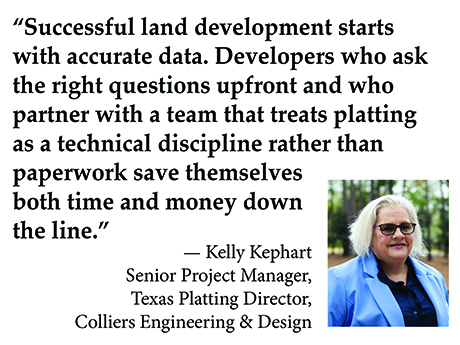
Successful land development starts with accurate data managed by a trusted partner. Developers who ask the right questions upfront and who partner with a team that treats platting as a technical discipline rather than paperwork save themselves both time and money down the line.
“One of the greatest values we bring to our clients is helping them identify opportunities and constraints they may not even know to ask about,” says Campbell. “When we’re involved early in the process, even at the bid stage, our team takes a proactive approach by conducting the research, evaluating site conditions and uncovering critical information that can impact project success. That insight allows us to better inform our clients, reduce surprises down the road and help them make smarter decisions from the very beginning.”
About the Experts
Corey Campbell, RPLS, serves as the Texas geographic discipline leader for survey/geospatial at Colliers Engineering & Design. With more than 20 years of industry experience, he specializes in end-to-end surveying services, bridging the gap between initial land platting (subdividing), residential and commercial site development and post-design construction support.
Kelly Kephart is the senior project manager and Texas platting director for survey/geospatial at Colliers Engineering & Design. A certified drafter and former engineering designer, she has spent 26 years mastering the platting process and has extensive experience throughout the state.