

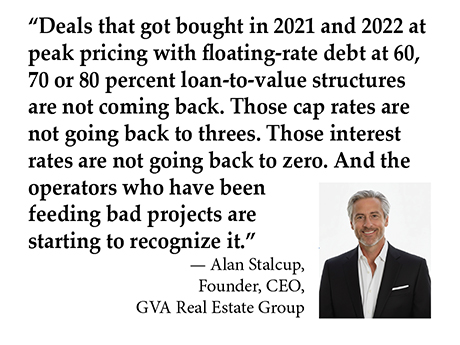
By Alan Stalcup, founder, CEO, GVA Real Estate Group
Many investors are watching the distressed commercial real estate market and waiting for the moment to buy. That moment isn’t here yet.
But the debt market? That’s a different conversation.
By some estimates, more than $600 billion of multifamily debt matured across 2024 and 2025 — the largest two-year concentration on record. Lenders extended roughly $400 billion of those loans over the past several years. Most of them are coming due again.

Same assets. Same problems. Higher rates, deflated values, limited options to refinance or sell. And to see what that looks like up close, look at the state of Texas.
More than $800 million a month in commercial loans have hit foreclosure auctions in this state for four straight months. About 70 percent of those loans are backed by apartments. Houston alone saw $250 million in multifamily debt go to auction in a single week last summer.
Dallas-Fort Worth (DFW) and Houston delivered record levels of new apartments between 2022 and 2024. All that supply is now sitting on top of the debt problem. Rent rolls are coming in below levels that were underwritten at origination. The income isn’t there. The basis doesn’t work. The debt is stuck.
Then there’s Texas House Bill 21, which just killed a tax loophole used by affordable housing operators. A $62.5 million Houston CMBS loan went to special servicing within weeks of it passing. And that’s not the last one.
The issues exist elsewhere too. Simply put, the can has been kicked down the road as far as it will go. When lenders can’t extend anymore, they have two choices: take the property back or sell the loan at a discount.
Both scenarios are happening now. The first camp is foreclosing. Most of these lenders aren’t operators. Those assets will eventually hit the market as real estate-owned (REO), the term for lender-owned assets that fail to sell at auction, and investors on broker lists are already starting to see these deals trickle through. The second camp is selling loans today at meaningful discounts rather than risk operating a deteriorating asset.
That second camp is where the opportunity lies.
Distressed Debt Offers Optionality
Distressed debt — loans discounted below the unpaid principal balance and in default — is trading at 50 to 85 cents on the dollar. At that pricing, discounted notes can generate 7 to 11 percent current yields, with total return potential in the high teens to low 20s. Loans in the 70- to 85-cent range still have fundamentally sound real estate underneath them.
Bigger discounts mean tougher assets. But tread carefully.
What makes debt different from a direct acquisition is optionality. Lenders can hold the note at a discount and collect income. They can modify terms with the borrower; the lower basis creates flexibility that those groups can’t get anywhere else. Lenders can foreclose and take the property back at a discounted cost basis, or they can exit the position as the market recovers. No direct purchase offers that many ways to win — sitting senior in the capital stack and generating current income, with multiple exits available.
In multiple high-growth markets, the note pipeline is packed with deals from 2021 and 2022: value-add multifamily, peak pricing, floating-rate debt.
The borrowers can’t refinance at today’s rates, nor do they have the equity to recapitalize. They’re effectively out of moves. That’s the profile that produces notes at real discounts with real collateral underneath.
There are numerous Class B and C garden-style apartment communities in submarkets where people need to live. The rental demand is there. The assets aren’t broken.
The capital stacks are.
This investor recently picked up a $15 million note at an 8 percent discount using assumed note-and-note financing. That structure creates a 16 percent cash-on-cash yield. Separately, this investor acquired a $25 million note for $18 million. Current pay on that one is an 8 percent cash-on-cash yield. Once it’s paid off, the deal should generate a internal rate of return of 22 percent.
That math doesn’t exist in direct acquisitions right now. Not even close.
From a portfolio standpoint, debt complements direct real estate well. Core real estate is generating mid-to-high single-digit yields with tax efficiency. Debt is generating low double-digit yields with hard collateral underneath it. Together, they produce a higher blended yield without leaving the world of real estate.
Look at the Great Financial Crisis for the reference point: Peak pricing in 2005, followed by the best direct buying in 2011 and 2012 — roughly a seven-year lag. This cycle peaked in 2022. That puts the best direct acquisition window somewhere around 2029.
In Texas, where distressed debt is further along than most markets, that window may open sooner. Nearly 4,000 properties were flagged for foreclosure in March alone. REO inventory is building.
You could see quality direct buys in markets like Texas in 2027 or 2028 — ahead of the national curve.
But right now, the debt is where the action is.
The reality is that the deals that got bought in 2021 and 2022 at peak pricing — the ones with floating-rate debt at 60, 70 or 80 percent loan-to-value structures — are not coming back. Those cap rates are not going back to threes. Those interest rates are not going back to zero. And operators who have been feeding bad projects, putting good money after bad, are starting to recognize it. The market is going to see a lot of those deals fold in 2026 and into 2027. That’s not speculation. The math doesn’t work, and there’s no version of the future in which it does.
We’re in the second or third inning of this reset. A lot of equity has already been wiped out, and a lot of debt still needs to be.
Bottom Line
Between now and the direct acquisition window, distressed debt is one of the better ways to stay productive.
The yield is real. The collateral is hard. And you’re buying into a position where time works in your favor — not against you.
That’s why until at least 2029, distressed debt is the smart trade.
Alan Stalcup is a Texas-based real estate executive best known as the CEO and founder of GVA Real Estate Group, a vertically integrated company focused on acquiring multifamily properties and adding value through effective asset, property and construction management. GVA has completed more than $10 billion in transactions and managed approximately 30,000 apartment units across Texas and the Southeastern United States.