

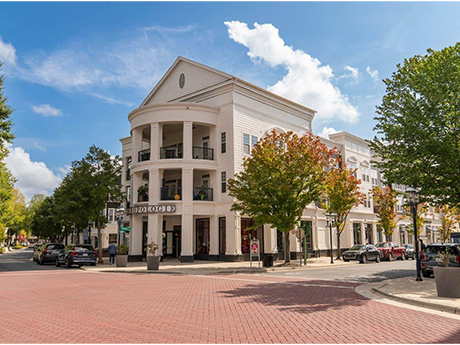
Years of nation-leading population growth, a robust job market and rising household incomes have propelled Charlotte retail onto the national stage as a major target for institutional and private investors alike. The market is now operating at a premium, with average asking rents surpassing the national average for the first time on record in late 2025 after rising more than 30 percent over the past five years, according to data from CoStar Group Inc.

That milestone says a lot about how far the market has come, but it also points to where it is headed.
The next phase of Charlotte retail will not be defined by growth alone. It will be defined by having the right tenant in the right format serving the right trade area.
The strongest corridors continue to command attention from retailers and investors alike, while rising occupancy costs are forcing every deal to stand on stronger fundamentals. For owners, tenants and capital sources, that dynamic makes Charlotte one of the Southeast’s most compelling retail markets, but also one of its most nuanced.
The new retail map
Charlotte gained 20,731 residents between 2024 and 2025, ranking among the fastest-growing major cities in the country, according to the U.S. Census Bureau, and that growth continues to reshape its retail market.

Housing development in suburban Charlotte communities continues to be shaped by school quality and relative affordability, pulling retail demand outward in the process. Retail has followed, but not fast enough to loosen the market.
That imbalance has made everyday-use retail especially valuable. Grocery anchors, service tenants, quick-service restaurants and neighborhood centers are benefiting from demand tied less to discretionary spending and more to daily routines. Much of the current pipeline reflects this, with new construction concentrated in grocery-anchored and mixed-use projects across growing suburban corridors.
That pipeline is important, but it is not enough to close the gap. Demand continues to far outpace new supply, which is why well-located retail remains so competitive and why the difference between trade areas is becoming more pronounced.
Defining corridors
Affluent suburban corridors such as Ballantyne, South Charlotte, Fort Mill and Lancaster County are increasingly setting the tone for today’s market, posting consistently positive absorption and persistent space scarcity quarter over quarter.
In these high-income pockets, availabilities have compressed closer to 3 percent, according to CoStar. Meanwhile, older centers and lower- to middle-income trade areas are seeing availability edge upward toward 5 percent.
Retailers are taking longer to underwrite and evaluate deals, particularly in locations that depend on discretionary spending, as rising rents, build-out costs and operating expenses make it harder to pencil out a profit. The bigger friction point today is less about face rents and more about build-out economics, with first-generation shell upfits running as high as $70 to $90 per square foot.
The result is not weakness, but a more disciplined market where tenant demand is increasingly tied to income durability, daily traffic and site-level fundamentals.
Concentrated capital
Capital is mirroring this demographic selectivity with striking symmetry. Institutional investors are no longer underwriting Charlotte with a broad brush. They are chasing the same affluent suburban corridors and daily-use profiles driving the tenant base. A clear pricing consensus has been established with cap rates stabilizing in the low- to mid-6 percent range, in many cases.
Hines’ $274.4 million acquisition of the retail-dominant Birkdale Village in Huntersville and Simon Property Group’s $144.8 million purchase of Phillips Place in South Park reinforce that this is not a passing trend. Essential-service retail is following suit, with grocery-anchored neighborhood centers continuing to attract institutional funds and REITs seeking durable, repeat consumer traffic.
Future outlook
The next five years will be defined by opportunities that are more targeted, more disciplined, and ultimately more durable.
Charlotte’s growth runway remains intact. Population and income gains should continue to support retail demand, particularly for grocery, quick-service restaurants, medical users and neighborhood service concepts tied to daily routines. But the market’s next phase will reward precision more than momentum alone.
For developers, capital partners and operators, the strongest opportunities will come from aligning with the trade areas where household growth, income durability and limited retail supply intersect. That is where Charlotte’s maturation becomes most compelling. The market is not losing its growth story. It is becoming a more institutional version of it.
— By Kyle Stonis and Pierce Mayson, senior vice presidents of Matthews. This article was originally published in the June 2026 issue of Southeast Real Estate Business.