

By Jim Adler, NAI Hiffman
For decades, suburban Chicago’s office market was defined by abundance. Corporate campuses, office parks and multi-building complexes supported a workforce that spent most of its week in the office.
Today, hybrid work has reshaped office demand, while investors and landlords have become increasingly selective about where they deploy capital. Well-located, amenity-rich properties continue to attract investment and tenants, while aging buildings face growing pressure to compete.

Recent market performance reflects this divide. While suburban vacancy remains elevated at 26.7 percent, Class A properties posted 43,337 square feet of positive absorption during the third quarter, while Class B buildings recorded negative absorption of 26,098 square feet.
Reinvestment and winners
Despite elevated vacancy rates, leasing activity is healthier than many headlines suggest. Class A office leasing in suburban Chicago increased 16.6 percent year over year to 644,228 square feet through third-quarter 2026, up from 552,698 square feet a year earlier.
Although Class A leasing remains down 11.3 percent year to date, its share of third-quarter leasing rose to 57.3 percent from 54.3 percent a year ago. The shift suggests that larger tenants are increasingly exploring higher-quality buildings they may have overlooked previously.
Inland Real Estate Group’s approximately 140,000-square-foot lease at 3050 Highland Parkway in Downers Grove and Claire’s commitment to approximately 43,000 square feet at Columbia Center III in Rosemont demonstrate that companies will make significant office commitments when location, building quality and workplace experience align with their needs.
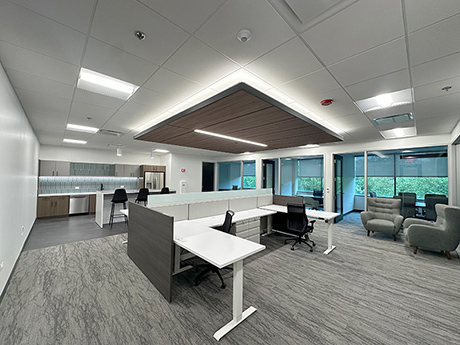
Meanwhile, demand for speculative suites remains strong. Unlike the cookie-cutter offices of previous cycles, today’s move-in-ready suites feature modern finishes, collaborative spaces and high-tech infrastructure that aid recruitment and retention. This requires more of an upfront investment, but well-capitalized owners with long-term hold strategies can more than recoup their construction costs by re-leasing these spaces with minimal additional spend, unlike a traditional, highly customized build-out.
At 535 Diehl Road in Naperville, ownership is converting a roughly 40,000-square-foot, former single-tenant floor into spec suites. The first phase, totaling approximately 20,000 square feet, is fully leased, prompting an accelerated second phase.
Spec suites appeal to companies seeking turnkey environments without the expense and delays of custom build-outs. Shorter leases also provide flexibility as workplace needs evolve. Some tenants are now becoming spec suite “graduates,” expanding into larger, conventional spaces as their businesses grow.
A barbell market
These leasing patterns illustrate the suburban office market’s growing barbell effect.
At one end are highly amenitized Class A buildings near restaurants, hotels and transportation. At the other are more affordable, move-in-ready spec suites in midsize buildings with upgraded common areas, along with well-maintained, single-story properties close to employees’ homes.
Caught in the middle are large blocks of aging inventory. Many require significant investment to meet today’s tenant expectations, but elevated vacancy and uncertain leasing prospects make those improvements difficult to justify. Higher borrowing costs and tighter lending standards further limit owners’ ability to finance such upgrades.
NAI Hiffman estimates approximately $1 billion in distressed debt tied to suburban office core and core-plus properties. For some buildings, recapitalization and targeted renovations may provide a path forward. Investments in modern amenities, flexible spaces and upgraded common areas can help reposition properties to attract tenants. For others, particularly those with significant capital needs and limited leasing prospects, conversion to residential or other alternative uses may be more viable.
The next chapter
Investment sales reflect this divide, with buyers distinguishing between properties that can remain competitive as offices and those better suited for repositioning or redevelopment.
In Naperville, the 207,700-square-foot MetroWest office building sold for approximately $16.1 million in 2026, roughly half its 2015 sales price, with plans for repositioning. In Glenview, a long-vacant, 256,700-square-foot
office building at 1900 E. Lake Ave. sold for approximately $14 million and is slated for residential redevelopment.
Even well-leased properties have experienced pricing resets. Mid America Plaza in Oakbrook Terrace, approximately 87 percent leased at the time of sale, sold for $59 million, about 24 percent below its $78 million sales price in 2016. The transaction illustrates how investors are repricing suburban office assets even when they have established tenant bases.
Together, these transactions show how investors are evaluating location, occupancy, physical condition, capital requirements and long-term leasing potential, rather than relying on historical valuations.
Leasing data tells a similar story. Through the first three quarters of 2026, suburban office leasing exceeded 3.8 million square feet, yet net absorption totaled just 59,097 square feet. While tenants remain active, leasing has not translated into substantial occupancy growth, leaving significant excess inventory.
Against that backdrop, the suburban office market’s next chapter is likely to be shaped by strategic reinvestment and repositioning as well as the removal of obsolete space. Owners who can align their properties with changing tenant expectations will be better positioned to compete, while buildings that cannot justify the cost of modernization may ultimately find their highest value in an alternative use.
Jim Adler is executive vice president of office services with NAI Hiffman. This article originally appeared in the October 2026 issue of Heartland Real Estate Business magazine.