

The mass of multifamily loan maturities that has peaked over the past few years remains elevated and is destined to impact the industry in 2026. Coupled with current elevated interest rates, and what accompanies them, these loans pose challenges to owners faced with the need to refinance. These hurdles are proving too difficult for some owners who secured their current property loans during the record low-interest rate period several years ago and who are now over-levered.
While the maturity wall did subside a bit in 2025, that doesn’t mean the 2026 volume of maturities isn’t sizable. According to the Mortgage Bankers Association 2025 Commercial Real Estate Survey of Loan Maturity Volumes, 13 percent of mortgages backed by multifamily properties will mature in 2026 — a wave that will inarguably lead to a surge in transaction activity, whether successful refinances or forced sales.
How We Got Here
Interest rates in the United States reached an all-time record low during the 2020 – 2021 period. Many apartment owners capitalized on the inexpensive cost of debt and financed their properties for extremely low rates. However, in the years since, the country has battled serious bouts of inflation which, in turn, have caused the Federal Reserve to respond with rate increases. While there has been some fluctuation in both inflation spikes and rates, inflation today remains an ongoing challenge with March Consumer Price Index data reporting it at 3.3 percent over the prior 12 months. In response, in late April the Federal Reserve voted to maintain the benchmark funds rate between a range of 3.5 percent to 3.75 percent. This inevitably impacts the outlook for apartment owners and their communities.
Many owners with maturing loans have delayed refinancing plans in the hope that rates might come down. But with the flood of loans coming due, many can no longer wait.
Challenging the situation further is the fact that operating expenses have increased, rent growth has slowed, cap rates have widened, and valuations have declined. With these factors causing downward pressure on net operating income, underwriting has tightened, as have lenders’ requirements surrounding property condition. The result of these combined factors is that refinance loan amounts are smaller than the original loans, requiring sponsors to bring more cash to the deal. Experienced, moderately levered sponsors with stabilized and well-maintained assets are better positioned to handle these pressures and are therefore able to pay off their existing loans and refinance with greater ease.
Others, however, face imbalanced capital stacks on properties with higher vacancy and deferred maintenance. If the equity contribution needed to refinance is too large, and/or if the owner doesn’t find another several years of diminished returns palatable, that’s when selling the asset and paying off the existing loan with the proceeds has greater appeal.
While unfortunate for this latter group of owners, apartment assets are now trading hands at a higher rate. This activity is a stark contrast to the dearth of multifamily sales during the past couple of years, attributable in part to heightened interest rates. Well-capitalized sponsors who had been sitting out the market are now entering the space once again to take advantage of the opportunity. The assets unfit for refinance are expected to be scooped up fairly quickly by this group.
Advising Apartment Owners Amid These Dynamics
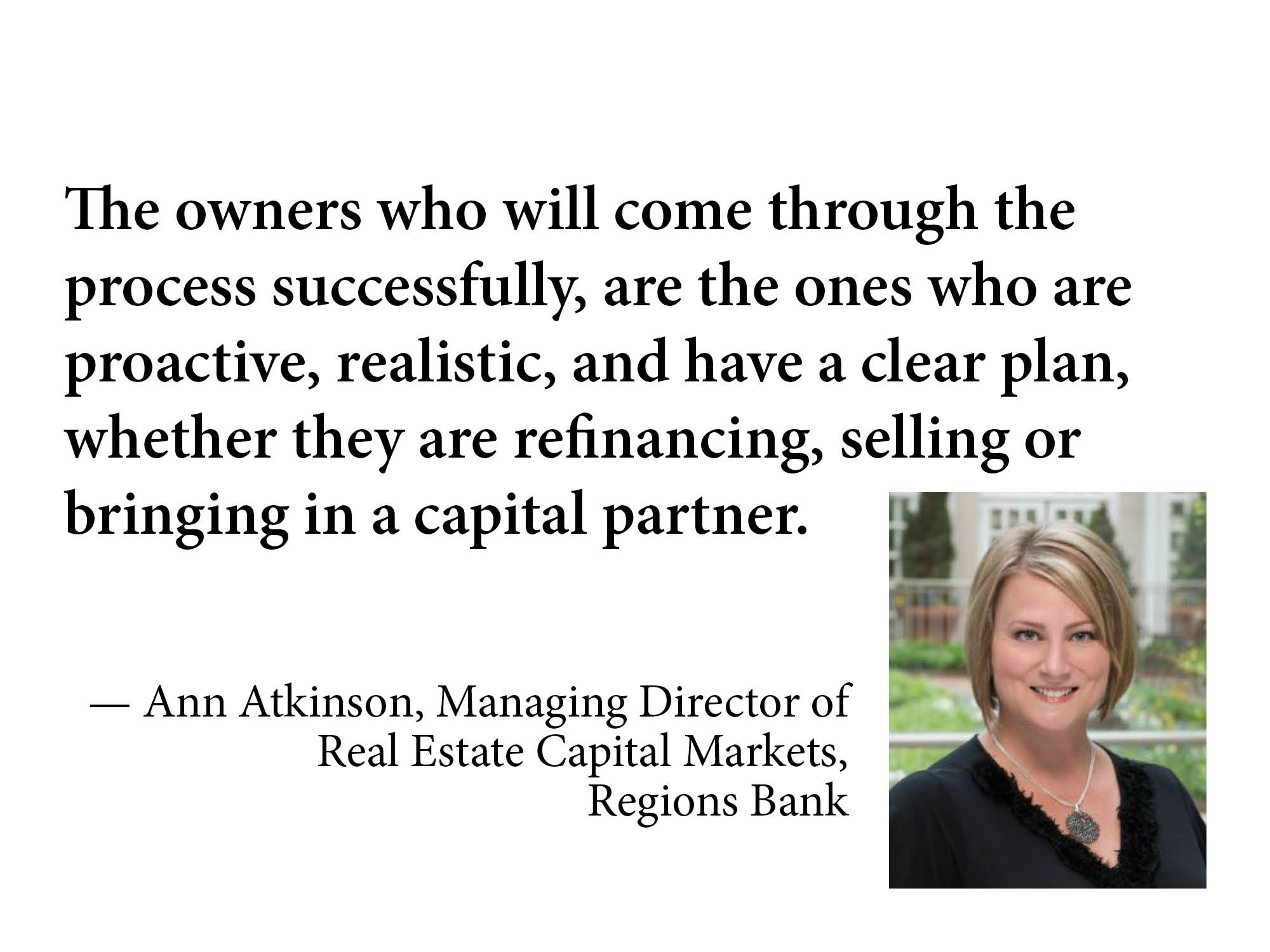
With these market dynamics as a backdrop, it is important as a borrower to start the loan process early. If refinancing is the goal, waiting until the loan is 90 days from maturity is not ideal. Instead, get your financials in order, know your current occupancy and rent roll inside and out. Be honest with yourself about what the apartment community is worth today — even if there is a discrepancy between that and what you initially paid. The owners who will come through the process successfully, are the ones who are proactive, realistic, and have a clear plan, whether they are refinancing, selling or bringing in a capital partner.
— Ann Atkinson is managing director of Real Estate Capital Markets for Regions Bank, a nationwide multifamily and seniors housing real estate lender. For more information, visit Regions Real Estate Capital Markets here.
Regions Real Estate Capital Markets is a content partner of REBusinessOnline. For more articles from and news about Regions Real Estate Capital Markets, click here.
This information is general education or marketing in nature and is not intended to be accounting, legal, tax, investment or financial advice. The information in this content (website, article, event invitation or other form) does not represent an offer or commitment to provide any product or service. The views, opinions, analyses, estimates and strategies, as the case may be (“views”), expressed in this content are those of the respective authors and speakers named in those pieces and may differ from those of Regions Bank and/or other Regions Bank employees and affiliates. This commentary includes forward-looking statements based on current market conditions and assumptions. Actual outcomes may differ materially due to economic, regulatory, and market-specific factors. These views are as of a certain date and often based on current market conditions and are subject to change. Any examples used are generic, hypothetical and for illustration purposes only. Any prices/quotes/statistics included have been obtained from sources deemed to be reliable, but we do not guarantee their accuracy or completeness. This information in no way constitutes research and should not be treated as such.