

By Denes Juhasz, NAI Hiffman
Two different star performers are emerging in Chicago’s suburban and downtown office markets. Practical Class B properties are gaining traction in the suburbs, while glitzy Class A+ trophy towers continue to outperform downtown. As the office sector adapts to post-pandemic workplace realities, the 278 million-square-foot metro Chicago office market ended 2025 with a 25.5 percent overall vacancy rate and 1.8 million square feet of negative net absorption.

The suburban market closed 2025 with positive net absorption totaling 282,285 square feet, while overall vacancy held steady at 26.2 percent, largely consistent with the year-end 2024 level of 26.3 percent.
Downtown, tenant space reductions and relocations continued to take a toll, with nearly 2.1 million square feet of negative net absorption recorded in 2025. Vacancy rose to 24.9 percent, up from 23.6 percent at year-end 2024.
Well-performing assets and a reduction in inventory are helping stabilize the market, albeit unevenly. Three distinct trends are emerging: an outperformance of well-positioned Class B suburban properties, a continued flight to trophy assets in the central business district (CBD) and the conversion of obsolete buildings to alternative uses across the region.
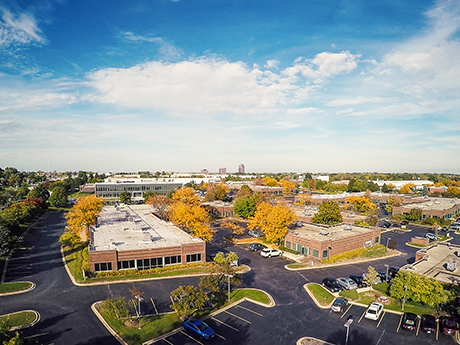
Rise of suburban Class B
One of the most notable shifts in 2025 was the outperformance of suburban Class B office space. Across all four quarters, Class B properties absorbed more square footage than their Class A counterparts.
In fourth-quarter 2025, suburban Class A assets recorded negative net absorption of 310,877 square feet while Class B posted positive absorption of 91,953 square feet. For the full year, Class A net absorption totaled negative 558,019 square feet compared with positive 866,691 square feet for Class B.
This outperformance does not signal declining tenant expectations. Instead, it reflects changing priorities.
Many occupiers are recalibrating workplace strategies around efficiency rather than prestige. Companies continue downsizing footprints but remain committed to maintaining physical offices that support collaboration, culture and client interaction. As a result, tenants increasingly favor functional, well-located buildings that offer value, flexibility and move-in readiness.
Midsize suburban properties between 20,000 and 100,000 square feet have proven particularly resilient, as evidenced by steady leasing velocity and comparatively lower vacancies than Class A buildings. At year-end 2025, suburban Class A vacancy reached 28.9 percent, while Class B vacancy declined to 24 percent. By comparison, year-end 2024 vacancy stood at 28.2 percent for Class A and 25.6 percent for Class B. Notably, there is no new suburban office construction underway.
For landlords, this shift underscores how practicality and affordability are increasingly competing with extensive amenity packages in attracting tenants, particularly smaller businesses.
Downtown trophy buildings
While the downtown office vacancy reached 24.9 percent at year-end 2025, much of the available space is outdated or distressed and unable to compete. Class A assets posted a slightly lower vacancy rate of 24.1 percent. Of the 1.8 million square feet of new leasing activity recorded in the CBD during the fourth quarter, 1.5 million square feet occurred in Class A buildings, consistent with Class A accounting for 82.2 percent of all new leases in 2025.
Among top-tier Class A+ trophy buildings, the vacancy rate is significantly lower at just 19 percent. Trophy buildings fall into a small, unofficial class of investment-grade properties that lead the industry in utilizing cutting-edge technology, high-end design, polished finishes, stand-out architecture and environmental sustainability. Many are concentrated in Fulton Market, a former warehouse district that has evolved into a major corporate and entertainment hub, and in the West Loop, particularly the Wacker Drive corridor, where Willis Tower is located.
Fulton Market’s vacancy rate currently stands at 17.8 percent, and the West Loop’s at 22.4 percent.
New office construction downtown has nearly ground to a halt, with just 439,902 square feet underway at year-end 2025, all in Fulton Market. The largest project, The Fulton at 919 W. Fulton St., opened earlier this year with 350,000 square feet of new office space alongside the conversion of a six-story apartment building into offices. Harrison Street Asset Management is relocating its headquarters to the building, joining tenants Permanent Capital and BlackEdge Capital, while Equinox and Gibsons Bar & Steakhouse have leased retail space in the building.
With minimal development underway and tightening availability within the highest-quality buildings, tenants may increasingly need to broaden their search parameters and consider “spillover” options within the next tier of well-located, quality spaces.
Owners of non-prime Class A and B buildings should proactively position their assets to capture demand created by the scarcity of top-tier space and the expected increase in leasing velocity. Properties offering accessible locations, large contiguous blocks of space, upgraded amenities and desirable views are best positioned to benefit.
Over the long term, owners should prioritize repositioning and modernization efforts to align with evolving tenant expectations and attract high-growth, innovation-driven sectors. This will become easier as distressed assets trade hands, allowing new owners with more capital to reinvest in their buildings.
Conversions reduce supply
Another important dynamic influencing Chicago’s office outlook is shrinking inventory. Since 2020, roughly 7.3 million square feet of office space has been removed from the market through conversions or redevelopment initiatives, with additional projects planned.
Residential adaptive reuse activity has accelerated significantly, with Chicago now holding one of the nation’s largest pipelines of office-to-apartment conversions. Six office-to-residential conversions have advanced along the LaSalle Street Corridor as part of the City of Chicago’s push for a more neighborhood-oriented public realm throughout the corridor, which represented over $900 million in total investment.
Office properties are also being repurposed for alternative commercial uses. In west suburban Oak Brook, a proposed redevelopment would replace seven office buildings along Butterfield Road with a 225,000-square-foot Amazon retail store and a 150,000-square-foot Ashley Furniture store on a 22-acre site.
Over time, this reduction in supply could help rebalance fundamentals by removing functionally obsolete buildings that no longer meet tenant needs.
Denes Juhasz is director of research for NAI Hiffman. This article originally appeared in the March 2026 issue of Heartland Real Estate Business magazine.