

By Hayden Spiess
At first glance, mixing university students in their late teens and early 20s with senior living residents might seem too unconventional to succeed. “These are two completely different worlds,” concedes Andrew Carle, president of Carle Consulting. “You cannot find a bigger odd couple than bureaucratic universities focused on 20-year-olds and fast-moving senior living providers that are focused on 80-year-olds. Bringing those worlds together is hard.”
Even so, the premise of university retirement communities (URCs) does exactly that, and Carle is one of the property type’s strongest proponents. More than 80 URCs are currently open throughout the U.S., according to UniversityRetirementCommunities.com, which is an online resource established and operated by Carle.
The proliferation of these niche properties marks a stark contrast from a few decades ago, when the first URCs began to pop up. Those first communities included Meadowood at Indiana University, which opened in 1983, and Green Hills at Iowa State, which was built in 1986.
Carle describes those two pioneering communities as “organically built” properties, rather than “intentionally built” URCs. “Most of the early ones were organically built,” explains Carle. “They didn’t even know what they were doing, frankly.”
As interest in senior living communities at universities has grown, so has the need for expertise and guidance around this particular brand of seniors housing. Carle’s website tracks existing URCs within a directory and provides information on the product type, and he operates a certification program and serves as a consultant for universities interested in exploring the possibility of a URC.
URCs are not only the most exciting prospect within seniors housing, Carle believes, but also the most economically sound one.
He is in good company, with other sources sharing his enthusiasm about the merits of these communities. Developers, designers and operators alike predict that URCs will continue to grow in number.
“There’s still opportunity for this model because it offers so much more,” says Carle.
Study in Success
Those with firsthand knowledge of URCs, including community residents and executive directors, are also confident about the benefits of the communities as a contrast to more traditional senior living properties.
Even Google reviews — which are typically not forgiving of any seniors housing community — seem to mirror this positivity. Broadview at Purchase College boasts a stellar Google reviews rating of 4.9 stars. Pillars of Prospect Park, a community affiliated with the University of Minnesota, has earned a similarly impressive 4.8 stars.
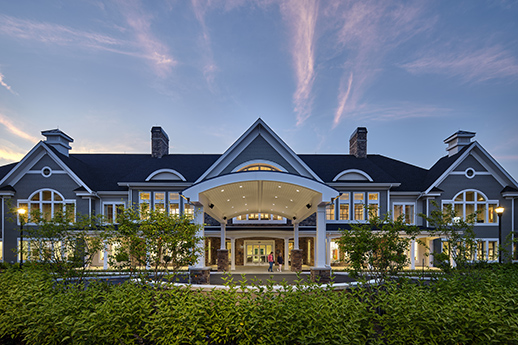
“My experience as an operator is that university retirement communities are a win-win,” says Ashley Wade, who serves as executive director of Broadview at Purchase College, located in Harrison, New York. At 288 units, Broadview’s size is standard of URCs, which typically range from 200 to 300 units. A large number of URCs operate as continuing care retirement communities (CCRCs), frequently with an entrance-fee model.
Life Care Services (LCS) developed and operates Broadview, which comprises 220 independent living residences, 34 assisted living units and 34 memory care units, on behalf of its ownership. Wade reports that the independent living portion of Broadview is fully occupied, with a robust waitlist.
“It’s a win for the student and the faculty and staff who see this as an opportunity-rich environment where they can collaborate and see synergies that really transform classrooms and trajectories for students and faculty alike,” says Wade.
According to Laurie Steber, executive director of The Spires at Berry College in Rome, Georgia, her community is also operating with waitlists for its independent living and assisted living apartments, with roughly 99 percent of the memory care and skilled nursing units occupied.
The Spires opened in June 2020, during the thick of the COVID-19 pandemic. Its success is even more notable as a testament to the URC model. “You would think that would have made the lease-up difficult, but we were actually ahead of schedule the whole time,” recalls Steber. “I think that is because we were connected to the college.”
Demand at The Spires is so strong that the ownership is planning an expansion project that will add seven cottages with the capacity for 14 additional residents. “We’ve got plenty of room to grow,” says Steber.
URCs Attract Attention
Carle argues that the intergenerational aspect — however peculiar it may seem initially — is part of the appeal of URCs. “There is some evidence that placing older adults in younger environments is healthier,” he argues. “It may actually reverse some aspects of aging.”
“Seniors are able to help mentor and have more of a purpose as they’re integrating with the students on campus,” adds Greg Hunteman, president of Pi Architects.
Pi designed Sooner Station in Norman, Oklahoma, which is affiliated with the University of Oklahoma. Opened in 2022, the 206,000-square-foot community features 101 independent living and 64 assisted living apartments, as well as 24 memory care units.
Dan Novelli, senior director of development at LCS Development, points out that the intergenerational aspect of URCs can also appeal to visiting family members.
“When I would go visit my grandfather, we’d sit around and stare at the wall,” recalls Novelli. “When you have grandchildren in the teenage years, what’s more vibrant than a college campus? That family connection and vibrancy is crucial to well span — how long you can live well.”
Interest from the baby boomer population confirms the attraction of URCs. “You get a larger amount of folks coming from further away for university retirement communities,” observes Hunteman. “With a typical development, your market is about five to 10 miles from the base community. With this kind of community, you really can depend on a wider group of people moving to it.”
“About 30 percent of our residents are associated with the university as staff, faculty, alumni and past presidents,” says Rick Brackett, president and CEO of The Woodlands at Furman in Greenville, South Carolina.
“The other 70 percent of residents have come from across the nation.”
David Johnson, a resident of The Woodlands, confirms that the community’s relationship with Furman University was the primary appeal for him and his wife Janifer, though neither was previously involved with Furman University.
“Some of the other communities we looked at were near universities, but they didn’t have any sort of affiliation with that university,” shares Johnson. “The only reason we are here is because of the connection to the university.”
Added Amenities
One of the greatest draws of URCs is the unique access to amenities that they offer by virtue of their relationship with college campuses.
At The Woodlands, residents take in musical and theater performances and can avail themselves of the on-campus physical activity center, as well as the dining halls and library.
“Student musical performers come every month,” says Johnson. “They have a different performance the first Friday of every month, as well as some other special performances.”
Johnson also notes that he frequently takes advantage of Furman’s golf course. “We have a lot of golfers in the community that enjoy playing every day,” says Brackett. Entrance fees at the life plan community cover green fees and costs for the university’s 18-hole golf course.
The Johnsons say that the continued learning and ability to take classes on campus are another perk of living in a URC. “One of the best is the politics class, where a different Furman professor from the political science department speaks every week,” says David. “We both have taken that class.”
According to Steber, residents of The Spires also enjoy the academic and recreational offerings at Berry College. “They are taking classes, and they spend time over in the student hall and eat meals with their student friends,” she relates. “They are at every show, be it a musical or play or recital, and they are at so many sporting events.”
Advantages Abound
Shared amenities do not serve only as perks available to residents of URCs. These amenities are also one component of the appealing return-on-investment equation that URCs pose for senior living owners and operators.
Senior living development is a costly and fraught process, especially in the current climate of elevated interest rates and expenses. Positioning communities within reach of existing university infrastructure and amenities eliminates the construction and maintenance associated with creating these elements from scratch.
“One of the largest costs of some of these developments is land cost,” adds Novelli. “Oftentimes you can work with the university to minimize the land cost, and the returns can come from an operational basis.”
Carle says that the financial benefit of partnering with universities can be significant. “What [universities] bring to the table is literally hundreds of millions of dollars of additional amenities and resources for free,” he emphasizes.
“I would say to a senior living developer that if you are frustrated about barriers to entry or how to make this work economically, this is a model that delivers exponentially more value for the same cost.”
Brackett agrees that university amenities are attractive to residents and operators alike. “University retirement communities give many more options for participating in different activities — whether it’s sporting events or musical performances — at a lower cost, and it is more economical for the community as opposed to having to outsource all of those events,” he elaborates. “The partnership between a community and a university keeps costs down for the community.”
Answer to Industry Angst?
In Carle’s view, URCs are an answer to a few other challenges afflicting the senior living sector, beyond the issue of heightened development costs.
He argues that this model of senior living could help boost market penetration rates, defined as the total number of occupied seniors housing units in relation to the number of households age 75 and older.
“We have been complaining for 30 years about not getting better than 10 percent market penetration,” says Carle.
“We weren’t offering something that more than 10 percent of people were willing to move for. If you build a university retirement community, it fills up faster. Sometimes these communities are sold out months before they are even open, and residents stay longer.”
URCs also provide a unique answer to workforce challenges by drawing on the student population for labor.
“Part of our whole plan was to have students that work,” remarks Steber. “Students have done everything from housekeeping to dining. We also have some interns in accounting, marketing and healthcare administration.”
Bilateral Benefits
Of course, the advantages of the college-URC relationship do not exclusively benefit senior living operators and residents.
“It’s a win from a financial perspective for the campuses that are able to monetize vacant land or buildings or spaces in ways that are mission-aligned,” attests Wade.
Brackett points out that universities also generate revenue through the addition of URCs. For many universities, that revenue comes in the form of leases, with an external entity owning and operating the URC.
In a number of cases, like those of The Spires and The Woodlands, nonprofits are created expressly to serve as the URC owner and operator.
“We lease the 45 acres our campus is on from the university,” says Brackett. “We consider ourselves locally owned, and we are a nonprofit, so our governing board is made up of 10 volunteer board members from the greater community.”
Rental revenue aside, URCs can also benefit universities in less expected ways. “A lot of times, the OU alumni and foundation can do more fundraising,” says Hunteman of the relationships that Sooner Station fosters between the University of Oklahoma and prospective donors. “There’s a big win from that standpoint.”
Brackett adds that Woodlands residents have even left bequests to Furman University, having fallen in love with the school during their time at the community.
Lessons Learned
Despite the many praises that sources sing about URCs and their virtues, not every project is a guaranteed success.
Carle cites Eckerd College in St. Petersburg, Florida, as an academic institution that was ill-prepared to execute a URC project. Though the campus now hosts a senior living community, first came years of tribulations and the failure of the originally planned development.
According to Carle’s account, Eckerd’s president jumped at the opportunity to establish a URC in 1984 but did not select a developer or owner with senior living experience to lead the effort, resulting in bankruptcy before the project could come to fruition.
“This is a case study in how a college lost more than a decade in effort and millions of its endowment, with a college president losing his job, by trying to build and operate a URC,” recalls Carle.
Now, in his role as a consultant, Carle advises a number of universities against attempting to establish URCs.
“Do not underestimate how complicated this could be,” he cautions universities. These developments take a lot of work and commitment on both sides. The university has to commit, and the senior living provider has to commit.”
Carle has also identified five criteria to guide the development of URCs.
According to the expert, long-term success is achieved when developments: (1) are located near core campus facilities; (2) feature formalized programming with letters of agreement; (3) offer a continuum of care; (4) maintain a formal relationship with the university in question; (5) are populated with a significant number of residents (at least 10 percent) that have ties to the university.
Despite his selectivity and having borne witness to a number of failures, Carle remains steadfastly bullish on the URC concept and the future for the community type.
“A lot of the problems are the same,” says Carle, referencing the headwinds that face the seniors housing industry at large.
“But what I would say to people in my industry is that if you’re going to build, if you’re going to gamble, wouldn’t you want to gamble on the thing that is the surest bet?”
— This article originally appeared in the May-June 2026 issue of Seniors Housing Business magazine.