

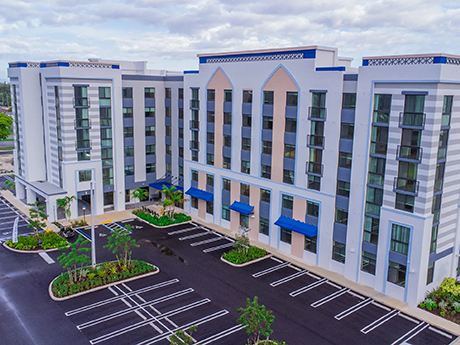
Senior living has changed a lot in the past five or six years. The shift was underway before the pandemic, but it has accelerated recently. Now, there is a clear move away from institutional designs toward communities that feel more like hotels, with a focus on wellness, flexibility and the resident experience.
The way spaces are designed has changed as well. In the past, facilities had large, central common areas. Now, layouts focus on flexible use and smaller, spread-out gathering spaces. There is also more focus on connecting with the outdoors, so courtyards, walking paths and shaded seating are now standard. Industry research shows that spaces that support social engagement and health are important, which is guiding how buildings are now designed and built.

We have seen these changes firsthand through our work across the senior living sector. ANF recently completed Wellspring Apartments in Miami, a complex that reflects the growing need for well-located, intentionally designed housing for older adults. We are also building All Seasons Delray Beach for Beztak, a luxury senior living community centered on hospitality, lifestyle and elevated amenities. In Pembroke Pines, we are completing the final phase of Douglas Gardens for McDowell Housing Partners and Miami Jewish Health, a mixed-income community that demonstrates how legacy campuses can be thoughtfully expanded and modernized to meet evolving resident needs while continuing to serve long-time residents.
Our perspective also extends beyond construction alone. As partners on Providence One in Pembroke Pines, we bring experience from the ownership and development side as well, giving us a deeper understanding of what it takes to create senior living communities that are operationally successful, financially viable and built for the long term.
When we look at upcoming projects, the senior living market has stayed steady even as other sectors have fluctuated. There was a time when projects slowed due to financing issues, but demand remains strong as the 65+ population is rising quickly, according to U.S. Census Bureau data. This means there is a continued need for investment in housing and care.
What has changed is how projects are planned. Owners are now more careful and spend more time upfront checking costs, plans and long-term success. Amenities have changed significantly, as well. Today’s communities focus on lifestyle just as much as care. Fitness centers, wellness areas and outdoor spaces are now standard features. Dining has also changed, with more options for flexibility and a homelike feel. Technology, from building systems to ways for residents to stay connected, is now expected to stay competitive.
Senior living is not a one-size-fits-all market. Active adult, assisted living, memory care and skilled nursing all require different approaches. Active adult communities are like regular apartments, focusing on independence and lifestyle. Assisted living offers more support and accessibility. Memory care needs careful design, with secure spaces and simple layouts for people with memory issues. Skilled nursing is the most medically intensive and has systems for higher levels of care. Knowing these differences is important in construction because they affect layout, systems and planning.
Accessibility remains important across all types of senior living. ADA compliance has long been required, but expectations have changed. Now, the focus is on making spaces that really support mobility, safety and dignity. This includes everything from unit layouts to common areas and site design. Many owners go beyond the basic code to create spaces that better support aging in place, which benefits both residents and operators.
From a construction perspective, cost and labor remain major challenges. Prices are more stable than a few years ago, but they are still difficult to predict. Labor shortages continue to affect schedules and productivity. Groups like Associated General Contractors (AGC) say most contractors struggle to find skilled workers. At ANF, we prepared for this by investing in better planning and preconstruction, including a dedicated scheduling team and more resources. This has helped us plan ahead, spot risks early and give owners clearer information on costs and schedules.
We are also seeing more interest in redeveloping and updating properties, especially where land is limited. Turning or expanding existing buildings into senior living facilities can be complicated by structural constraints, system upgrades and regulatory requirements. But when it is done well, it allows owners to offer new options in established areas, which can be a big advantage. For contractors, success now means knowing these new priorities and building communities that meet changing market expectations.
— By Al Fernandez, CEO and principal, ANF Group Inc. This article was originally published in the July 2026 issue of Southeast Real Estate Business.