

By Mark McDonald, president of visual lease and CoStar real estate manager
The recent shift back to in-person work isn’t a mere passing trend, and it’s forcing companies to reassess their office leases and how they manage them.
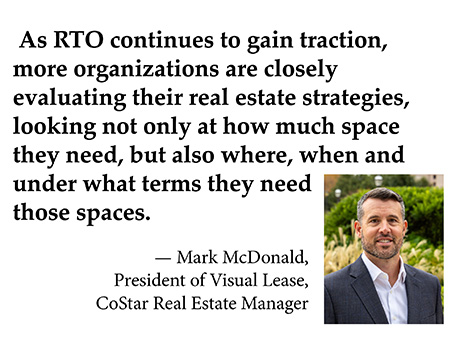
According to resume.org, industry estimates suggest that around 75 percent of companies that were formerly remote have now implemented some version of RTO (return-to-office) since the pandemic. Many large, publicly traded companies spanning various industries, including tech (Amazon, Dell) and financial services (J.P. Morgan), are requiring employees to work onsite full time. As RTO continues to gain traction, more organizations are closely evaluating their real estate strategies, looking not only at how much space they need, but also where, when and under what terms they need those spaces.

As leaders make these difficult and often high-stakes decisions, many executives are recognizing the importance of quality lease portfolio management. This involves tracking, analyzing and optimizing an organization’s leased properties with actions like consolidating space, exiting underused locations or renegotiating existing terms.
So how exactly is RTO reshaping lease management, and why is accurate, real-time lease data now a critical asset for fast, informed business decisions?
Rethinking Lease Management in the Era of RTO
As more companies implement RTO policies, corporate real estate leaders are approaching physical office space with a sharper focus on return on investment (ROI).
Recent research confirms this shift. For example, according to a new report by the Visual Lease Data Institute (VLDI), 70 percent of real estate executives plan to add space for 2025 and/or 2026, while 45 percent of real estate strategies are calling for a reduction in footprints.
This finding suggests a stabilization in office space strategy; leaders are no longer making extreme cuts, nor are they aggressively expanding. Instead, they are refining their portfolios to ensure the right mix of space for business needs. Achieving this balance is critical to strengthening ROI during RTO but is impossible to act on without an accurate, up-to-date understanding of their leases.
Gaining this understanding and acting on it requires modern, centralized lease controls to properly track renewal dates, monitor terms, enforce obligations and highlight opportunities for cost savings and strategic adjustments. Without these controls, 42 percent of real estate executives have forgotten to update unfavorable or unwanted lease terms, according to the same VLDI report.
The cost of this oversight can be significant, resulting in misaligned leases, overlooked renewals, continued payments on unused space and missed opportunities to renegotiate or exit on better terms.
Lease Strategies Reimagined
As employees return to offices, real estate leaders aren’t just determining how much space is required — they’re also rethinking where it should be located, how long to commit and under what terms to potentially do so. Each of these factors carries strategic and financial weight.
Leaders are asking questions such as, “What spaces are underutilized, which can be repurposed and which are optimal for hybrid teams?” For companies with hybrid work schedules, proximity to teams or commuter hubs is a major factor, since commute times can significantly impact employee retention, engagement and overall satisfaction.
In other words, as a company’s workforce shifts, so too does its lease portfolio. With each renewal or relocation opportunity, forward-thinking business leaders are considering ways to align their space needs with their evolving workforce footprint. This might mean relocating a satellite office closer to a regional talent pool or reconfiguring a traditional space into a hybrid-friendly collaboration hub.
These shifts, in turn, have direct implications for landlords, which must adapt their lease offerings to remain competitive. Clauses covering expansion rights, early termination clauses and shorter lease terms are no longer optional add-ons. Rather, these pieces of language are quickly becoming essential in lease negotiations. Landlords that can offer creative deal structures that include free rent, build-out allowances, subleasing provisions and expansion or contraction options will find it easier to attract longer-term tenants in today’s landscape.
Robust Lease Data as a Strategic Asset
Business leaders need timely, trustworthy data to drive strategic real estate decisions, whether that means subleasing underutilized space, consolidating redundant locations or expanding into high-growth markets.
And yet, according to the VLDI report, 37 percent of finance executives still rely on spreadsheets or manual methods, which can lead to inefficiencies and a higher likelihood of data errors.
To address these gaps, many companies have turned to integrated lease platforms for a necessary single source of truth. This allows them to merge lease terms, occupancy analytics, financial forecasts and, in some cases, ESG (environmental, social and governance) metrics. Leveraging real-time market updates from platforms like CoStar Market Data + Analytics helps organizations minimize exposure to inaccurate data.
Having all lease data in one central hub enables accurate lease oversight while streamlining collaboration across finance, real estate, legal and sustainability teams. This cross-functional visibility empowers leaders to make faster, more informed decisions. As a result, companies are better positioned to adapt quickly to market volatility, workforce shifts or regulatory changes.
The ROI of Smart Lease Portfolio Management
As RTO becomes the new norm, companies that embrace the value of integrated lease portfolio management will gain a competitive advantage. While other companies scramble to manually collect and track their lease information, those that use technology to unify their data, ensure its accuracy and collaborate cross-departmentally will be better equipped to navigate the rapidly changing work environment.