

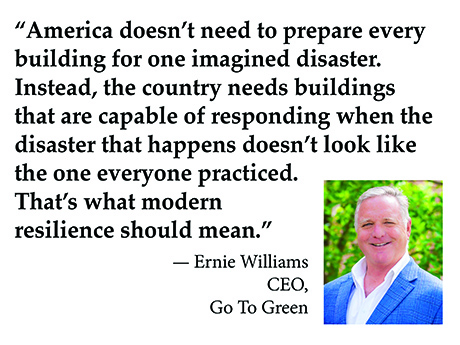
By Ernie Williams, CEO of Go To Green
Commercial buildings have changed dramatically over the past several decades. They’re taller, denser, more connected and increasingly filled with technologies that can control everything from temperature and lighting to access, energy consumption and security. Yet when an emergency occurs, many of those same buildings still rely on surprisingly old models for getting people to safety.
A traditional evacuation plan works best when an emergency is predictable. A fire alarm sounds; occupants move toward the nearest available exit, and first responders arrive to address the source of the danger. The problem, of course, is that many modern emergencies aren’t static.

Fire and smoke can spread; severe weather can make one side of a property more dangerous than another, and active threats can move through a building. Floodwater can block an exit that was accessible minutes earlier. In a large multifamily, commercial or mixed-use development, thousands of people may need to make decisions at the same time without having the same information.
Property owners and operators may need to plan for severe thunderstorms, flash flooding, hurricanes, extreme heat, wildfires, power disruptions and human-generated emergencies. The response required for one event can be entirely different from the response required for another. In some circumstances, evacuation is the right decision. In others, moving people outside may put them in greater danger.
From Static Plans to Adaptive Buildings
The commercial real estate industry has already embraced the idea that buildings should respond to changing conditions. We see smart HVAC systems that adjust based on occupancy. Sensors detect leaks before they become major losses. Security systems can restrict access to certain areas, and building management platforms can provide operators with real-time information about what is happening throughout a property.
Emergency preparedness should evolve according to these same philosophies.
A printed evacuation map serves an important purpose but only shows where an exit is located. That map can’t tell an occupant that smoke has filled the hallway leading to it. A conventional exit sign can point toward a door, but it doesn’t know whether conditions beyond that door have changed. The next generation of building preparedness should focus on closing that information gap.
That doesn’t mean replacing existing emergency procedures or abandoning the fundamentals of drills, signage and clearly marked exits. It means creating layers of preparedness that can become more useful as incidents develop. Buildings should be able to communicate changing conditions quickly, direct people away from known hazards and give emergency personnel better information about the environment they’re entering.
During a crisis, people shouldn’t have to interpret complicated information while under stress. The building and its emergency systems should make the safest available action easier to understand.
The Seconds After the Alert Matter
Real estate owners have invested heavily in notification systems, and for good reason. Speed matters. Residents, employees and visitors need to know when there is a threat within seconds. However, notifications should be considered the beginning of the response rather than the end of it.
An alert that says “evacuate” may create another series of decisions. Which stairwell? Which exit? Is the normal route still accessible? Should someone on another floor follow the same directions? Where will first responders be entering the property?
Those questions become even more complicated in large properties where occupants may have very different levels of familiarity with the building. An employee who has worked in an office for five years may know three ways out. A visitor attending a meeting may know only the elevator they used to come in. A resident of an apartment building may understand the property well, while a delivery driver, contractor or guest may not.
Good emergency design has to account for the people who know the building least, not just those who know it best.
That principle has influenced Texas-based Go To Green’s view of safety since its inception. This writer’s background as a Marine reinforced the notion that having plans matters, but situational awareness matters just as much. Conditions shift. Information changes. The safest decision made five minutes ago may not be the safest decision now.
Preparedness Is Also a First Responder Issue
First responders arriving at a large development may be entering a property they’ve never seen before. Even when departments have access to maps or pre-incident planning information, an emergency can change the physical environment before they arrive. A hallway may be blocked. A particular entrance may become inaccessible. Victims may be concentrated in an area that wasn’t anticipated in the original response plan. That’s where better coordination between real estate operators, emergency planners and local agencies can have tremendous value.
Preparedness should begin long before flashing lights arrive outside a property. Developers and operators should understand what information responders would need, how that information would be communicated and whether emergency personnel can quickly understand the building’s layout and current conditions. The most sophisticated safety system in the world is of limited value if the building owner, property staff and local first responders have never determined how they will use it together.
Designing Resilience Before the Emergency
The commercial real estate industry has an opportunity to stop treating emergency preparedness as something to be added after buildings are completed. Safety should be part of the design conversation alongside accessibility, energy efficiency, security and connectivity.
Architects can consider how people will understand their surroundings when visibility or normal circulation are disrupted; developers can evaluate whether emergency communications reach every part of a property, and property operators can examine how information moves between building systems, staff and first responders. Meanwhile, multifamily owners can consider the needs of residents with limited mobility, families with children, older adults and visitors who are unfamiliar with the property.
This is also where emerging technologies are beginning to change expectations. Through our work at Go To Green, we’ve seen growing interest in systems that combine building information, visual guidance and real-time communication so emergency directions can adapt as conditions change. Technologies like these represent a bigger movement toward buildings that can provide more useful information when occupants need it most. That shift is ultimately bigger than any individual technology.
America doesn’t need to prepare every building for one imagined disaster. Instead, the country needs buildings that are capable of responding when the disaster that happens doesn’t look like the one everyone practiced. That is what modern resilience should mean.